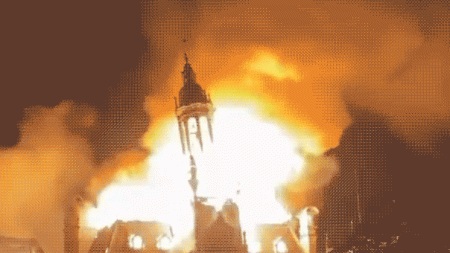



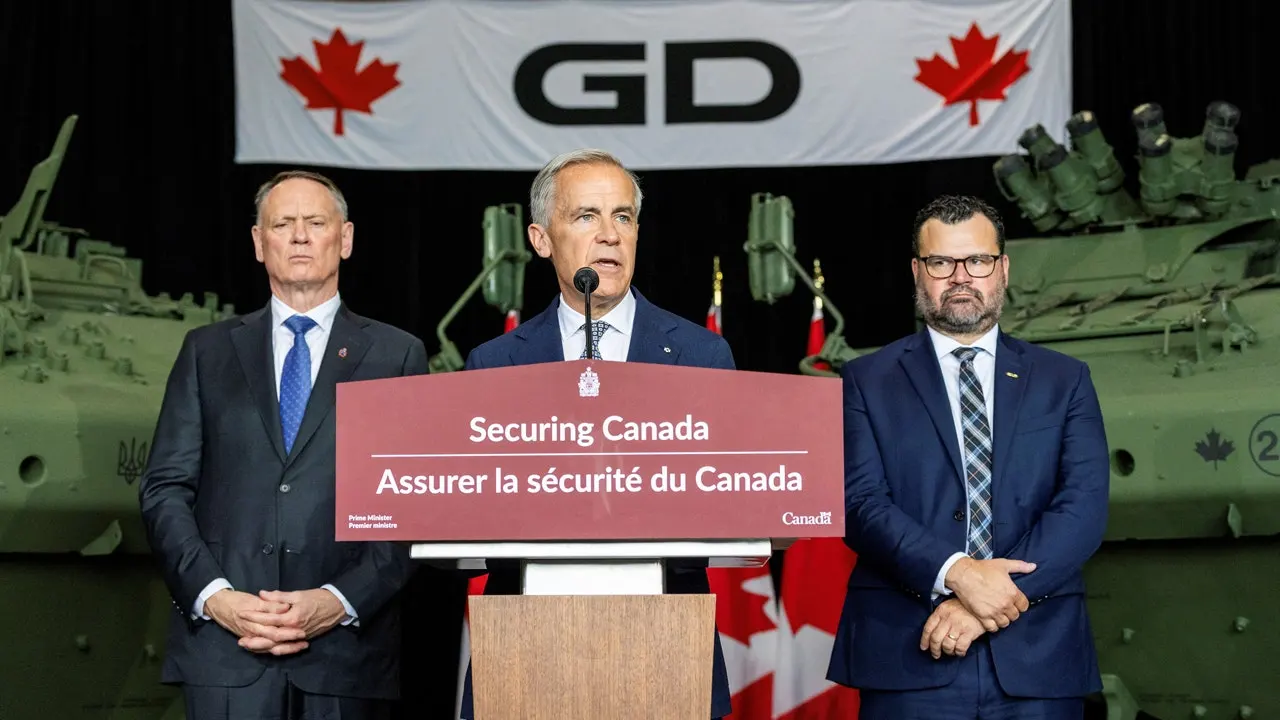
A heavy stillness settled over the prairie on Saturday evening as word began to spread of a devastating incident at Canadian Forces Base Wainwright. The base, one of the busiest and most vital Army training installations in Canada, had been transformed from a place of routine discipline and preparation into a scene of emergency and grief. Canadian Defense Minister David McGuinty confirmed what many had feared: there had been both fatalities and injuries as a result of an incident on the base, with a major fire continuing to burn as the hours passed. With a solemn voice, McGuinty addressed reporters, offering no immediate numbers, no clear explanation, and no comforting certainty—only the stark acknowledgment that lives had been lost and others changed forever. The gravity of the moment was unmistakable. He admitted that he could not recall an incident like this in recent memory, and those words carried a particular weight coming from a national defense leader accustomed to managing crises. The base itself, located roughly 130 miles east of Edmonton in Alberta, is a vast training ground that hosts thousands of soldiers each year, preparing them for deployments and demanding operational roles. It is not simply a collection of buildings and barracks; it is a living, breathing community of military personnel, civilian employees, contractors, and their families. And on this Saturday, that community was plunged into sorrow and uncertainty, with the flames of a serious fire spreading beyond the perimeter of the base into the surrounding area, as local officials scrambled to assess the danger and support the response.
The human dimensions of this tragedy are profound, because CFB Wainwright is woven into the identity of the region and the lives of the people who serve there. The base had approximately 1,310 military and civilian personnel stationed there according to recent census figures, but those numbers only hint at the web of relationships and routines that define everyday life in that corner of Alberta. Soldiers train there for months at a time, often far from their families, while civilian workers maintain equipment, prepare meals, run logistics, and keep the installation functioning. The nearby town of Wainwright, with a population of around 6,600, shares a deep and historic connection with the base. Local businesses serve the soldiers and their families; local schools enroll military children; local nurses, paramedics, and firefighters respond to emergencies both on and off the base. When something goes wrong at CFB Wainwright, it does not feel distant or abstract to the people of the region—it feels personal, immediate, and heartbreaking. On that Saturday evening, residents would have watched from their homes as emergency vehicles raced along roads, their sirens carrying through the cold prairie air, carrying with them the fear that something terrible had happened to people they knew by name or by face. The fire was not merely a defense story; it was a community waking up to tragedy. It was the moment when neighbors stopped what they were doing and reached for their phones, checking on friends and loved ones who worked at the base, hoping for reassurance while the smoke on the horizon said otherwise.
The response to the incident was swift and broad, according to reports from the Canadian Broadcasting Corporation and other outlets. The Canadian Armed Forces, the Royal Canadian Mounted Police, and a range of local emergency personnel were all called to the scene, working side by side amid the chaos and danger of the fire. McGuinty explained that the Department of National Defence, along with partners across the federal government, including public safety officials, was coordinating closely with the government of Alberta and local municipal governments to mobilize every necessary resource. This is the kind of moment that reveals the importance of preparedness at every level—military, civic, medical, and emotional. Firefighters and emergency responders, many of whom may have been off duty or preparing for a quiet weekend, found themselves pulled into the effort to contain the flames, rescue the wounded, and do the difficult work of recovering what had been lost. The decision not to issue evacuation orders, as indicated by local officials, may have come as a relief to residents, but it also underscored the uncertainty of the moment. The fire had spread beyond the base perimeter into the surrounding area, but officials were apparently confident enough in the containment to avoid ordering people to leave their homes. Still, the image of fire flickering near the edge of the base, encroaching on the familiar territory of the prairie landscape, was a chilling reminder that crises do not always remain contained within fenced boundaries. Every person on the scene—from the first responders to the commanding officers to the federal and provincial leaders watching from afar—was confronting a situation that had no easy answers, no simple explanations, and no quick path forward.
In the hours following the incident, Canada’s national leaders spoke with a shared sense of sorrow and seriousness. Prime Minister Mark Carney took to X, formerly known as Twitter, to address the country directly, writing that a serious incident creating a major fire had occurred at CFB Wainwright in Alberta. His message was brief but meaningful: “Our thoughts are with all the brave women and men affected.” Those words, while carefully chosen, captured the emotional weight that many Canadians were feeling. Alberta Premier Danielle Smith, whose province includes the base and the surrounding communities, described the situation as a “significant and tragic fire” affecting military personnel at the installation. Her statement reflected the close bond between Alberta and its military population, a bond forged through decades of shared hardship and mutual respect. The reactions from Carney and Smith were not just political formalities; they were expressions of a nation directing its collective attention and concern toward the victims, the injured, and the families who were waiting in agony for news. It is in these moments that the abstract concept of “the military” becomes deeply personal—the soldiers and civilian employees at CFB Wainwright are not anonymous figures in uniforms. They are sons and daughters, husbands and wives, mothers and fathers, friends and colleagues. They are people who showed up for duty on an ordinary Saturday, expecting another day of training or maintenance, and instead found themselves in the path of an unexpected and deadly incident. And, like anyone in such circumstances, their loved ones could do nothing but wait, hope, and pray as the fire continued to burn through the evening.
What caused the incident remains unknown, and that uncertainty only deepens the anguish. There is something especially difficult about a tragedy that strikes without explanation, leaving survivors and grieving families to wonder what happened, why it happened, and whether it could have been prevented. Investigators will eventually sift through the debris, interview witnesses, and examine records in search of answers. But for the moment, the priority is not blame or analysis; it is care and compassion. The injured must be treated, the dead must be mourned, and those who witnessed the horror must be supported. McGuinty’s surprising admission that he could not recall an incident like this in recent memory underscores just how serious this event appears to be. It is not every day that a major military installation experiences an incident causing fatalities and injuries, a fire that spreads beyond its borders, and an emergency response that draws in multiple levels of government. Canadian Forces Base Wainwright has long been regarded as a cornerstone of the Army’s training system, a place where soldiers learn the skills they need to operate under stress and danger. It is deeply ironic and painful that a place dedicated to preparing for the worst should itself fall victim to tragedy. The base’s location in the rugged beauty of central Alberta, with its wide open skies, rolling grasslands, and harsh seasonal weather, has always made it a fitting environment for demanding military exercises. But the beauty of the landscape cannot soften the grief of this moment. It only serves as a quiet witness to the suffering that has unfolded there.
As the flames are eventually brought under control and the immediate emergency subsides, a longer process will begin—a process of healing, inquiry, and remembrance. The families of the fallen will need time to grieve and support from a grateful nation. The injured will need medical care and rehabilitation, physical and emotional. The soldiers and workers who survived the incident, many of whom may have seen things no one should have to see, will need counselors and coworkers who understand the weight of military service. The community of Wainwright, both the base and the town, will need to come together in the days ahead, to hold each other up and to honor the lives that were lost. There may be memorial services, moments of silence, and long conversations about safety, prevention, and preparedness. There will also be questions that demand answers, and authorities must be transparent and thorough in their investigations. Yet in the midst of the confusion and sorrow, there is room for resilience. Canada is no stranger to tragedy, and military communities, in particular, have learned how to endure hardship with dignity and solidarity. The dark smoke rising from CFB Wainwright on that Saturday evening will not be the end of the story. It will become part of the base’s history, a chapter that no one wanted but that everyone must now live with. The names of the dead will be remembered, the bravery of the responders will be honored, and the families will be wrapped in the care of a nation that owes them a profound debt. In time, the base will likely resume its mission, training the next generation of soldiers, but it will never be quite the same. The memory of this tragic day will linger in the hallways, on the training grounds, and in the hearts of all who call CFB Wainwright home. And as the investigation unfolds and the answers slowly emerge, the hope is that some comfort can be found in the knowledge that their fellow Canadians stand with them, even from afar, waiting to help however they can.