

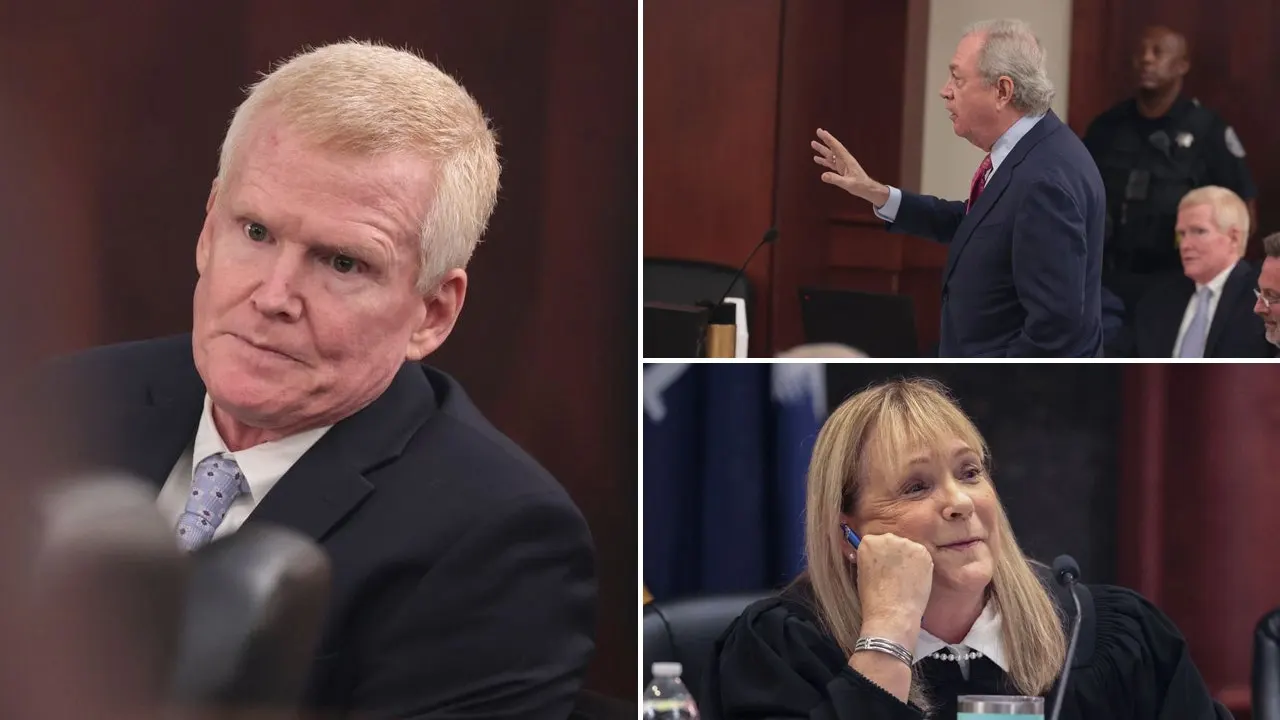
In a small South Carolina courtroom, the latest chapter of the Alex Murdaugh saga unfolded not with dramatic testimony or a surprise witness, but with a quiet, technical debate over DNA testing—a debate that could shape the future of one of the most closely watched murder retrials in recent memory. The defense team, fighting to save a man already convicted once of killing his wife and son, won a critical victory on Friday when Judge Debra McCaslin sided with them over prosecutors’ objections. The ruling allows new, cutting-edge DNA testing on evidence recovered from Maggie Murdaugh’s cellphone and clippings taken from beneath her fingernails. But the decision came with an enormous caveat: the testing will likely consume the last remaining samples, leaving nothing behind for future analysis. For the defense, it is a calculated roll of the dice. For prosecutors, it is a “high risk” gamble that could produce nothing at all. And for Murdaugh himself, it is a choice he made knowingly, waiving any right to retest the evidence after trial, signaling just how desperate and determined his legal team has become.
The case against Alex Murdaugh has always been as much about narrative as it is about forensic evidence. In 2023, a jury found him guilty of murdering his wife, Maggie, and their younger son, Paul, at the family’s sprawling Moselle property in Colleton County. The prosecution painted a picture of a man driven to violence to cover up a web of financial crimes and desperate to escape the mounting pressure of an investigation into his dealings. The defense, meanwhile, has maintained his innocence, insisting that Murdaugh was not the killer and that the real perpetrator remains unknown. That conviction, however, did not stand. The South Carolina Supreme Court later overturned the verdict after finding that Becky Hill, the former Colleton County clerk of court, had improperly influenced the jury. Hill’s actions, which included making comments about Murdaugh’s guilt and allegedly manipulating the deliberating jurors, cast a long shadow over the entire proceeding. Now, with a retrial scheduled to begin on April 5, 2027, Murdaugh is back in a familiar position: fighting for his life, his freedom, and his legacy, while a new team of lawyers tries to rewrite the narrative that once seemed so damning.
At the center of this latest legal battle is a scientific process that sounds more like something from a forensic television drama than a real courtroom. The defense plans to use a company called Othram to conduct a Y-STR test—a method that isolates DNA from the Y chromosome, which is passed down from father to son. In samples where female DNA is overwhelming, this test can still generate a profile of a male contributor. It is a powerful tool, one that has helped solve cold cases and identify unknown remains. But it is also a fragile one. The samples in question are tiny, degraded, and already tested multiple times. The defense argues that all three samples—two from under Maggie’s fingernails and one from her cellphone—contain unidentified male DNA. They want to know whether that DNA belongs to a single man, and if so, whether that man could be the real killer. Defense attorney Phil Barber laid out the logic in court with a mix of caution and conviction. He acknowledged that the unknown male DNA could have an innocent explanation, but he insisted the pattern was hard to ignore. “Maybe it’s different male DNA. Maybe it’s the same. Maybe it’s red herrings,” Barber said. “But as we keep progressing from one hand to two hands and now the phone, you know, it’s starting to look less and less like a red herring. If you have an unknown person under both her fingernails and throwing the phone out the side of the road after she’s murdered and it’s not him, that’s extremely important to the defense.”
The prosecution, however, sees things very differently. Lead prosecutor Creighton Waters pushed back against the testing, warning the judge that the process was unlikely to yield any meaningful results. He said the state had consulted with the defense’s own expert, who reportedly admitted that the samples were essentially “sole source” and that testing them would be “high risk” and unlikely to generate anything. Waters went further, revealing that when Othram performed an initial quantification of the samples, the results were, in his words, “goose eggs on the Y chromosome.” That phrase—”goose eggs”—hung in the air like a warning. It suggested that even before the full test begins, the DNA might be too degraded or too scarce to provide any usable information. For the prosecution, the entire exercise is a waste of time and evidence, a last-ditch attempt to manufacture doubt where none exists. But Judge McCaslin was not persuaded by those arguments. She ruled that due process requires a defendant be given “a meaningful opportunity to present a full and complete defense,” and that Murdaugh, facing a retrial for his life, deserved the chance to pursue this avenue, no matter how uncertain the outcome.
The most striking moment of the hearing, perhaps, came when the defense revealed the true cost of the test. Both sides acknowledged that once the Y-STR analysis is performed, there will not be enough material left to test again in any post-trial proceedings. The samples will be gone, consumed by the very process meant to unlock their secrets. Barber was blunt about this reality: “To perform the test, there is enough to perform the test, but there’s not enough to perform the test and then have enough left over.” Then came the quiet, almost understated decision from the man at the center of it all. “My client just informed me that he will waive that,” Barber said, referring to any future retesting. Alex Murdaugh, who has spent years proclaiming his innocence and fighting to clear his name, was willing to burn the evidence—literally and figuratively—in order to find an answer now. It is a bold, all-in bet, the kind of move you make when you believe you have nothing left to lose. But it is also a dangerous one. If the test fails to produce a meaningful result, the defense will have lost its ability to point to untested DNA as a source of reasonable doubt. If the test produces a match to someone with a solid alibi or an innocent explanation, it could destroy the narrative that another killer is out there. And if the test produces nothing at all, the prosecution will be able to say that the defense’s last-gasp effort came up empty.
Former prosecutor Joshua Ritter, who has watched the case from the outside, believes the strategy could backfire in a spectacular way. He told Fox News Digital that the defense may have been better off leaving the DNA untested and using the existence of unknown male DNA to raise reasonable doubt at trial. “They could make an argument, hey you found samples, it was unknown male DNA. That DNA did not come back to our client, correct? There’s somebody else out there who could potentially be linked to this crime,” Ritter explained. “Now, unless it comes back that it’s a person who does have some reason to be suspicious, they’ve got a problem because if it comes back to a person with a rock solid alibi or a person with an innocent explanation as to why their DNA would end up underneath her fingernails, they’ve foreclosed any argument that they could have made.” Ritter added, “It’s one of those situations where sometimes it’s better left unknown for the defense, but they seem to be determined to try to figure out who that DNA belongs to.” That determination is telling. It suggests a defense team that is not content to simply poke holes in the state’s case, but one that believes there is a real, identifiable killer out there—someone whose DNA is hiding in plain sight, waiting to be discovered. Whether that belief is justified or a desperate delusion will become clearer in the months ahead.
For now, Murdaugh is due back in court on November 13, where more details about the testing and the timeline are expected to be discussed. The process itself will take approximately 90 days, meaning results could come just as the retrial draws nearer. But the human story behind the legal maneuvering is impossible to ignore. Maggie and Paul Murdaugh were beloved members of a family that had dominated the Lowcountry for generations. Their deaths sent shockwaves through the community and the nation, not only because of the violence but because of the man accused of killing them—a once-respected attorney and political powerhouse whose fall from grace has been as dramatic as it is tragic. Alex Murdaugh has already spent time in prison, not only for the murders but for a litany of financial crimes that painted a portrait of a man living a double life. He has maintained his innocence in the killings, even as evidence mounted against him. Now, with a new trial on the horizon and a new legal team employing cutting-edge science, he is making one last stand. The decision to test the remaining DNA is a gamble, but it is also a statement: that he is willing to risk everything, including the only physical evidence that might exonerate him, in the pursuit of a truth he insists will set him free. Whether that truth exists, or whether it is just another mirage in a desert of lies, is a question that will haunt both sides until the results come back. And in a case already defined by twists, turns, and betrayals, it may prove to be the most consequential chapter yet.