

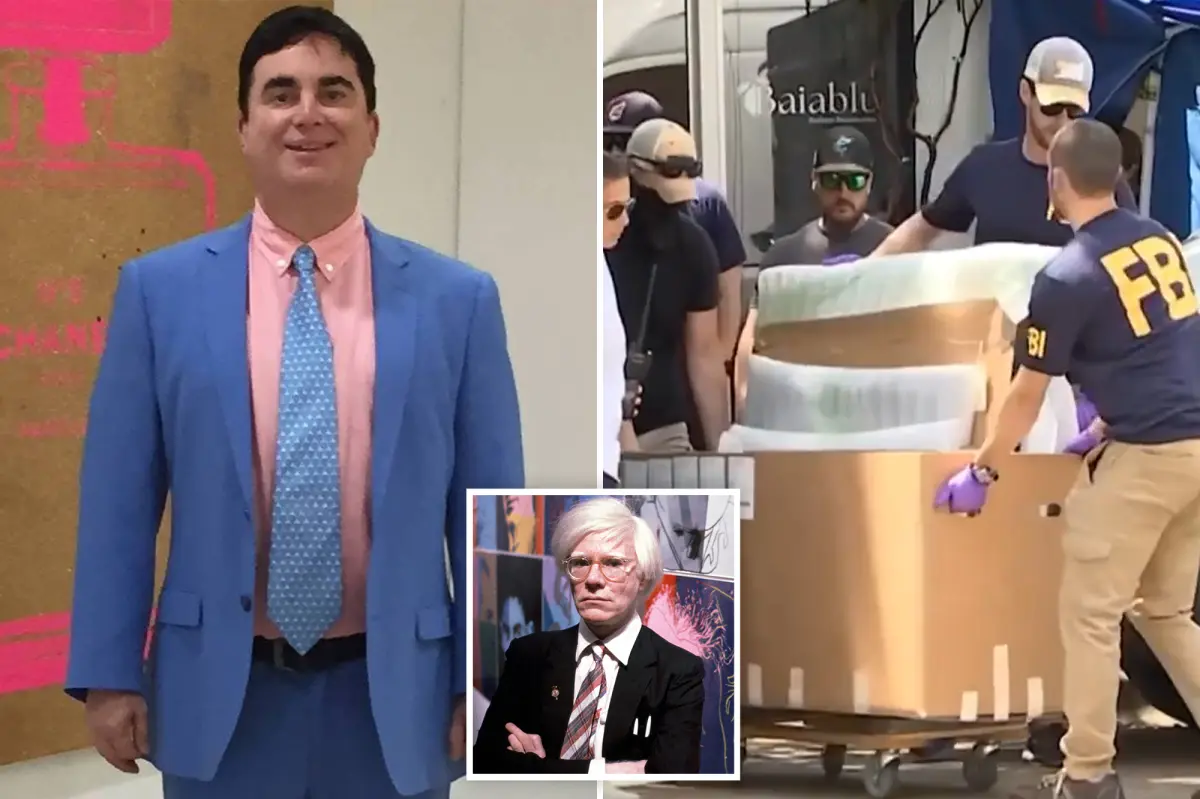
Here is the story of a man who spent his life surrounded by beautiful things, yet in the end, it was all built on a foundation of lies. Leslie Howard Roberts, a 63-year-old art dealer from South Florida, once stood at the center of Miami’s vibrant cultural scene. His gallery, Miami Fine Art Gallery in the leafy, picturesque neighborhood of Coconut Grove, was a place where collectors came to find treasures. But in April 2025, that world came crashing down. Roberts was arrested and later pleaded guilty to conspiracy to commit wire fraud. In a Miami federal courtroom this month, he was sentenced to three years and ten months in prison—a staggering fall from grace for a man who had traded in the glamour of the art world. Beyond the prison bars, he must also repay nearly $2.6 million he earned from his crimes. The sentence was more than just a punishment; it was a reckoning with the deep harm he had caused, not only to the buyers he defrauded but to the very idea of trust that makes art collecting possible.
The scheme itself was as brazen as it was deceptive. Roberts, according to federal prosecutors, sold artworks that he claimed were original pieces by Andy Warhol, the iconic figure of American pop art. But these works were not created by Warhol at all. They were forgeries, dressed up with convincing lies. Roberts told his clients that he had obtained the artwork directly from the Andy Warhol Foundation for the Visual Arts, a name that carried immense weight and legitimacy. To back up his claims, he provided fake and fraudulent invoices, documents designed to look official and trustworthy. It was a carefully constructed illusion, one that preyed on the hopes and desires of art lovers. As U.S. Attorney for the Southern District of Florida, Jason Reding Quiñones, put it, Roberts “exploited the trust that collectors place in art dealers and the authenticity of the works they purchase.” He wasn’t just stealing money; he was stealing something far more intangible—the confidence people have that the art they love is genuine, and the belief that the dealers they rely on are honorable.
Roberts did not act alone. The conspiracy involved another man, Carlos Rodriguez Melendez, who played a crucial role in making the fakes seem real. Rodriguez Melendez posed as an employee of a New York-based auction company, a name that would reassure buyers that the artwork had been properly vetted and verified. He would falsely authenticate the forged pieces, giving them a patina of legitimacy that they did not deserve. This was a coordinated effort, a two-man performance designed to exploit every loophole and trust signal in the art market. Rodriguez Melendez pleaded guilty to conspiracy to commit wire fraud last year and was sentenced to probation. While his punishment was lighter than Roberts’, his participation was essential to the fraud. Without his fake authentication, the scheme might have collapsed early. Together, they created a convincing but hollow world, one where paper trails led nowhere and signatures meant nothing. It was a stark reminder that even in the world of beauty and culture, there are those who will manipulate, deceive, and steal, using the very institutions meant to protect art as weapons of fraud.
There is a deep irony in the fact that the artist at the center of this fraud was Andy Warhol himself. Warhol, the visionary of the 1960s pop art movement, was an American visual artist and filmmaker who redefined what art could be. He embraced mass production, celebrity, and the blurring of lines between high and low culture. His famous silkscreens of Marilyn Monroe, soup cans, and Campbell’s soup cans challenged the very notion of originality. Warhol himself often said that art was about business, and he famously predicted that in the future, everyone would be world-famous for fifteen minutes. Yet his own work has become some of the most valuable and sought-after in the world, with pieces fetching tens of millions of dollars at auction. That immense value is precisely why forgers target his name. But there is a poignant tragedy in using Warhol as a vehicle for deception. Warhol’s art was about questioning what is real and what is copied, about the commodity of images and the nature of authenticity. To forge his work is to turn his philosophy on its head, turning a commentary on originality into a crime built on counterfeit. The very concept of a “fake Warhol” would have fascinated and perhaps amused him, but for the collectors who lost their savings, the joke was not funny at all.
The impact of Roberts’ crime extends far beyond the courtroom. For the victims, the loss was both financial and emotional. They did not just lose money; they lost a piece of their passion, their trust, and their belief in the art world. Imagine saving for years to buy a piece of art that speaks to your soul, only to discover that it is a worthless forgery. The shame, the embarrassment, and the anger are immeasurable. And Roberts was not an isolated case in South Florida. The region has become a hotbed for art fraud, with another dealer, Daniel Elie Bouaziz, sentenced in 2023 to two years and three months in federal prison for selling fake Warhols. Bouaziz, who owned two galleries in Palm Beach County, pleaded guilty to a single count of money laundering, while prosecutors agreed to drop 16 other counts related to fraud and embezzlement. The pattern is disturbingly familiar: fake artworks, fabricated provenance, and dealers who use their charm and reputation to deceive wealthy collectors. These cases show that the problem is not just a few bad apples but a systemic vulnerability in the art market, where vast sums of money change hands based on little more than a signature and a story.
In the end, the sentencing of Leslie Howard Roberts is a cautionary tale about the fragile nature of trust and the consequences of betrayal. The art world is built on relationships—between artists and collectors, dealers and museums, buyers and sellers. It is a world where a handshake can still mean something, and where a name like Warhol carries the weight of history. But it is also a world where greed can corrupt everything. Roberts’ fall from grace should serve as a warning to those who would exploit the love of art for personal gain. For the collectors, it is a reminder to be vigilant, to demand proof, and to question the stories they are told. For the dealers, it is a reminder that their reputation is their most valuable asset, and once lost, it cannot be bought back. Justice has been served, but the scars remain. The victims will never fully recover what was taken from them, and the art world will continue to grapple with the question of authenticity in an age of endless reproduction. But perhaps there is a glimmer of hope in the fact that the law caught up with Roberts, that his lies were exposed, and that he will pay for his crimes. Art is supposed to inspire, to uplift, and to connect us to something greater than ourselves. When it is used as a tool for deception, it becomes something far darker. The story of the fake Warhols is a sad chapter in the history of South Florida’s art scene, but it is also a reminder that truth, though sometimes buried, has a way of coming to light.