


The New Face of Luxury Travel: Why Meaning, Not Opulence, Will Define 2027
Gone are the days when luxury travel meant gold-plated fixtures, champagne on demand, and a conspicuous display of wealth. As we peer into 2027, a profound shift is underway—one that redefines what it truly means to travel well. The future of high-end travel is not about accumulating more, but about curating experiences that money can’t always buy: stillness, authenticity, and a deep connection to place. Marie-France Perrel, Head of Business Development for Hotels at the Michelin Guide, captured this sentiment perfectly at the Euronews Travel & Tourism Summit in Brussels, noting, “Luxury today is completely different than what it was… It’s no longer the sort of standards of opulence that we had in mind.” Instead, today’s discerning traveler seeks properties that offer a “sense of place,” a soulful, rooted experience that transcends mere aesthetics. Imagine swapping the frantic airport rush for a serene private lounge away from the terminal, or choosing a slow, scenic rail journey over a hurried flight. This is the new luxury—one that prioritizes intention over excess, depth over display, and peace over prestige. It’s a quieter, more thoughtful way of seeing the world, where every choice is deliberate, and every moment is savored. The buzzword for 2027 is not “extravagance” but “intentionality,” and it’s changing everything from how we book to where we go.
When it comes to choosing a destination, the map of luxury is tilting decidedly toward Europe. According to Virtuoso’s 2027 Luxe Report, which polled over 3,100 travel advisors across more than 50 countries, seven of the top ten most coveted global spots will be on the European continent. Japan leads the pack, followed closely by Italy, France, Greece, and Spain, with Croatia, Portugal, and the UK also making the cut—proving that old-world charm, culinary excellence, and cultural depth remain irresistible. But the savvy traveler is also looking beyond the well-trodden paths. Abercrombie & Kent (A&K) suggests adding Chile’s Easter Island to your 2027 bucket list, not just for its mysterious 1,000 moai statues, but for its open-air museum atmosphere and the film locations of Martin McDonagh’s “Wild Horse Nine.” Meanwhile, China is “firmly back on the radar” for its iconic sights, and Egypt is experiencing a renewed wave of fascination. Yet, even with these alluring options, the way we plan these journeys is changing. Enter the resurrected travel agent—now rebranded as a “travel advisor” or “trip designer” and suddenly chic again. As Elle magazine points out, these gurus are all over Instagram, curating endless streams of glamorous content with captions that whisper, “this could be yours.” But they offer far more than aesthetics: they negotiate, fix, and sometimes perform “miracles.” While AI can draft an itinerary in seconds, it cannot replicate the human intuition that knows exactly when to visit a city, which hotel room to request, and which hidden bistro truly lives up to the hype. In a world saturated with algorithms, the wealthy are rediscovering the irreplaceable value of a trusted, discerning human touch.
In an era of hyper-connectivity, where every vacation can become an instant social media spectacle, the most coveted luxury is privacy. Virtuoso’s Luxe Report underscores this desire, framing privacy as the ability to “avoid the queues and camera clicks, while being able to move through the world with minimal friction.” Sherif Khalil, writing on A Luxury Travel Blog, calls privacy “the new luxury,” noting that wealthy travelers now crave it “more than prestige.” He paints a picture of what this means in practice: having a museum entirely to yourself before it opens to the public, quietly sailing away from a dock instead of jostling in a queue, or lingering over breakfast without a care for the day’s schedule. Perhaps the rarest thing money can buy is simply the freedom to be unobserved. This pursuit of seclusion extends to accommodation. Holiday villas, with their promise of exclusive amenities and no shared spaces, are a natural fit. But privacy also matters for air travel. DiamondAir’s newly launched private check-in lounge, located minutes from London Heathrow, offers an “intimate space” with à la carte dining and a wellness area, all with runway views. Departing guests can relax while their luggage is pre-collected and transported; arriving passengers can retreat there to decompress before a concierge handles the transfer. It’s a seamless, cocooned experience that transforms the airport from a chaotic checkpoint into a tranquil prelude to the journey—proof that the ultimate luxury is often about what you can avoid.
The journey itself is becoming a canvas for elevated experiences, particularly when it comes to dining. Airlines are reimagining food at 30,000 feet, turning the meal into a centerpiece rather than an afterthought. Singapore Airlines, for instance, will unveil its latest in-flight dining across Suites, First, and Business Class this November, featuring over 100 new and revamped dishes developed by in-house and guest chefs, served on bespoke serviceware with the brand’s signature batik motif. But the most transformative trend is the embrace of slow luxury—a deliberate rejection of the fast lane. Rather than rushing through packed itineraries, travelers in 2027 are seeking deep, culturally immersive experiences that prioritize quality, depth, and privacy over opulent displays. This is where luxury rail shines. The Northern Belle, a meticulously restored 1930s train in the UK, will debut a new program of day trips in 2027, pairing caviar blinis and afternoon tea with sweeping countryside views. Meanwhile, Italy’s La Dolce Vita Orient Express offers a two-night “truffle route” from Rome to Alba and back, a journey that indulges the senses and connects you to the land. These are not mere modes of transport; they are floating, gliding sanctuaries that slow down time, allowing for genuine connection with the places you pass. The philosophy is simple: the best travels are those that allow you to breathe, to wander, and to let the world unfold at its own pace.
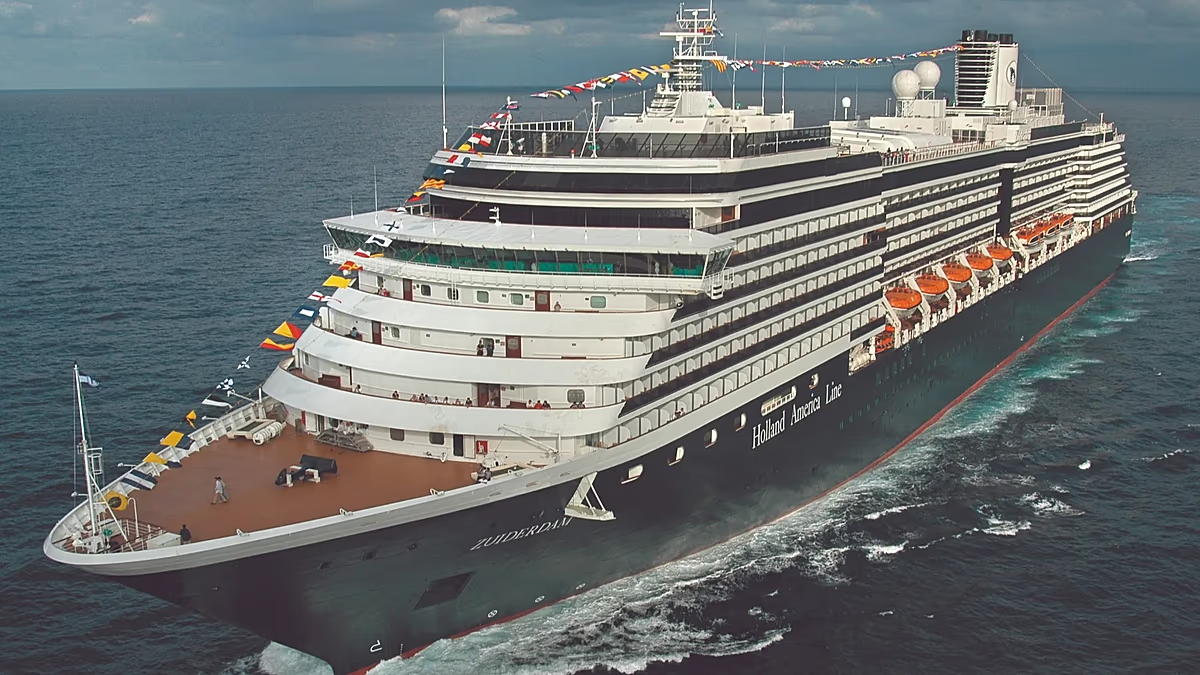
For those who prefer water, river cruises are emerging as the epitome of intimate luxury. Unlike ocean liners with thousands of passengers, these vessels glide directly into the hearts of inland cities and towns, offering a boutique-hotel-on-water experience with a fraction of the guests. The Viking Sekhmet, launching this November, is a prime example—built specifically for the Nile and hosting just 82 travelers. In 2027, it offers the signature Pharaohs & Pyramids journey and a new 12-day Total Eclipse on the Nile itinerary. In Europe, Scenic Cruises is introducing a 27-day river-and-land odyssey that includes a 13-day tour of Switzerland, with dining woven into the adventure—think risotto-making and 29 breakfasts, 15 lunches, and 19 dinners, all set against the backdrop of Interlaken. Simultaneously, the hotel industry is rethinking wellness itself. The Lemongrass Annual Travel Trend Report 2027 predicts that successful luxury properties will not simply add more treatments or diagnostics. Instead, they’ll remove stressors, design spaces with restorative lighting and acoustics, reduce sensory overload, and integrate biophilic elements throughout. They’ll be beautiful, yes, but they will also help guests regulate and restore their entire being. Estonia’s Eha Retreat exemplifies this, starting each stay with a consultation to craft a personalized wellness program, complete with in-room guided sleep meditations. This is wellness as a holistic, invisible embrace—not a checklist of spa services.
Finally, the luxury traveler of 2027 is becoming strikingly pragmatic about spending. Lemongrass calls this the “great trade-off”: a growing number of affluent holidaymakers are intentional about where their money goes, often pairing premium indulgences with practical bargains. A traveler might choose an economy or premium economy seat instead of business class, freeing up funds for an unforgettable, once-in-a-lifetime stay. That saved money can then be devoted to tailor-made experiences—private cultural encounters, witnessing rare natural phenomena, or booking a trip that is “genuinely personal and difficult to replicate,” as Signature Travel Network’s trend report notes. This is the ultimate luxury: the ability to craft a journey that feels uniquely yours, one that can’t be copied from an Instagram feed. In essence, 2027’s luxury is about intentional living. It’s about knowing when to splurge and when to save, when to seek company and when to crave solitude, when to speed up and when to savor. It’s less about flaunting wealth and more about nurturing the self, connecting with cultures, and protecting your peace. As we look ahead, the most luxurious travel won’t be defined by the thread count of your sheets or the vintage of your champagne—but by the quiet, authentic, and deeply personal moments that leave you changed long after you return home.