


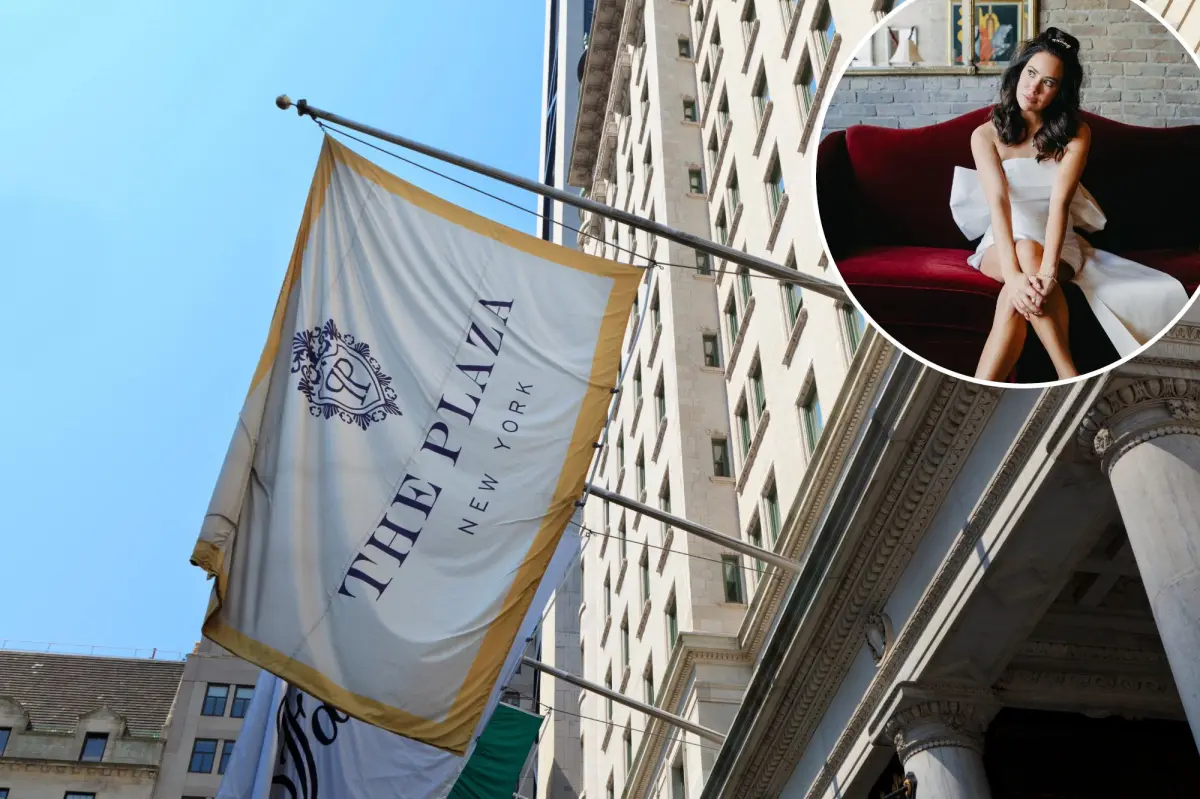
It began as the stuff of childhood fantasies: a proposal, a ring, a date circled on the calendar, and a venue so iconic that saying “I’m getting married at The Plaza” felt like stepping into a movie. For dozens of couples, that dream was supposed to culminate in glittering ballrooms beneath crystal chandeliers, with the grandeur of Central Park South as the backdrop to the most photographed moments of their lives. But in a sudden and devastating announcement, the legendary ultra-luxury Plaza Hotel revealed it would close in January for at least four years, citing an extensive restoration of its landmark-protected façade. The news hit like a thunderbolt, transforming fairy tales into logistical nightmares overnight. Brides who had spent months, sometimes years, planning six-figure weddings were left staring at their phones in disbelief, wondering if the deposit they had poured into a single perfect day had vanished into the marble floors of a building that would soon be swallowed by scaffolding. What made it worse, beyond the sheer shock, was the silence. The hotel’s official statement offered no details about affected bookings, no guidance about refunds, and no comforting words for the heartbroken couples who had already sent save-the-dates and secured vendors with non-refundable checks. For many, the first notification did not come from a hotel representative at all, but from a friend’s forwarded news link, a social media post, or a TikTok scroll that stopped the heart.
Christine Carney, a 38-year-old bride from Chicago, embodied that anguish. She had wanted to be married at The Plaza since she was a child, and when her dream finally felt real—a May 1 wedding booked nearly a year in advance, with 200 guests expected to celebrate in opulent surroundings—she allowed herself to believe in the magic. Then a friend texted her about the closure, and Carney spent seven agonizing minutes on hold with the hotel’s concierge, clinging to the faint hope that it was all a mistake. When a human voice finally came on the line, the message was blunt: her wedding no longer had a venue. There was no apology that could soften the blow, no alternative offered, and no clear answer about the money she had already committed. The photographer, the band, the flowers, the rentals—all had been secured with deposits, and her rehearsal dinner and welcome party were now dangling in limbo. “We haven’t yet had anyone from the Plaza reach out to tell us what next steps are and what happens with our money,” she said, her frustration palpable. The spring wedding season books up at lightning speed, and with every comparable venue in New York likely already reserved, she faced an impossible choice: hope for a refund that might never come, or eat the deposits and scramble to find a replacement anyway. She had already sent save-the-dates, so downsizing was not an option. The show, she insisted, must go on. The only question was where—and when—and that uncertainty was slowly consuming the joy that should have belonged to this season of her life.
Behind every bride stood an event planner tasked with performing miracles, and for Alyssa Pettinato, owner of Alinato Events, the Plaza’s sudden shutdown meant something almost absurdly unfair: she would have to plan Carney’s entire extravagant wedding all over again, for free. “Technically, we are getting penalized as planners,” she said. “Am I allowed to ask them for payment for this?” It was not an idle question. The logistics were staggering—rebooking a 200-guest celebration in a city where every desirable venue was already spoken for, coordinating a wedding band that had already proven difficult about date changes, and untangling contracts that had been signed months earlier. Pettinato noted that this was the third wedding she had to replan this year because of venue-related disruptions, a grim pattern that spoke to the fragility of the events industry. But what stung most was the lack of communication from a hotel that was supposed to represent the pinnacle of white-glove service. Pettinato had been in contact with Plaza employees about room-block contracts right up until the news broke, and she believed the staff themselves were caught completely off guard. “People who have been working there for decades are blindsided,” she said. “It feels like it was a leak because they seem extremely ill-prepared.” There was a particular cruelty in that silence: couples were left to wonder whether the hotel had knowingly accepted bookings for dates it had no intention of honoring, and whether the people who had greeted them warmly during site visits were just as betrayed as they were.
The pain was not limited to grand American weddings. Hannah Livingstone, a 30-year-old bride from Scotland, had dreamed of a New York romance straight out of the films she had grown up loving—romantic comedies, Sex and the City, the glittering fantasy of a city that never sleeps. She booked eight nights in a Plaza suite for roughly $9,000, splurged on first-class flights across the Atlantic, and planned an intimate February wedding with her partner, James McPherson. There would be a first look in the Plaza’s bar, the moment the couple saw each other for the first time on their wedding day, captured by photographers against the hotel’s gilded elegance. She had arranged for dress-steaming services, coordinated wedding photographs, and carefully mapped out every detail to make the day perfect. Then she discovered the hotel was closing—not through a formal email or a phone call, but while scrolling TikTok. “I thought, no, that surely can’t be right,” she said. The disbelief was compounded by the fact that just weeks earlier, she had been in touch with the hotel to confirm her booking and finalize preparations. They had been responsive, professional, and utterly normal. “It’s a bit mad to me that they’ve still been taking bookings and still being in contact like things are as normal,” she said, noting that with her wedding only four months away, she had still heard nothing directly from the hotel. The couple still planned to marry in New York on the same date, but finding a comparable venue had been disheartening, and the timing could not have been worse. “I’m actually going away this weekend for my hen do, so obviously I was very upset last night,” she confessed. “It has come at a pretty rubbish time.” Her story was a reminder that the Plaza was not just a building; it was a promise of magic, and for international couples, it represented an entire dream holiday wrapped around a single, irreplaceable day.
The hotel’s management framed the closure as a necessary, responsible step, attributing it to the complexity and safety considerations of restoring a landmark-protected façade. But those who knew The Plaza best whispered that the gilded grandeur was already showing its age. Casey Kaufman, founder of Imagine Party and Events, had planned countless lavish affairs within those storied walls and estimated that weddings at the legendary landmark could easily run upward of $1,200 per guest, with elaborate celebrations reaching $500,000 or more. She recalled one wedding where her team essentially built an entirely new room inside a Plaza event space, erecting temporary walls to conceal the existing ones. At another, they installed new window treatments to hide dated architectural features that no amount of candlelight could flatter. “I’ve taken people to the Plaza recently, and they’re just like, it’s dated,” she said. The costly upgrades piled onto already astronomical bills, and with the newly renovated Waldorf Astoria back in business, the competition for ultra-luxury weddings had intensified. Kaufman speculated that The Plaza may have felt the pressure to keep up, and she would be surprised if the four-year closure was not used to refresh its ballrooms as well. Yet even as she acknowledged the hotel’s physical flaws, she emphasized that its name, history, and prestige were nearly impossible to replicate. Clients had come to her before they were even engaged, announcing with certainty, “I know I’m getting married at the Plaza.” They dreamed of following in their grandparents’ footsteps, of dancing in the same rooms where generations of families had celebrated love. Those sentimental bonds could not be contracted, insured, or replaced.
The collateral damage extended far beyond wedding parties. The Russian Children’s Welfare Society announced that its annual Petroushka Ball, a beloved fixture of New York’s charity gala circuit held every February, could no longer be hosted at The Plaza next year. The shutdown would also freeze other quintessential Plaza experiences—extravagant birthday celebrations in the Eloise Suite, whimsical high teas, and the kitschy joy of the Home Alone 2 experience—all of them abruptly silenced by the restoration project. For those left holding contracts, the question of refunds loomed large. Pettinato hoped the hotel would choose integrity over legalism. “Your contract could say whatever you wanted to say, but are you going to blow up your reputation by fighting something that’s technically immoral,” she argued. “That’s where it gets a little blurry. Something of the caliber of The Plaza, like I would expect them to give everyone a refund and not even fight that.” She was not asking for sympathy; she was asking for accountability. The Plaza had spent more than a century building a reputation as the gold standard of luxury and romance, and in a single announcement, it had jeopardized the trust of the very people who kept its legend alive. The brides, the planners, the charitable organizations, the families with decades of memories—all of them were left waiting, hoping that someone would make the right choice. In the end, when The Post reached out for comment, the hotel provided only its public statement and offered no further details about the hundreds of affected bookings. The silence spoke volumes. For Christine Carney, Hannah Livingstone, and countless others, the fairy tale had not just been postponed; it had been broken, and only time would tell whether the magic could ever be restored. But one thing remained certain: love, unlike marble and gilt, does not need a landmark to endure. The couples would find another altar, another room, another place to say “I do.” The pain of the betrayal, however, would linger long after the last champagne toast, a poignant reminder that even the most beautiful dreams can be shattered by the careless hands of those who promised to protect them.