


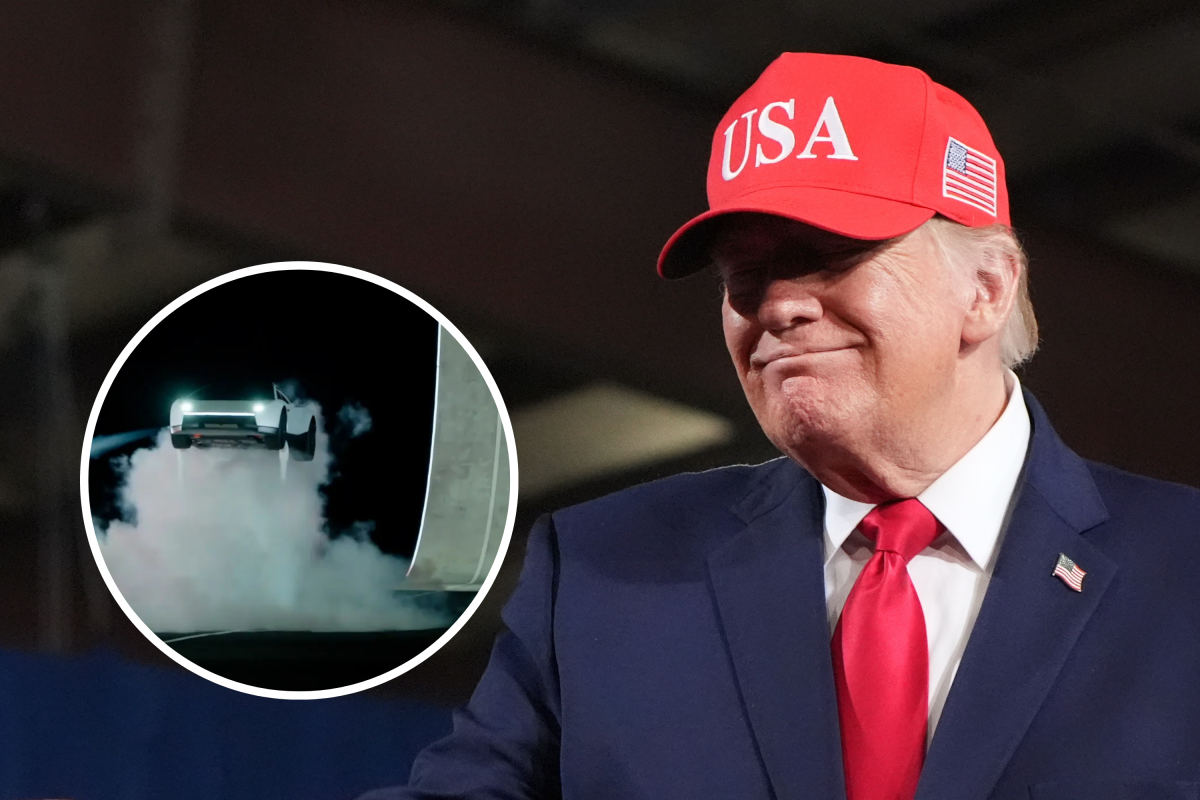
When Elon Musk pulled back the curtain on the Tesla Roadster 2 at a SpaceX facility in Texas on Thursday, it was hard to know whether you were watching a car reveal, a magic show, or a daredevil stunt that somehow escaped from a Hollywood action movie. The vehicle drove straight up a curved wall and hung upside down like it was defying the laws of physics simply for fun. Then, with the help of rocket thrusters, it flipped in midair, briefly levitated, and came back down with all the softness of a falling feather. It wasn’t done yet. The same thrusters pushed it from zero to sixty miles per hour in under a second, launched it over six vehicles, and ended the performance with a kickflip that Tony Hawk himself would have nodded at in appreciation. It was stunning, it was scarcely believable, and you’ve never seen anything quite like it before. But here’s the rub: the Roadster has not yet managed the far less glamorous but slightly more important feat of arriving at a dealership. The production version won’t exist until 2028, and the flying version you just watched isn’t for sale at all. It’s invitation-only, and it isn’t even road legal. So what we saw on that stage was less a car and more a piece of art—a dazzling, impossible sculpture meant to grab your attention and hold it hostage. And in that sense, it was also a fitting allegory for the political moment, for the era of Trump, for a time in which spectacle is often mistaken for success and a promise of magic is treated as a deliverable.
The timeline of the Roadster tells a deeper story, and it reads like a cautionary tale. Tesla first unveiled the second-generation Roadster back in 2017, when Musk promised customers they would have it by 2020. That didn’t happen. Now, nine years after the original announcement, Musk finally demonstrated the car and said production would begin in 2028—eight years behind schedule. Even more telling is that Musk himself doesn’t expect the Roadster to make money. Earlier this year, he admitted it probably wouldn’t “move the needle massively from a revenue standpoint.” But, he added, “it is very cool.” That’s a nice problem for a billionaire to have, but Tesla could use something that actually moves the needle. Annual vehicle deliveries fell 9.5 percent between 2023 and 2025, sliding from 1.81 million to 1.64 million, while automotive revenue dropped roughly 16 percent to $69.5 billion. Net income attributable to shareholders plunged 46 percent last year. The company is still a giant, but it is a giant with a limp. Yet instead of focusing on the quiet, unglamorous work of shoring up the core business, Musk chose to wow the world with a prototype that few will ever get near. There is something very familiar about that exchange. Two years ago, Trump promised, for the third time, to Make America Great Again. He said he would cut inflation, immediately bring prices down, and put an end to the wars raging around the globe. Instead, inflation is now running at 3.7 percent—0.8 percent higher than it was in Biden’s last year in office. Gasoline averages $4.33 a gallon, and diesel has climbed well above $6, hitting a record high of $6.53 in September. Chief among the reasons for these unwelcome realities is a war in Iran, which Trump started in February and which has stoked an increasingly complex regional conflict in the Middle East. There are real successes to acknowledge: GDP grew at a 2.2 percent annual rate in the second quarter, and Wall Street has prospered. But grocery stores and gas stations don’t charge in S&P 500 points. For millions of ordinary Americans, the big promises have not delivered results, and the latest polling suggests they’re growing tired of the promises. A recent AP-NORC poll found that only 26 percent of Americans approved of Trump’s handling of the economy, and a mere 17 percent approved of his handling of living costs—exactly the same share of people who believe he keeps his promises.
Musk’s foray into politics, as the architect of the Department of Government Efficiency, followed the same familiar script. He arrived in Washington promising to slash up to $2 trillion in spending, smash through bureaucratic nonsense, and post the triumphs online. And to be fair, DOGE did cut some things. It terminated government contracts, reduced staff, and made at least a dent in the federal workforce. But the Government Accountability Office found serious problems with DOGE’s claims of $110 billion in itemized savings. The GAO accused the department of questionable data collection and reporting practices, taking credit for cuts that were planned before DOGE even existed, and in some cases reporting savings that simply didn’t exist. Among the most embarrassing examples was $1.7 billion supposedly saved on a military healthcare contract that had not actually been cut. It was as if someone had balanced a budget by inventing numbers and hoping no one noticed. The deeper issue is that making government smaller and making government work better are not the same thing. You can shrink a department and leave it unable to fulfill its basic duties. You can cut a program and call it efficiency while people who depended on that program fall through the cracks. This is kind of like the difference between a flying prototype car and one that most people can actually buy and drive. Except there’s a crucial difference: you can choose not to put down a deposit on a Tesla, but you can’t opt out of the federal government. The consequences of these half-baked cuts are not a spectacle to be enjoyed from a safe distance. They land on real people, in real time, and they have a way of making a mockery of the promise that government would stop taking your money and start delivering services. A flying car is a wonderful thing to gawk at; a functioning government is something you need to live in.
Let’s be fair, though. None of this is meant to disparage Musk, his companies, or the achievements they’ve racked up over the years. There is something genuinely magnificent about the new Roadster, regardless of whether anyone can buy it. It is a feat of engineering that would have seemed like science fiction just a couple of decades ago. Tesla changed the auto industry and turned the electric car from a niche curiosity into a global force. SpaceX has made reusable rockets a working reality and routinely carries astronauts to the International Space Station. Its subsidiary, Starlink, has brought fast, reliable satellite internet to millions of people around the world, many of whom had no connection before. America has always had a culture that breeds ambition and innovation; the willingness of its entrepreneurs and companies to attempt audacious, improbable things—and sometimes pull them off—is part of what makes this country great. For all its faults, it remains an economic and technological powerhouse. But alongside that healthy ambition, America has bred another, more insidious kind of culture: one in which attention often carries more currency than action. We live in an age of digital spectacle, where engagement is measured in views, likes, shares, and retweets, and where the loudest, most outrageous thing often wins the day. We reward the appearance of progress over actual progress. We celebrate the rocket launch and forget to fix the potholes. We watch a car flip through the air and forget that no one can drive it home. There is a reason that “influencer” is now a legitimate career, and there is a reason that presidents now behave like influencers-in-chief. The incentive structure has shifted, and the people who thrive in that structure are not always the ones who are best at governing, or building, or delivering real value. They’re the ones who are best at putting on a show.
The Trump presidency could only have happened in our time. Social media has created an ecosystem that rewards spectacle over substance, and Trump has an almost supernatural command of spectacle. He knows how to create a moment, how to dominate a news cycle, how to turn a mundane press event into appointment viewing. But much like the dopamine crash that follows an extended period of scrolling, the Trump administration’s failure to deliver on grand promises has resulted in bitter disappointment. Rather than take responsibility for the hardships facing the nation and work to resolve them, he has resorted to yet more promises and quick fixes that do not, in fact, fix anything at all. Consider the $5,000 “dividend” that will supposedly be funded by tariff income and paid out to every American if Republicans keep control of Congress at the midterms. The whole scheme would cost roughly $1.2 trillion, which is not far off the amount that Trump and his family’s business reportedly earned from cryptocurrency ventures last year. The math is dubious, the timing is suspicious, and the whole thing sounds less like serious fiscal policy and more like a marketing gimmick. Or consider his approach to diesel prices. To tackle the cost of diesel, he announced a deal with Vladimir Putin to waive sanctions on Russian fuel exports, while simultaneously blaming Ukrainian attacks on Russian refineries for rising prices. Energy experts say the amount of diesel to be provided by Moscow is a mere drop in the bucket and will make little difference at the pump. But the deal makes a major difference to the Kremlin, which will enjoy considerable political and economic capital as Moscow continues its war in Ukraine. And through it all, the standoff with Iran over the Strait of Hormuz and Tehran’s elusive nuclear program—and the consequences it has brought—continues to haunt the global economy. The promise was to end wars and lower prices. Instead, we have new wars and higher prices, wrapped in the language of deals and victories.
None of this means we shouldn’t build flying cars. There is nothing wrong with a feat of engineering done for the sheer pleasure of proving you can do it. Nor should a country stop attempting extraordinary things because ordinary problems remain unsolved. The trouble begins when governments and presidents confuse the task of governing with the task of marketing; eventually, you have to deliver at least some of what you promised. You can’t just keep showing people shiny prototypes and expect them to forget that their bills are piling up. You can’t just post about your accomplishments on social media and ignore the fact that the government agency you were supposed to run is reporting fabricated savings. You can’t promise to bring prices down and then start a war that sends fuel prices through the roof. The Roadster is beautiful. It is a genuine technical achievement. But a car that no one can buy is just a sculpture, and a government that no one can rely on is worse than no government at all. We don’t need fewer impossible dreams. We need more basic competence. We need the quiet, unglamorous work of repairing roads, lowering prices, making healthcare affordable, and keeping the peace—none of it photogenic, all of it vital. We need leaders who understand that governing is not about taking our attention for a ride; it is about taking responsibility for our lives. Until that happens, we’ll be left standing on the curb, watching spectacular vehicles leap through the air, while the road we actually need to travel remains broken, unpaved, and pothole-ridden. And that is the real trick, isn’t it? We could have both. We could build the flying car and fix the road. But it takes humility, patience, and a willingness to do the boring work. It takes a president who would rather be competent than famous. And it takes a culture that values substance over spectacle, delivery over promises. We aren’t there yet. But maybe, just maybe, the next thing we build will be something that actually arrives on time, costs what it should, and does what it promises. That would be more impressive than any kickflip.