



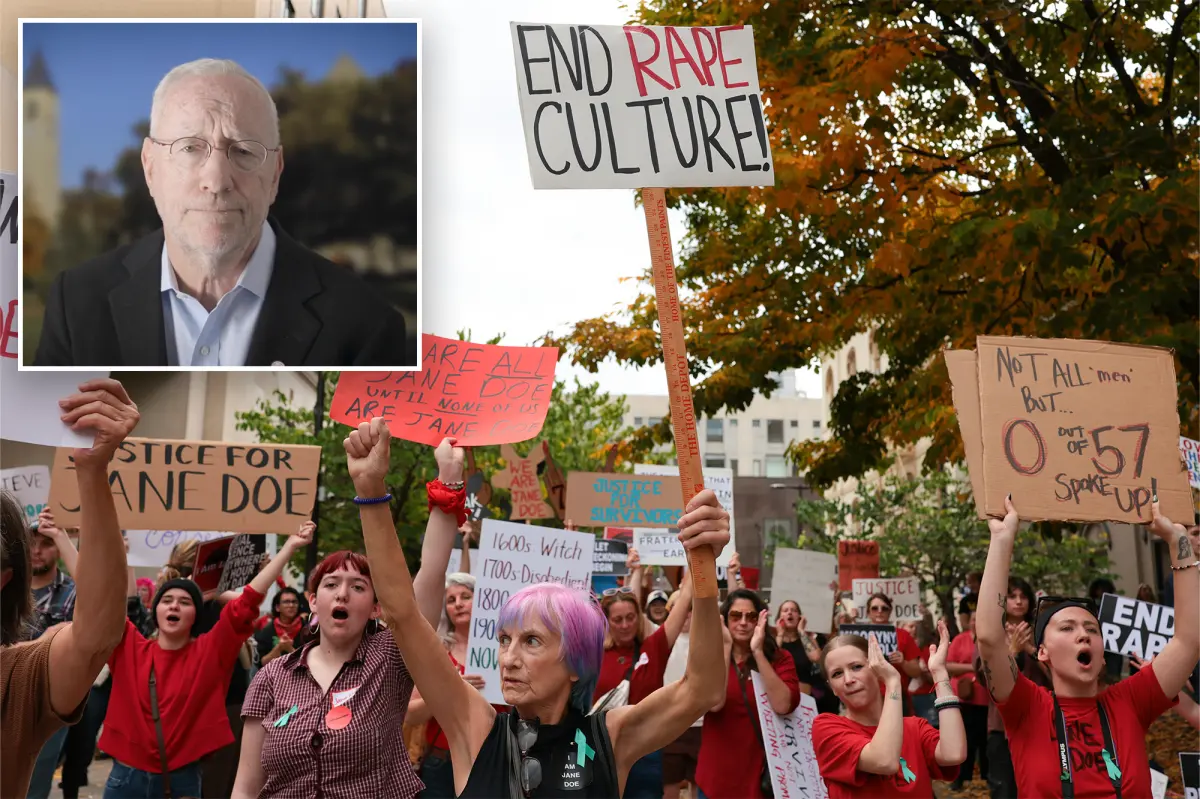
Cornell University President Michael Kotlikoff walked into the Faculty Senate meeting Wednesday knowing the room was not on his side. The air was thick with the weight of a year that had already tested the campus in profound ways, and at the center of it all was a young woman’s report that she had been gang-raped at a fraternity house in October 2024. Her case, filed under the pseudonym Jane Doe, has become a painful symbol of what many faculty members see as a broken system: a student who says she was failed by the institution meant to protect her, an administration that seems distant from the details of her suffering, and a president who, by his own admission, never followed up to learn what happened to her or why the criminal investigation stalled. The meeting was closed to the media, but an audio recording obtained by The Associated Press captured the raw, frustrated exchanges. Faculty members pressed Kotlikoff with pointed questions, their voices carrying the exhaustion of people who had been waiting for accountability for too long. Some wanted answers about the police report. Others wanted to know why he hadn’t checked on the survivor. Kotlikoff acknowledged some missteps, but he also defended his leadership, asking for more time to implement reforms and push for cultural changes in student social life. He insisted that experienced leadership was necessary to confront problems that, in his words, “are not simplistic, they’re not easy, they can’t be brushed aside with a wave of a hand.”
Kotlikoff’s defense was both an apology and a plea. He admitted that mistakes had been made, but he warned that removing him would not solve the deeper issues and would only harm Cornell’s reputation. Replacing a president, he argued, was not the right way to address a crisis that demanded steady, experienced hands. He spoke about the complexity of the situation, urging faculty not to reduce it to a single failure or a single villain. He also left open the possibility of sweeping restrictions on Greek life, saying Cornell needed to determine whether fraternities could operate safely at all. Just a day before the Senate meeting, Kotlikoff had announced a ban on fraternity parties through the end of the academic year, a significant step that acknowledged the gravity of the moment. But he framed it not as an emotional reaction but as a decision that should be guided by research and evidence. “If at the end of the day fraternities cannot exist in a safe environment and we can’t be convinced that they can be safe, then we should make that decision,” he said. It was a measured statement, but for many faculty members, it felt too little, too late. They wanted to know why such measures hadn’t come sooner, why the administration had seemed so reactive rather than proactive, and why a survivor had to file a lawsuit before her voice was truly heard.
After Kotlikoff left the room, the frustration spilled out. A string of faculty speakers stood up to say they had lost confidence in the administration’s ability to combat sexual assault on campus. “The faculty were extremely angry. They gave him a hard time, I think appropriately so,” said Richard Bensel, a professor of government. The debate was contentious, and it revealed deep divisions within the faculty itself. Grant Farred, a professor of Africana Studies and English, described the institution as “split in significant ways,” with those in the humanities feeling they had enough information to proceed with a no-confidence vote while those in the sciences wanted more data before making such a consequential decision. Iris Packman, a research and policy expert at Cornell’s Climate Jobs Institute, said Kotlikoff came across as “defensive.” Labor history professor Paul Ortiz, the lead sponsor of the no-confidence resolution, said the debate was animated by a widespread perception that the administration wasn’t doing enough to address what he called “a perpetual ongoing crisis.” Even those who welcomed some of Kotlikoff’s recent moves, like Anne Marie Brady, a senior extension associate at the School of Industrial and Labor Relations, questioned the timing. Brady said she appreciated his announcement that state police, rather than campus police, would temporarily handle investigations of sexual assaults, but she wondered why it had taken so long and why it was announced just a day before the Senate debate. The no-confidence vote would be largely symbolic, but it could send a powerful message to the university’s trustees, who ultimately decide how the university is run and who leads it. Debate was expected to continue on October 28, followed by electronic voting.
At the heart of this crisis is Jane Doe’s lawsuit, filed last month, which alleged that seven Chi Phi fraternity members sexually assaulted or exploited her in October 2024 and that Cornell mishandled her complaints. All of the men denied the allegations, saying either that their interactions were consensual or that they were not involved. The criminal investigation by Cornell’s police department stalled after the local district attorney quickly decided that no crime had occurred. Kotlikoff publicly addressed what he called “deeply disturbing” allegations at the time, suspended the fraternity, and said criminal and university investigations were underway. He also convened a presidential task force to examine how Cornell handles sexual assault. But in an interview with The New York Times published Tuesday, Kotlikoff admitted that he never followed up to learn what had happened to the woman or the criminal investigation. When asked by a faculty member whether he had read the Cornell Police Department’s report on the rape allegations, Kotlikoff acknowledged that he had not. He explained that the police investigation was confidential and that university policy dictates top administrators shouldn’t have a role in criminal investigations. “I really reject the idea that I had no interest in it or was not concerned about it,” he said. Yet he also denied that he wasn’t aware students had been expelled or suspended as a result of the university’s Title IX investigation, while acknowledging that, until recently, he didn’t even know the woman had dropped out of Cornell. For many in the room, that admission was devastating. How could the president of a university not know that a student at the center of such a high-profile case had left the institution? How could he claim concern without ever reading the report or checking on her?
The broader context only deepens the sense of institutional strain. Kotlikoff became the university’s interim president in July 2024 and took the job permanently last year. His tenure has been marked by a series of challenges: a dining and custodial workers strike, anger over his decision to pay $60 million to settle Trump administration civil rights investigations, and accusations from activists that his administration stifled campus protests. The sexual assault crisis has now become the most personal and painful of these issues, cutting to the core of what a university owes its students. One faculty member, Kim, shared her own story of how her efforts to avoid colleagues who had harassed her later became a point of criticism during her tenure review. In one instance, a professor cited her unwillingness to accept his advice and her avoidance of him when he voted against granting her tenure. Her voice, as she recounted this, seemed to carry the weight of years of frustration and betrayal. It was a stark reminder that the failures at Cornell are not abstract policy problems but lived experiences, shaped by power dynamics, silence, and the fear of retaliation. The faculty’s anger was not just about one case or one president; it was about a culture that too often protects the institution and its reputed members while leaving survivors and those who speak out to fend for themselves.
As the vote approaches, the question is not simply whether Kotlikoff will survive. It is whether Cornell can begin to rebuild the trust it has lost. A no-confidence vote, even if symbolic, would be a loud and clear signal that the faculty no longer believes the administration can lead the way forward. But some warned that a hasty vote would do little to address the underlying problems, and that the institution needed a coherent plan, not just a change in leadership. The woman at the center of this storm, Jane Doe, remains a haunting presence in the debate. Her name is hidden, but her story is everywhere: in the faculty senate chambers, in the audio recordings, in the headlines, and in the hearts of those who have been waiting for justice. Kotlikoff asked for more time, but time is a luxury that many feel the university has already squandered. The real work, as difficult as it may be, is not just about removing a president or saving a reputation. It is about creating a campus where students are believed, where reports are taken seriously, where survivors are not left to disappear into the shadows, and where the people in power are willing to look at the painful details and say, without flinching, “I see you, I hear you, and I will do everything in my power to make this right.” That is the Cornell that faculty, students, and survivors are still waiting for.