


-
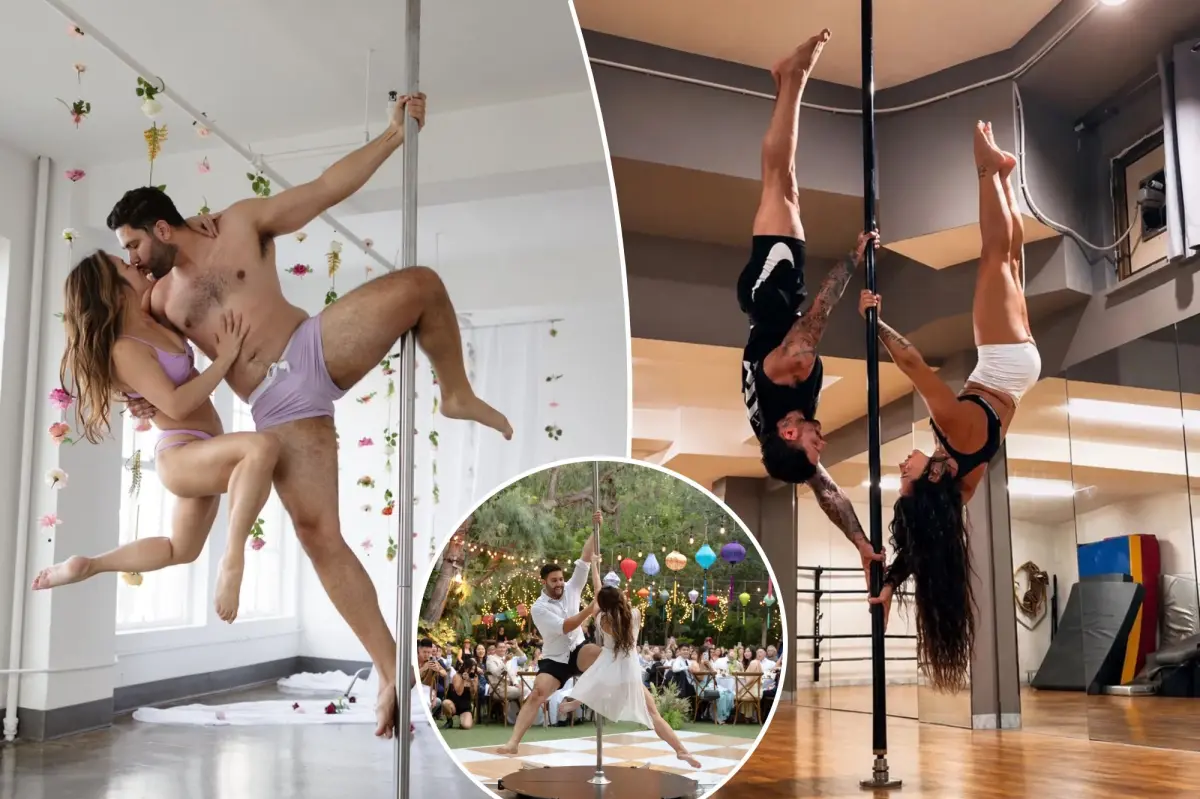
There is a certain magic in the moment a couple discovers something that belongs only to them—a shared secret, a shared thrill, a shared challenge that makes them feel like teammates in a world that often pulls partners apart. For Misha and Sam, a newlywed pair living in Los Angeles, that discovery came in the form of a ten-foot, stainless steel pole that now stands at the center of their marriage. When they married in August, they skipped the traditional first dance, the familiar swaying and dipping that most guests expect, and instead performed a sequence of flips, splits, and daring suspended poses on that polished metal pillar. Their 150 wedding guests sat stunned, then cheered, and the video of their unapologetic debut as husband and wife has since racked up more than 300,000 views online. Misha, a finance professional, and Sam, an engineer, paid $1,800 for the pole, but they describe it as less of an expense and more of an investment in their connection. “There’s a lot of stigma around pole dancing, some people might think, ‘Oh, that’s just for strippers,’” Misha says. “Yes, it has sensual roots. But there’s so much athleticism that go into it. It’s a lot harder than it looks. We love it.” The pair, who prefer to keep their last names private, have learned to shrug off the nasty comments that flood their videos—the digs at Sam’s sexuality, the sneers about their “weird” and taboo antics. Sam, a 6-foot-1, roughly 230-pound hunk, is not fazed. “A lot of people think pole is just for women,” he says. “It’s strange for them to see a guy do it, especially with his female partner. I just don’t feed into the negativity.” For him, the pole is not just fitness; it is a living metaphor for marriage. “There are times I have to hold all of Misha’s weight while we’re doing a move, or she may have to position herself in a certain way to accommodate me,” he adds. “It’s like a metaphor for marriage.” Their story is not isolated. Across the country and around the world, a rising swarm of sweethearts are trading pickleball, predictable movie dates, and board game nights for the dizzying heights and intimate challenges of pole dancing. They are spinning, climbing, and inverting together, using the pole as a physical and emotional anchor in their relationships.
-
In New York City, Amanda Kenberg and George Forchuk have built their entire romance around this shared passion. The couple met at a pole dancing event nearly three years ago, so George was already familiar with the art form before they ever locked eyes. Amanda, 32, an esthetician and waxer from Jersey City, and George, 35, a photographer, both came to the pole with backgrounds in martial arts and weightlifting. But they quickly discovered that training side by side on a pole was unlike any workout either had experienced. It demanded trust, vulnerability, and an almost telepathic awareness of each other’s bodies. “George and I met at a pole dancing event so he wasn’t a stranger to it already,” Amanda says. “Pole dancing together is very rewarding. We get to see each other learn and fail, we record each other doing something we feel our best at—it’s really fun to see someone you love learning about themselves in real time too.” For George, the ability to distinguish the athletic artistry of pole from its stripping stereotype is exhausting, but he refuses to let the criticism dim his enthusiasm. “Having to distinguish the art from those who believe pole dancing is just stripping gets really annoying,” he admits. “But I love making fun of dudes who are just not comfortable with themselves or their own relationships. Their insecurity isn’t alpha or cute. Learn to enjoy and support your partner in everything they do.” The couple, who study at Pole Superwoman in Manhattan, are part of a growing movement of men, some 400,000 practitioners worldwide, who are spinning circles around their wives and girlfriends on social media under the hashtag #PoleTok. Some use their videos to attract clients or build OnlyFans followings, but many, like Amanda and George, simply see the pole as a way to deepen their bond. Gotham-based sex and relationship therapist Cyndi Darnell says there is science behind this phenomenon. Physical activities that require close contact create what she calls “attunement”—a co-regulation of nervous systems and heartbeats that fosters connection beyond words. “When engaging in a physical activity with another person, a co-regulation of nervous systems and heartbeats can occur, creating a sense of connection and communication that transcends words and conscious thought,” she explains. “Through couples activities that require very close physical connection, you and your partner become one being during the exercise.” For Amanda and George, that oneness is the reason they keep coming back to the studio, week after week, laughing through the bruises and celebrating each new trick as a shared victory.
-
For Travis and Laura, a couple from New Jersey, pole dancing has become the cherry on top of a 22-year marriage that was already strong. Travis, 43, is an Army veteran and IT specialist with a macho demeanor that makes him an unlikely poster boy for the sport. Laura, 40, is a nurse who first approached the pole in 2022 as a way to rebuild her confidence. Like many women, she had experienced changes to her physique that left her feeling less desirable, and she was searching for something that would make her feel powerful in her own skin again. She found Pole To Pole Fitness, a studio with locations across New York City and New Jersey, and fell in love with the community, the tricks, and the way the sport made her feel. “It built my confidence. I started to get more comfortable and fell in love with the community, learning tricks and doing exercises that feel more like fun,” she says. But what started as Laura’s personal journey soon became a shared adventure. She lassoed Travis into the risqué revelry, and although he was admittedly “uncomfortable” at first, he began to see the pole as an opportunity to increase his mobility, flexibility, and agility. Now the couple trains together several times a week, treating their sessions like date nights. “As a couple, we’ve always been very into physical touch, so pole dancing can add to that in a way,” Travis says. “But it’s really helped us rely on one another, supporting each other in areas—both on or off the poles—where the other is in need.” Their routines are intricate and deeply trusting: dance lifts, mounts, and dismounts on the same pole, with Travis lifting Laura onto the apparatus or carrying her between poles, moving her gracefully like a partner in a ballet that happens to be suspended in the air. And yes, Travis has heard the heckling. His friends in the armed forces give him grief on a regular basis. “They absolutely give me grief. But then at the same time, they’re also like, ‘Wow. It’s impressive that at 43 you’re still doing the splits and moving, doing things that we could never do,’” he laughs. “I’ve even booked private lessons for my Army and Marines buddies. Afterwards they love it just as much as I do.” There is a particular joy in watching a man like Travis, someone who has spent his life in the hyper-masculine world of the military, discover a form of self-expression that requires grace and vulnerability. It is a reminder that strength comes in many forms, and that love, when nurtured with intention, can make us willing to try anything—even things that scare us.
-
Across the ocean, in Naples, Italy, another couple is discovering the same truth. Domenico, a lifelong soccer player and professional tattoo artist, never imagined he would find himself hanging upside down from a pole next to his girlfriend, Lauryn. He had always assumed pole dancing was an activity practiced primarily by women, and that its benefits, including flexibility, were mostly for them. But when Lauryn, 31, became a pole instructor nearly six years ago, she was in the middle of a painful personal transformation. A devastating family death had sent her into a period of grief and weight gain, and she turned to the pole as a way to reclaim her body and her spirit. Domenico, seeing how much the practice meant to her, decided to try it himself—not because he was naturally drawn to it, but because he wanted to support her healing journey. What began as an act of love soon became a shared obsession. “I’d never really considered pole dancing as a sport because I assumed it was mostly practiced by women and that the benefits, such as flexibility, were mainly for them,” Domenico says. “But now, I would absolutely recommend pole dance to men.” The couple now trains together regularly, and Domenico, who once measured his life in goals and championships, says that stealing a kiss from Lauryn while they are both inverted in an extended position on the pole feels better than scoring the winning goal. It is a sentiment that speaks to the profound way pole dancing can transform a relationship. When you are hanging by your legs from a slim metal pole, your body twisted into a shape that defies gravity, there is no room for ego or pretense. You have to trust your partner completely, and that trust spills over into every other aspect of your life. Lauryn says the practice has helped them challenge themselves, push beyond their limits, and grow together. She is already planning to transform a spare bedroom in their home, which they had earmarked for a future baby, into a pole room until she becomes pregnant. It is a beautiful image: a nursery waiting in the wings, and in the meantime, a space filled with spinning, laughing, and the occasional kiss while upside down. Their story is a testament to the idea that love is not just about being there for the big moments, but about showing up for the small, strange, and unexpected ones too.
-
Even the youngest generation is catching on. Tara Atienza, 22, and her boyfriend Francis Santos, 21, live in San Diego, California, where they have turned their living room into a home studio featuring what Tara calls the “gold standard of poles”—a nine-foot home tension pole. Tara, a recent college graduate, first learned to rotate and gyrate from strippers, whom she affectionately calls “nighttime ballerinas,” and she has become something of an influencer, amassing nearly 200,000 social media followers who delight in watching the young couple’s joint jigs. She is currently teaching Francis how to do an advanced move called the Ayesha, in which a dancer suspends their body weight horizontally, or in a wide V-straddle, using an inverted two-hand grip. It is a difficult trick that requires immense strength and coordination, and Francis, still an undergrad, is determined to master it. “Despite the stigma around pole dancing, there’s a major emphasis on calisthenics,” he says. “It requires a ton of skill, strength and coordination.” The couple is part of a movement to destigmatize pole dancing, to make it more appealing to young and old couples across generations. They want people to understand that the pole is not just a prop for titillation; it is a tool for building strength, confidence, and intimacy. Tara is refreshingly candid about her affection for the pole and for Francis. “Pole isn’t specific to one gender, it’s literally for everybody and any type of body. I’m grateful to have Francis as my partner in life and in pole,” she says. “Doing anything with someone you love, will strengthen your relationship,” Francis agrees. “I wouldn’t want to do anything else.” Watching them, one gets the sense that pole dancing is less about the movement itself and more about what the movement represents: a willingness to be vulnerable, to try new things, to support each other through failure and celebrate each other through success. It is the stuff of good relationships, translated into physical form.
-
In the end, these couples are proof that shared interests can keep a relationship firmly in pole position. According to the Pew Research Center, more than 60% of married adults cite “shared interests,” along with satisfying sex, as key to a successful marriage. But the couples featured here are not just sharing a hobby; they are sharing an experience that requires them to trust, communicate, and rely on one another in ways most activities never will. Pole dancing has a way of stripping away pretense. You cannot hide behind small talk or a screen when you are clinging to a metal pole with your legs hooked over your head and your partner’s hands steadying your hips. You have to be present, honest, and open. And in that openness, something beautiful happens: you see your partner not just as the person they are in the world, but as the person they are when they are trying, failing, and finally succeeding. That is why Misha and Sam, Amanda and George, Travis and Laura, Domenico and Lauryn, and Tara and Francis all insist that pole dancing has made their relationships stronger. It is not the pole itself that is magical; it is what the pole demands of them. It demands strength, but also softness. It demands independence, but also interdependence. It demands that they show up for each other, again and again, even when it would be easier to stay on the ground. The stigma around pole dancing may persist, but these couples are happy to be ambassadors for the sport, whether they are posting videos online, booking private lessons for skeptical friends, or simply doing the splits in their living rooms. They have learned that the opinions of strangers matter far less than the bond they share with the person they love. As Travis says, with the wisdom of a man who has spent decades in service and now spends his free time flying upside down on a pole, love is about support in every area of life—on the pole and off it. And as Santos puts it, there is nothing else he would rather do. In a world that often tells us to play it safe, these couples are choosing to spin, to climb, to invert, and to fall—knowing that their partner will be there to catch them. That, more than any trick, is the real magic of pole dancing for couples. It is a reminder that love is not just a feeling; it is a practice, a discipline, and a dance.