


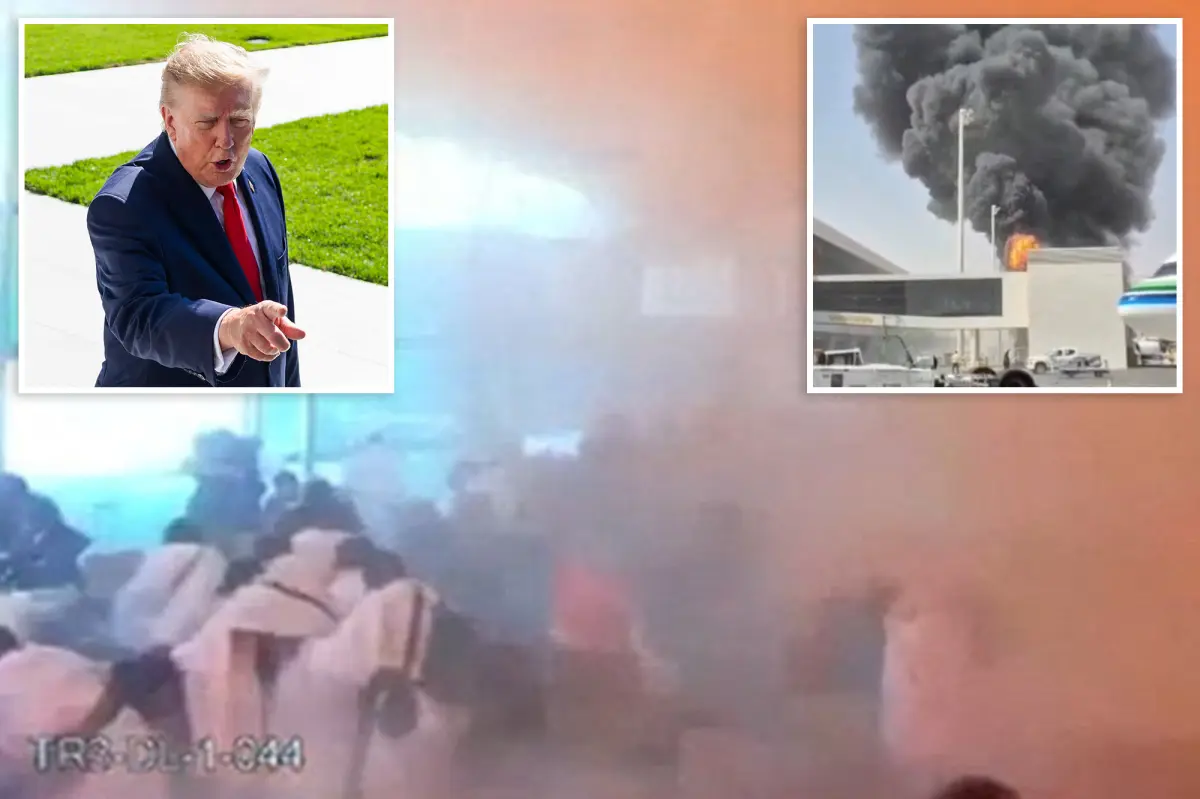
The news lands like a heavy stone in still water: President Trump is warning the Houthis against launching further deadly attacks against Saudi Arabia, and he is suggesting that he may ask Turkey to help confront the Iran-backed terror group. There is something almost casual about the way he said it, as if he were discussing a favor between old friends rather than a potential military escalation involving NATO’s second-largest army and one of the most volatile corners of the Middle East. The question came from a reporter, asking whether he would ask President Recep Tayyip Erdoğan to hit the Houthis. Trump didn’t hesitate. “I might do it,” he said. Then, with the kind of offhand confidence that has defined his public voice for years, he added, “I have a lot of respect for the president of Turkey. President Erdogan, I think, would do as I ask.” It’s a remarkable statement, one that blurs the line between personal diplomacy and geopolitical coercion. But beneath the bravado, there is a human story unfolding, one that involves grieving families, hospital corridors, and a region that has already endured far too much bloodshed. This is not just a story about presidents and generals; it’s a story about people waking up on a Tuesday morning, going to an airport, and suddenly finding themselves in the middle of a war they never asked for.
Two days before those comments, Trump had already signaled that the United States was weighing retaliatory attacks against the Houthis after the Yemen-based terror group fired on King Khalid International Airport in Riyadh. The strike was not a distant, abstract act of violence. It tore through a place where ordinary life happens every day: travelers rolling suitcases, families saying goodbye, businesspeople checking flight times, young children holding their parents’ hands. When the projectile hit, it killed twelve people, including one American citizen. More than three hundred others were injured. That single attack turned a routine day into a nightmare, leaving behind wreckage, screams, and a long, agonizing wait for families who had no idea whether their loved ones would make it home. In the aftermath, the airport became a scene of chaos and courage, with first responders rushing through smoke and debris, doctors working through the night, and survivors trying to piece together what had just happened. The American killed in the attack was someone’s father, mother, son, or daughter. The twelve people who died were not statistics; they were people with names, dreams, and plans. The three hundred injured were people whose lives will forever be marked by that moment, living with scars, surgeries, and memories they cannot erase. This is the reality behind the headlines, a reality that often gets lost in the language of airstrikes, retaliation, and geopolitical posturing. But it is the reason why Trump’s words carry such weight. When he warns the Houthis against further attacks, he is not just speaking as the leader of a world power; he is responding to a tragedy that touched American soil and American lives, albeit on foreign ground.
Trump’s suggestion that he might turn to Erdoğan is intriguing on multiple levels. It reflects a personal relationship that has weathered its share of diplomatic storms, from disagreements over Syria policy to debates about NATO defense spending and human rights concerns. Yet here, Trump speaks of the Turkish leader almost warmly. “He is a great friend of mine,” Trump said, according to the social media post that captured his remarks. That friendship, if it translates into action, could reshape the conflict in Yemen in ways that are difficult to predict. Turkey controls one of the most powerful armies in NATO, a force with extensive experience in counterinsurgency, drone warfare, and cross-border operations. If Erdoğan were to answer Trump’s call, the Houthis would face not only American firepower but also a regional power with its own interests, its own capabilities, and its own complicated relationships with Iran, Saudi Arabia, and the broader Muslim world. But the word “if” is doing a lot of work in that sentence. Erdoğan has his own calculations, his own domestic pressures, and his own strategic ambitions. He may not be as willing to “do as I ask” as Trump assumes. There is also the question of what Turkey would demand in return, whether it would want American concessions on issues like the Kurdish forces in Syria, sanctions, or arms sales. International alliances are rarely built on personal affection alone. They are built on interests, threats, and opportunities. Yet Trump’s language suggests he believes that his rapport with Erdoğan can cut through all that complexity, that a personal bond can serve as a shortcut to military cooperation. It’s a bold assumption, and it may be true. It may also be a miscalculation, because Erdoğan has a long history of surprising his allies and pursuing his own course when he feels his nation’s interests are at stake.
If Turkey were to get involved, it would change the dynamics of a conflict that has already caused catastrophic suffering. The Houthis, who control large parts of Yemen, have been locked in a grinding war with the Saudi-led coalition for years, a war that has turned Yemen into what the United Nations has called the world’s worst humanitarian crisis. Thousands of civilians have been killed, millions have been displaced, and famine has crept across the country while the world watches with a mixture of horror and helplessness. The Houthis are often described as Iran-backed, and indeed they have received support, weapons, and training from Tehran over the years. But they are also a local movement with deep roots in Yemen’s history, religion, and politics. They have survived years of bombing, blockade, and battlefield setbacks. They have shown a remarkable ability to adapt, to hide their weapons, and to launch long-range strikes at targets deep inside Saudi Arabia, including airports and oil facilities. The attack on King Khalid International Airport was not an isolated incident; it was part of a broader campaign that has aimed to pressure the Saudi government by inflicting pain on its civilian infrastructure. From the Houthis’ perspective, this is their only way to fight a much stronger enemy, firing missiles at places where ordinary people live and work, hoping that the cost of war will become too high for their adversaries to bear. From the perspective of Washington and Riyadh, this is terrorism, pure and simple. Trump’s warning reflects that view, framing the Houthis as a terror group that must be stopped before it can strike again. But stopping them has proven elusive, and adding another military power to the conflict does not guarantee a solution. It may simply widen the fire.
In the days ahead, the world will be watching to see whether Trump follows through on his words. Will he actually ask Erdoğan to intervene? And if he does, will the Turkish leader agree? These are questions that cannot be answered from press conferences or social media posts. They will be answered in private conversations, secure phone lines, and closed-door meetings. What is clear is that the crisis is far from over. The Houthis have shown no sign that they are willing to stop their attacks, and Saudi Arabia has shown no sign that it will accept them. The United States, meanwhile, is caught in a delicate position, trying to protect its allies, honor its commitments, and avoid being drawn into another endless Middle Eastern war. Trump’s suggestion about Turkey may be a genuine diplomatic opening, or it may be another example of his tendency to speak first and worry about consequences later. Either way, the stakes are enormous. A single miscalculation could lead to a broader regional conflict, drawing in Iran, Turkey, Saudi Arabia, and the United States in ways that none of them fully control. And in the middle of all this political maneuvering, there are still people in Yemen, Saudi Arabia, and beyond who are suffering, whose lives are shaped by decisions made far away from their homes. They are the ones who will feel the effects of whatever happens next, whether that means more airstrikes, more missiles, more diplomacy, or more silence.
For all the talk of friendship, respect, and influence, what remains most important is the human cost of this conflict. The attack on the airport in Riyadh was a terrible reminder that war does not stay on the battlefield. It follows people into hospitals, schools, and airports. It takes away fathers and mothers, siblings and children. It leaves behind grief that cannot be measured in casualty counts. Trump’s warning to the Houthis, his comments about Erdoğan, and the possibility of Turkish military involvement are all part of a larger story about how nations respond to violence. But in the end, the true test of any response is whether it keeps people safe, whether it preserves life, and whether it brings peace ever closer to a region that has known too little of it. The families who lost loved ones in Riyadh do not care about the political calculations behind a phone call between presidents; they care about justice, safety, and the assurance that no other family will have to bury someone because of a missile launched from Yemen. The injured survivors, recovering in hospitals, do not care about the intricacies of NATO alliances; they care about rising from their beds, returning to their jobs, and finding some semblance of normalcy again. That is the human face of this story, the face that often gets hidden behind official statements and military jargon. As Trump weighs his options and Erdoğan considers his next move, the world should remember that at the center of this crisis are not abstractions but people. And whatever happens in the coming days, those people deserve more than posturing. They deserve a genuine effort to stop the violence, to calm the region, and to build a future where airports are only places of departure and arrival, not of grief and fear.