

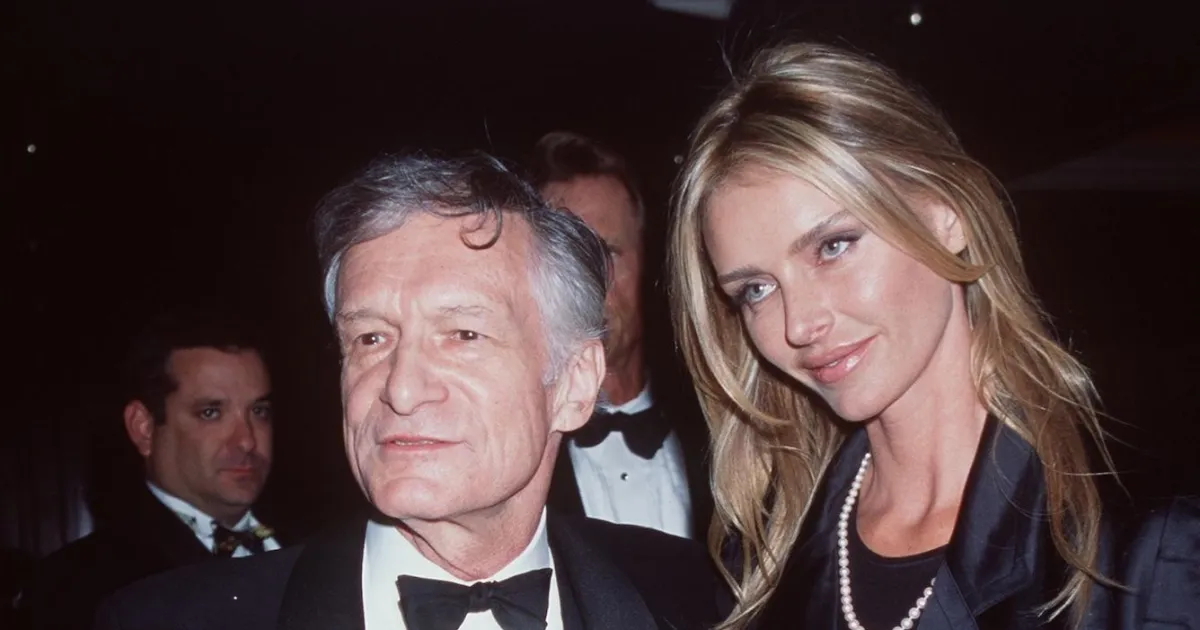
For decades, Hugh Hefner occupied a strange and contradictory place in American culture: a man who built an empire on fantasy, sex, and rebellion against convention, yet also a figure whose legacy has been reexamined in the harsh light of contemporary accountability. Now, as Hollywood prepares to revisit that world in an upcoming film called Playmates, the women closest to him are beginning to speak, and their voices are not in harmony. Kimberley Conrad, Hefner’s second wife and the mother of two of his sons, has stepped forward with a deeply personal and loving tribute to the late Playboy founder, offering a counterpoint to the criticism surrounding the project. In an Instagram post on Saturday, October 10, Conrad, now 64, addressed the controversy directly by sharing her own intimate history. “I was married to Hef for over 21 years,” she wrote. “We shared a lifetime of beautiful memories, raised 2 wonderful sons together, and had a deeply loving bond that remained strong until his passing on September 27th, 2017 and continues with me to this day.” Her words are deliberate, tender, and strikingly at odds with the accusations that have emerged from other women in Hefner’s orbit.
Conrad’s tribute went beyond the abstract. She painted a portrait of a man she insists was misunderstood by the public. Married to Hefner from 1989 until their separation in 1998 and final divorce in 2010, she said their bond never truly dissolved, especially because they shared Marston, now 36, and Cooper, now 35. She described Hefner as a true gentleman in the fullest sense. “I often told him if you look up the word gentleman in the dictionary you would find his name and photograph,” she recalled. “Hef was in every sense of the word, a true gentleman, kind, loving, generous, philanthropic, and a man of extraordinary character.” Her grief is still present. “Losing Hef was devastating, and his absence is still deeply felt,” she admitted. “I had the privilege of knowing and loving the man behind the public image, and I will always treasure the life and memories we shared. I will always believe the world was a better place because he was in it. I am forever grateful and blessed.” In a moment when Hefner’s legacy is being questioned, Conrad’s words are not just a defense; they are an act of love from a woman who spent more than two decades beside him.
The catalyst for this emotional outpouring is Playmates, a semi-fictional film written and directed by Lorraine Nicholson, the daughter of legendary actor Jack Nicholson. The story centers on a 13-year-old girl, played by Indiana Elle, who forms an unlikely friendship with an aspiring Playmate, portrayed by Lily-Rose Depp, against the backdrop of the Playboy Mansion. Bill Pullman, best known for his role in Independence Day, has been cast as Hefner himself, while Jessica Biel, 44, will play a fictional former Playmate who becomes Hugh’s wife. The character is deliberately not based on any of Hefner’s three actual wives, a creative choice that may be intended to give the filmmakers latitude, but which has already stirred sharp reactions. Hefner’s marriages were a significant part of his story: his first wife was Mildred Williams, to whom he was married from 1949 to 1959; then came Conrad, his longest marriage; and finally Crystal Harris, who was with him from 2012 until his death in 2017. The film has yet to receive an official release date, but the casting and premise have ignited a cultural flashpoint about how the Playboy era should be remembered.
Crystal Harris, Hefner’s third wife, has made her position unmistakably clear. At 40, Harris is no longer willing to remain silent about her time at the Mansion, and she has personally appealed to Biel to reconsider her role in the project. In an open letter posted on Thursday, October 8, Harris warned that the film risks sanitizing a world she experienced as deeply harmful. “I was actually his wife, and I experienced sexual, emotional, financial and physical abuse in this relationship,” she wrote. She went further, pointing to the broader pattern of allegations that have haunted Hefner’s legacy: “Many other women have come forward with allegations of rape, coercion, drugging and exploitation” at the Playboy Mansion, including what she called “deeply troubling concerns” that allegedly involve “minors.” Her plea was not just for herself but for all the women who carried these experiences in silence. “I hope everyone involved in this film takes the time to listen to the women who lived it before helping Hollywood turn it back into nostalgia,” Harris added. Her words carry the weight of lived experience, and they are impossible to dismiss.
Harris’s public statement is not new territory for her. In her 2024 memoir, Only Say Good Things: Surviving Playboy and Finding Myself, she detailed her years at the Mansion in unflinching terms, describing the environment as “emotionally abusive and traumatizing.” The age difference between her and Hefner is stark and often cited: she was 26 and he was 86 when they married in 2012, a union that lasted until his death five years later. Her account of that period stands in stark contrast to the glamorous image projected by the Playboy brand. But Harris is not the only voice from that world, and the chorus is not unified. Holly Madison, who became famous as one of Hefner’s three girlfriends on the reality series The Girls Next Door, alongside Kendra Wilkinson and Bridget Marquardt, offered a completely different reaction when asked about the film by TMZ. Madison, now 46, said simply, “I can’t wait to see it.” Her enthusiasm suggests that for some women, the Playboy Mansion represents not trauma but opportunity, adventure, and even liberation. The divide between Harris and Madison is not just personal; it illustrates the deep cultural rift in how the Playboy era is understood, a rift that no single film can easily bridge.
What emerges from these competing narratives is a complicated human story, one that resists easy moralizing. Kimberley Conrad remembers a gentleman; Crystal Harris remembers an abuser; Holly Madison remembers something worth waiting to see. All of them were there. All of them were married to or intimately involved with the same powerful man. The truth, as ever, may be multiple truths, each valid in the person who lived it. As Playmates moves through production, the challenge will be whether its creators can honor that complexity rather than flattening it into a nostalgic fantasy or a one-dimensional villain. The debate over Hefner is ultimately a debate about how we hold the flaws and virtues of a person together in the same frame, and how we listen to women without imposing our own conclusions. At its best, the film might offer an opportunity for that listening. At its worst, it could re-traumatize the very people it claims to portray. For now, the women have spoken, and their words are raw, heartfelt, and irreconcilable. For anyone who has been sexually assaulted, the National Sexual Assault Hotline is available at 1-800-656-HOPE (4673), a reminder that behind every scandal, every casting decision, and every nostalgic memory, there are real lives still healing.