


Amid an Iranian-backed multi-front war against the Jewish state, and beneath the headlines of destruction and loss, there is a quieter story unfolding on the battlefields of the Middle East—a story about the stubborn, almost sacred effort to bring wounded soldiers home alive. It is rooted in the darkest day in Israel’s history, October 7, 2023, when Hamas, a U.S.-designated terrorist organization, invaded southern Israel, murdering more than 1,200 people—including over forty Americans—and taking 251 others hostage. In the shock and grief that followed, Israel launched a large ground offensive in Gaza, and the Israel Defense Forces were suddenly pulled into a new kind of warfare: urban, brutal, fought among tunnels, rubble, and civilians, and complicated by threats on multiple fronts. But amid the chaos, a medical revolution was taking place. According to a senior IDF medical specialist who spoke with Fox News Digital, the pressures of this war forced the military’s medical corps to transform how it saves lives at the front. An IDF spokesman described the changes simply: “The IDF Medical Corps adapted its operational capabilities during the war, including casualty evacuation, innovative medical technologies and providing treatment under fire in a challenging terrain.” The result is not just a list of new procedures, but a philosophy of care that begins at the exact moment of injury—with soldiers themselves, then medics, doctors embedded in companies, and evacuation teams waiting to move in an instant. To understand what this means, one must look at the seconds and minutes immediately after a soldier falls. In the new reality of war, those moments are being remade in ways that will likely echo across militaries for decades.
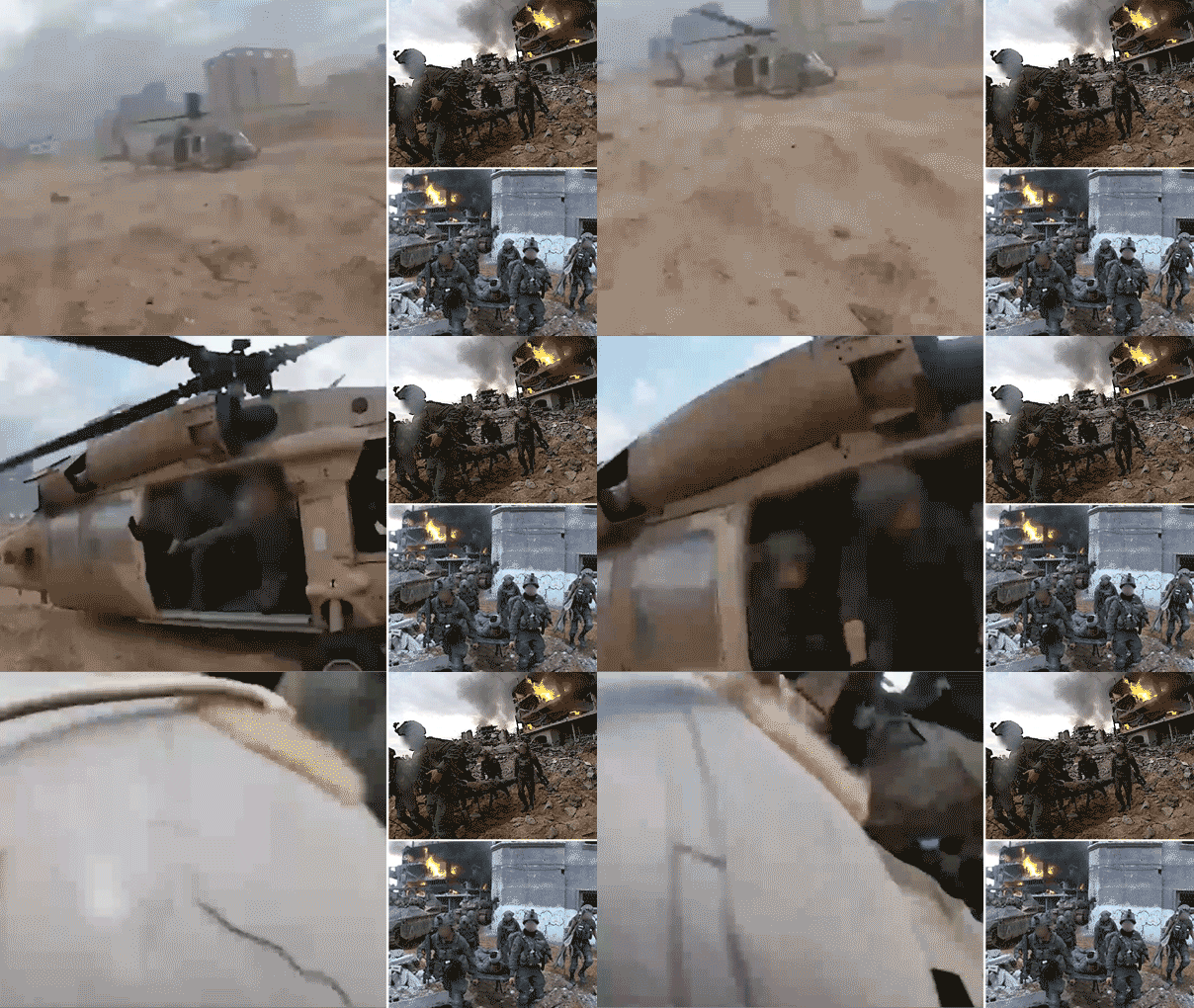
Consider the first critical metric: time. In the 2006 war with Hezbollah, the IDF medical specialist explained, advanced life support took fifteen to twenty minutes to reach a casualty. Now, he said, advanced life support can reach a wounded soldier immediately, or within four minutes. That transformation is not accidental. The IDF placed medical personnel directly on the battlefield, including a doctor assigned to every company. These embedded physicians are not waiting at a rear command post; they are moving with troops, exposed to the same dangers, making critical decisions in the middle of firefights. This close presence matters more than almost anything else in trauma care. A doctor who can assess a blast injury, control bleeding, and decide whether to evacuate within seconds changes the entire trajectory of survival. Alongside this, helicopters are used to lift the most seriously wounded from the battlefield to major medical facilities. Video footage supplied to Fox News Digital shows the intensity of these missions: soldiers, medics, and flight crews working together against a ticking clock Secure a? Actually “against a ticking clock.” The goal is rapid evacuation to hospitals inside Israel, where advanced surgical teams are waiting. As the specialist said, “We can evacuate casualties to Israeli hospitals rapidly.” This is not merely a logistical triumph; it is a human one. Every minute saved is someone who will see their family again. In earlier conflicts, a severely wounded soldier might have bled out waiting for help to arrive. Now the help is already there. And when a wound is beyond what a forward medic can manage, the helicopter becomes an ambulance in the sky, cutting through the noise of war to place a soldier into the hands of trauma surgeons before the body can surrender. The speed is no accident. It is the product of years of study, practice, and a military culture that regards medical care as a core combat capability rather than an afterthought.
The next transformation lies in what travels with those medics and doctors—and in a substance that has quietly become the most precious cargo on the battlefield. Since 2013, the IDF has placed strong emphasis on the use of blood products to stop bleeding. But the war in Gaza pushed this approach further than ever before. According to the IDF medical specialist, Israel is the first medical organization to use plasma at the point of injury instead of the traditional salt-and-water intravenous fluids. The logic is simple and profound: when a soldier suffers catastrophic hemorrhaging, the body is losing the very elements needed to keep blood liquid and clot wounds. Salt water can replace lost volume, but it cannot replace the ability to clot. Plasma, on the other hand, helps the blood do what it was designed to do—clot, seal, and heal. The IDF put this knowledge into practice in a strikingly direct way. Medics and first responders carried coolers of blood products on their backs, not in distant ambulances, so that transfusions could begin in the dirt, dust, and smoke of the battlefield. This method, the specialist said, “saved significant numbers” of injured soldiers. One can picture the scene: a young medic crouching over a wounded comrade, the hum of drones overhead, the chaos of battle around them, and a small cooler opened between them—not holding water or bandages, but the living gift of plasma. It is a powerful image of modern medicine: advanced trauma care delivered in the simplest, most portable way, right where the injury occurs. The decision to use plasma early does more than stabilize a patient; it changes the entire course of treatment. Soldiers who would have reached hospitals in profound shock now arrive with a fighting chance. This approach, combined with rapid surgical intervention and modern burn treatments, underpins the IDF’s remarkable survival statistics, and it offers the wider world a vital lesson: in trauma care, the first minutes after injury can matter more than what happens in the operating room hours later.
Perhaps the most quietly revolutionary innovation, though, is not a drug or a device—it is the flow of information. The IDF has developed what the medical specialist described as an “advanced system of learning and the collection of data that transmits the data over technical networks so that every provider can see patient data.” In plain terms, every relevant medical officer in the chain of care can access a wounded soldier’s real-time data—vitals, injuries, treatments given, responses, and timeline—at any moment. The specialist said, “Every relevant medical officer on the chain can see the patient data. This system had very good results.” Imagine the difference this makes. A soldier is wounded in Gaza; the moment a medic begins care, the details are transmitted to a battalion commander, to a trauma surgeon in an Israeli hospital, and to the general overseeing the mission. Everyone sees the same picture. There is no waiting for a radio report, no misunderstanding in a rushed handoff, no fumbling for a paper chart. The hospital team knows what is coming before the helicopter lifts off. They can prepare an operating room, summon specialists, and anticipate complications. This data-driven strategy is paired with a system of continuous learning, so that lessons from every casualty are studied and absorbed almost in real time. It is a feedback loop that makes the military smarter every day it fights. The specialist noted that the case mortality rate is the most reliable way to measure the quality of care. The numbers are striking: during the 2006 war with Hezbollah, the mortality rate among casualties was 15 percent. In the current war, that figure has fallen to 7.1 percent. That is more than a statistic. It represents a dramatic increase in the chance of survival for a wounded soldier. An Israeli soldier injured today is more than twice as likely to live as a soldier injured in a similar way fewer than twenty years ago. Behind that number is a system built on speed, blood, and information—and a culture that refuses to accept death when it can be prevented.
These advances did not emerge from thin air. The IDF medical specialist credits, in part, a landmark 2012 American study, “Death on the Battlefield (2001–2011): Implications for the Future of Combat Casualty Care,” which examined how American medics saved lives during the wars in Iraq and Afghanistan. Israel studied those lessons carefully and then built on them. Now the relationship has come full circle. The U.S. Army has taken a deep interest in what the IDF learned in Gaza. According to a 78-page U.S. military report dated April 2026, titled “Israeli Defense Force Medical Lessons Learned,” American military authors urge their own forces to absorb Israel’s experience from the Swords of Iron War. The report praises the IDF’s proactive public health measures—including robust bio-surveillance, forward-positioned preventive medicine teams, and stringent food safety protocols—as key to maintaining operational readiness during a prolonged conflict. But perhaps the report’s most urgent warning is this: “Despite Israel’s preparations, it had to undergo a painful process of transformation in contact that the U.S. now has the opportunity to avoid. The time for preparation is now. Simply possessing clinical and tactical skills is insufficient.” This is a rare and remarkable acknowledgment from one of the world’s most advanced militaries to another. It signals that Israel’s battlefield medical innovations are not merely experiments; they are essential knowledge for the next generation of warfare. An IDF spokesman told Fox News Digital that the U.S. Army’s study of Israel’s emergency health care providers during the wars was a joint collaboration, and that American officers came to learn directly from the IDF. That partnership is a powerful reminder that, even in an era of global division, the shared commitment to saving lives can bring allies closer together. The lessons are not only about what to do, but about how to think—about readiness, improvisation, and the moral conviction that every wounded soldier deserves every possible chance.
For all the technology and data, the true story of these advances is human. Dr. Marc Siegel, senior medical analyst for Fox News and a practicing internist at NYU Langone Medical Center, emphasized that the ripple effects extend far beyond Israel. “Battlefield advances based on the latest technologies that have been developed in Israel, including surgical techniques as well as the latest burn treatment Nexobrid, help not just today’s wounded but fuel medical and surgical advances around the world,” he told Fox News Digital. Siegel’s latest book, “The Angels Among Us: How God’s Messengers Play a Role in Healing,” includes a chapter about a medical rescue during the Gaza war—a story that brings together skill, courage, and a moment of unexpected grace. What emerges from these accounts is a deeply human picture of war. Every number, every percentage point, every minute cut from the response time represents a person who gets to come home. The doctor crouched in the dirt with a cooler of plasma is not just a soldier; she or he is a guardian. The pilot flying a helicopter through dangerous skies is not just a driver; she or he is an angel in a steel shell. The data transmitted through networks is not just information; it is a plea from one human being to another: do not let me die. In a region marked by conflict, the determination to preserve life has become its own powerful narrative. It is not about politics or borders, but about the sacred moments just before a heartbeat disappears, when the decisions made by a medic, a doctor, and a data system determine whether a family will mourn or celebrate. The IDF’s dramatic drop in mortality—from 15 percent to 7.1 percent—is proof of what is possible when human imagination is aimed at healing even in the midst of war. And as the U.S. military learns from Israel’s experiences, those lessons will continue to echo, saving lives on battlefields far from Gaza, and in hospitals treating trauma all over the world. In the end, the advancement of battlefield medicine is a reminder that even in the darkest of times, the human spirit still clings fiercely to the light—and to one another.