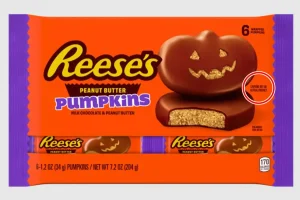



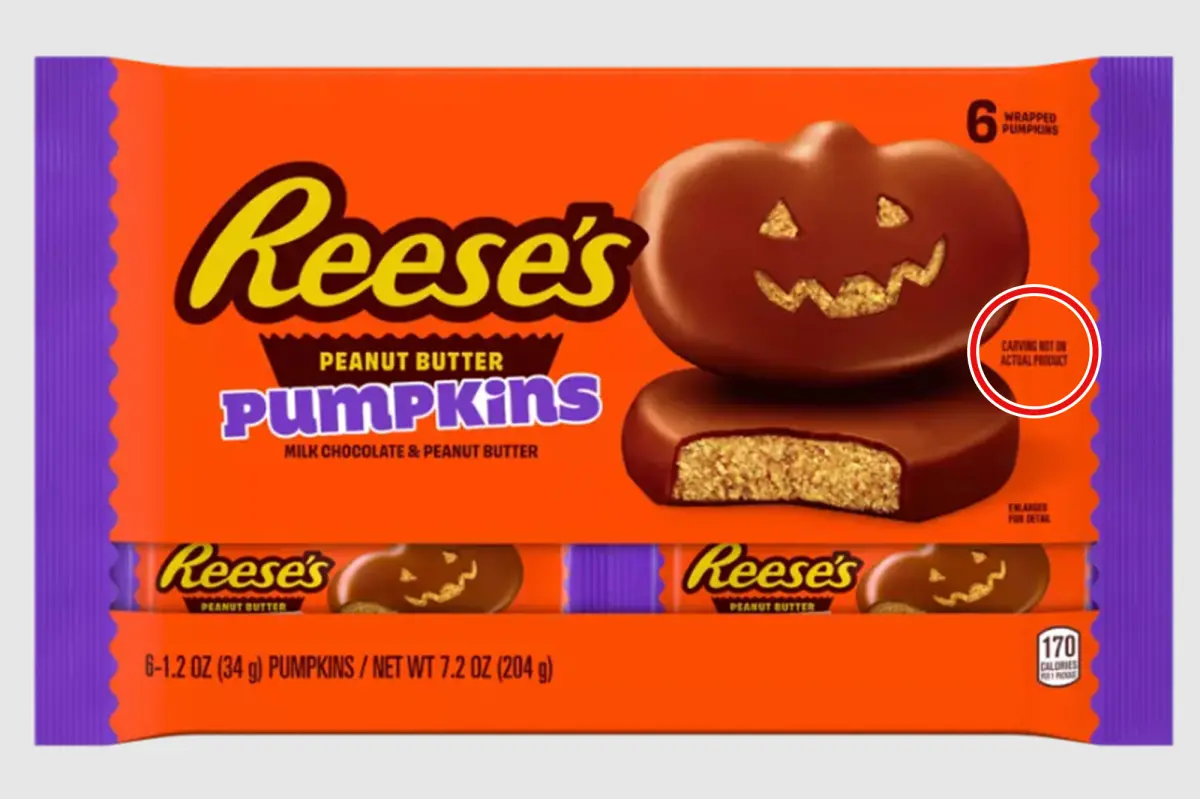
Picture this: it’s late September, and you’re wandering down the seasonal aisle at your local grocery store. The Halloween candy has arrived, and there, bright orange and cheerfully wrapped, sit the Reese’s Peanut Butter Pumpkins. The package shows a perfect little pumpkin, with cute jack-o’-lantern eyes and a toothy grin carved right into the chocolate-peanut butter surface. It looks festive, playful, almost too good to eat. But then you open the wrapper,and you find a solid, smooth pumpkin shape, no carved face at all. If you’ve ever felta flicker of disappointment at that moment, you’re not alone. Two Florida consumers felt strongly enough about it to file a lawsuit, and while they ultimately lost in court, their complaint has left a permanent mark on the packaging. The Hershey Co. has quietly added a new disclaimer to its Reese’s Peanut Butter Pumpkins: “Carving not on actual product,” printed in small text next to the image of the carved pumpkin. The words now appear on both the front and back of the package, a tiny but telling acknowledgment that what you see on the wrapper isn’t exactly what you get inside.
For years, the packaging had contained a much softer caveat: “Decorating Suggestion.” That phrase, according to court documents, was meant to indicate that the carved face was an optional, DIY embellishment — something you could add yourself if you had the time, the knife, and the steady hand. In other words, the pumpkin in the picture wasn’t lying; it was just showing off a craft project. But to some consumers, that distinction was lost. The image of the smiling, carved pumpkin felt like a promise, not a suggestion. After all, people don’t typically buy Halloween candy expecting to perform surgery on it before serving. The difference between “decorating suggestion” and“not on actual product” might seem subtle, but it speaks to a much bigger conversation about food marketing, consumer expectations, and the legal line between puffery and deception. Hershey’s decision to update the language, even after winning the case, suggests the company recognized that a clearer message on the wrapper might be worth more than a courtroom victory.
The lawsuit itself began with two Florida men, Nathan Vidal and Eduardo Granados, who said they bought the peanut butter pumpkins specifically for the “novelty” of those “cool and beautiful carved-out designs.” They weren’t claiming the candy tasted bad or was unsafe; their issue was with the missing artistry. They argued that the packages misled them into paying more—up to 25% more, they estimated—for a product whose appearance fell far short of the advertised image. Their proposed class-action lawsuit sought to represent a broader group of consumers who felt similarly cheated by the gap between the picture and the reality. It’s an argument that likely resonates with anyone who has ever felt that familiar sink when fast food doesn’t look like the commercial, or when a toy looks magnificent in the catalog but flimsy in real life. We live in a world saturated with idealized images, and sometimes it’s hard to tell where enhancement ends and honest depiction begins. The plaintiffs believed Hershey had crossed that line, translating a whimsical Halloween image into real economic harm for candy buyers who expected a little more magic in their seasonal treat.
But the courts saw things differently. US District Judge Melissa Damian in Miami dismissed the proposed class action, ruling that Vidal and Granados lacked legal standing to claim they overpaid for the candy. The judge’s reasoning was straightforward: accepting the plaintiffs’ allegations as true, their only injury was “subjective disappointment.” The pumpkins they purchased were not defective, worthless, or even inherently misleading in a legal sense; they still delivered exactly what a Reese’s product is supposed to deliver—a tasty, recognizable peanut butter and chocolate treat. The absence of a carved face didn’t strip the candy of its economic value, and the judge rejected the argument that consumers had paid a premium for decorations that were never really part of the product. Damian also noted that Hershey had described the pictured carvings as a “decorating suggestion” in court filings, reinforcing the idea that the images were illustrative ideas, not contractual promises. This wasn’t the first time such a case had come before her, either. She had dismissed an earlier version of the lawsuit the previous September, giving the plaintiffs a chance to refine their arguments. But the refined version still couldn’t clear the legal bar. In the eyes of the law, there’s a big difference between a product failing to meet subjective expectations and a product actually causing measurable financial harm. Disappointment, however genuine, isn’t always something the courts can remedy.
The plaintiffs’ attorney, James Kelly, made no secret of his displeasure with the outcome. He said his clients were disappointed with the ruling and planned to appeal. In a statement that captured the broader stakes, Kelly declared:“Consumers in Florida deserve to get what they pay for, and it is troubling to see them left without protection.” His words hint at a deeper anxiety: that if companies can get away with packaging that overpromises, then consumers are left to navigate a marketplace where “buyer beware” becomes the unofficial motto. Yet the appeal faces an uphill climb. Legal standing requires more than a feeling of being misled; it requires showing a concrete, particularized injury—typically, a financial loss that can be quantified and linked directly to the deceptive practice. A subjective sense of letdown, no matter how understandable, rarely suffices. Still, Kelly’s frustration reflects a growing cultural impatience with fine print and tiny disclaimers. Many consumers feel that corporations should simply do better, rather than hide behind legal technicalities. Whether you agree with the judge’s decision or the plaintiffs’ outrage, the case reveals a fundamental tension: the law often moves slower than marketing, and what feels like common sense to a shopper doesn’t always translate into a winning legal argument.
In the end, the most practical outcome of this legal battle may be the small but meaningful change on the package itself. Instead of relying on the ambiguous phrase “Decorating Suggestion,” Hershey has chosen to tell consumers, in plain terms, that the carving isn’t on the actual product. It’s a blunt but honest disclaimer—perhaps not the stuff of advertising awards, but certainly a step toward clearer communication. Hershey, for its part, has moved on, rolling out more than twenty Halloween-themed products ahead of the holiday, including its familiar lineup of peanut butter pumpkins, bats, skeletons, and other seasonal shapes. For shoppers, this entire episode serves as a reminder that packaging images are often aspirational. The glossy photos are styled by professionals, sometimes using glue, acrylic paint, and other tricks to make food look irresistible. That doesn’t mean companies are villains; it just means the average consumer has to keep one eye on the fine print. And for Reese’s fans, the next time you unwrap a pumpkin with no face, you’ll at least know the carving was never part of the deal. The candy will still taste the same, the nostalgia will still be there, and maybe—just maybe—the tiny disclaimer can even inspire you to grab a knife and carve your own little jack-o’-lantern, turning a small disappointment into a fun Halloween tradition. After all, sometimes the real magic isn’t in the packaging; it’s in what you make of it yourself.