
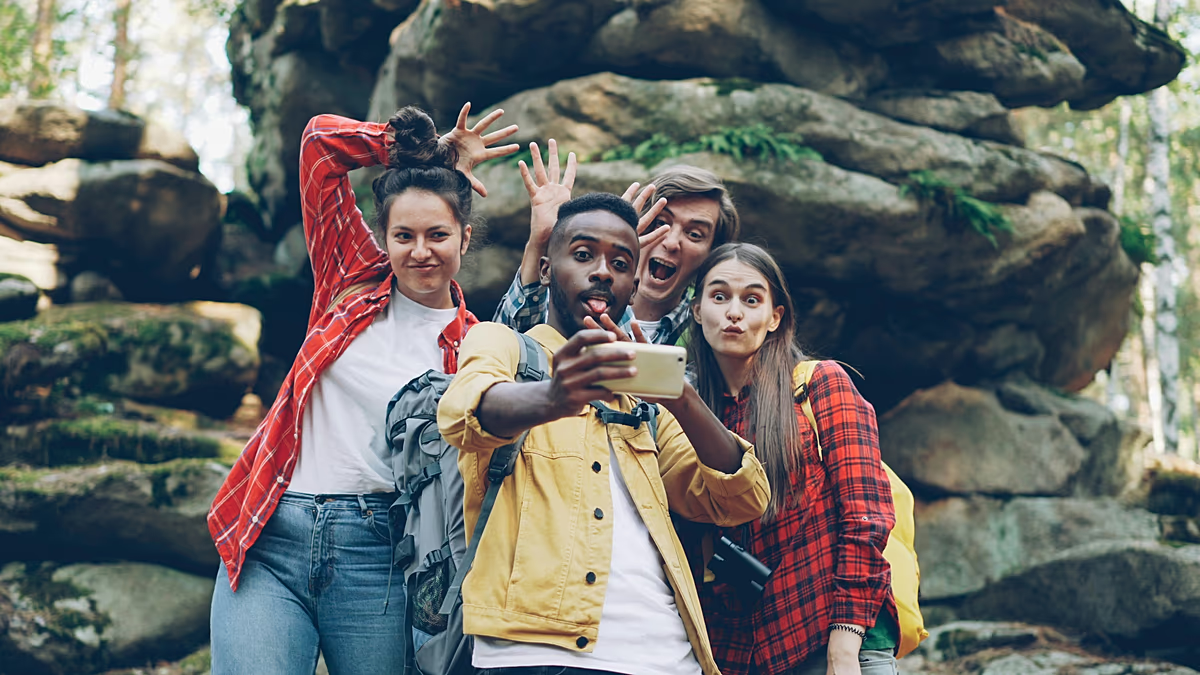


It begins quietly: you are lying on the sofa, half-watching a vlogger’s “48 hours in Lisbon” video, and by the end of it you have already checked flight prices. That is the modern ritual of travel inspiration. Social media has become a strange, shimmering window through which we glimpse distant places, and that window is now influencing not just where we dream about going, but where we actually go. A recent study by the online travel agency Opodo surveyed 9,000 travelers from the United Kingdom, the United States, Portugal, Spain, Italy, Germany, and France to understand exactly how much digital content shapes real-life journeys. The results are fascinating, especially for anyone who has ever felt that magnetic pull of a perfectly framed sunset on Instagram. Among all nationalities, Portuguese travelers stand out as the most enthusiastic sharers of their personal travel moments. Fifty percent say they upload selfies and personal photos from their trips, a habit that places them comfortably ahead of Spanish travelers in second place at 40%, Italians at 35%, Germans at 30%, and the French at 22%. What emerges from these numbers is a clear sense that for many people, travel is not just about being somewhere; it is also about showing others that you were there, and perhaps even proving to yourself that the experience mattered.
Yet the study goes far beyond selfies. It also reveals how deeply social media has woven itself into the decision-making process, particularly for younger generations. When respondents were asked whether social media had ever inspired them to visit a destination they had never previously considered, the answer was a resounding yes for many. Among travelers aged 25 to 35, 52% said that online content influences their holiday choices—a striking jump from 32% in a similar survey conducted just a year earlier. Even more telling, 59% of Gen Z travelers said the same, suggesting that for the youngest adults, scrolling through invites to wander is a completely natural way to discover new places. On the other end of the spectrum, only 5% of respondents aged 65 and above get their travel inspiration from social media, a reminder that old habits and trusted sources like guidebooks and word of mouth still carry weight for some. Across countries, American travelers are the most likely to book a trip abroad after being influenced by what they see online, with 49% saying social media pushes them to venture overseas. They are closely followed by Spanish travelers at 48% and Italians at 44%. British travelers, on the other hand, appear to be the least moved by virtual wanderlust, with only 25% saying that social media influences their choices. As Pablo Caspers, Chief Travel Officer at eDreams ODIGEO, put it, “Social media has become a powerful window to the world, making travel discovery more accessible, visual, and personal than ever before.” His words capture the optimism of the trend: online platforms have opened doors to off-the-beaten-track wonders and allowed people to celebrate their journeys while inspiring others to do the same.
But there is another side to this digital travel story, one that raises questions about honesty and authenticity. Opodo asked travelers whether they would post a positive image of their travels on social media even if the trip itself had fallen flat. Once again, Portuguese travelers topped the list, with 54% saying they would maintain a cheerful online presence no matter how disappointing the reality was. American travelers followed at 46%, and Spaniards came next at 36%. This might sound like pretending, but it is also understandable. A vacation is often a long-awaited escape, and when it does not live up to expectations, some people still want to capture the few beautiful moments and share them with friends and family. It is a way of holding on to the joy rather than dwelling on flat hotel pillows or rainy afternoons. Meanwhile, British travelers came across as the most grounded, with 27% saying they would be “very unlikely” to post positively about a trip they did not enjoy. German travelers were also notably honest, with only 23% saying they would put a positive spin on a disappointing experience. These differences reveal something important about how national cultures interact with social media. For some, the travel feed is a highlight reel, a curated scrapbook where only golden hours exist. For others, authenticity matters more than likes, and they refuse to pretend that a bad time was actually wonderful. In a world where everyone is curating their lives, the line between fact and digital fiction has become delicate, and travel is one of the main places where that line is being tested.
What exactly are European travelers posting while they are away? The answer, according to the study, depends on what they love most. When it comes to food, the Portuguese are clearly a nation of hungry foodies: 66% say they share pictures of their meals online. Spanish travelers are close behind at 57%, followed by Germans at 51%. There is something deeply human about photographing a beautifully plated dish before eating it, and these stats suggest that a meal abroad is no longer just a meal; it is a memory to be framed and shared. Accommodation is another favorite subject, and here German travelers lead the way, with 51% posting photos of their hotels and rented apartments. The Portuguese are not far behind at 41%, while French and Spanish travelers both share their stays at 38%. Landscapes and landmarks, however, remain the most universal subject matter. Eighty-eight percent of Portuguese travelers say they post scenery and famous sights, followed by 82% of Spanish travelers and 76% of both French and German travelers. The Portuguese also appear to be the most adventure-hungry travelers in the survey: 66% share their experiences and activities, from hiking trails to boat trips to dance classes. Spanish and German travelers both follow at 57%, with Italians rounding out the top three at 53%. When you piece all of this together, a portrait emerges of the modern traveler as a visual storyteller, moving through the world with a phone in hand, documenting not just the famous monuments but also the food, the bed, the view, and the moment of thrill. The travel experience has become a kind of immersive content creation, where the act of sharing sometimes feels as important as the experience itself.
The study also suggests that social media is not something travelers leave behind when they finally reach their destination. In fact, it follows them onto the plane, into the hotel room, and all the way to the beach. Ninety percent of Portuguese travelers say they are mindful of what is being said on social media when it comes to travel, while Italians and Spaniards are close behind at 87%. French and German travelers both rank at 82%, showing that almost everyone is at least aware of the online conversation around travel. But checking social media regularly while on holiday is a slightly different matter. Here German and American travelers are the most likely to stay plugged in, with 34% of both groups checking their feeds while away. Portugal follows at 33%, Spain at 27%, and Italy at 20%, making Italians the travelers most likely to switch off from the internet while on vacation. There is a certain irony in this: the same people who document every meal and selfie might also be the ones who feel the least pressure to constantly check what others are doing. On the other hand, the habit of checking social media even during a trip suggests that many of us find it difficult to fully disconnect. The phone has become a security blanket, a window onto the lives of others, and a source of reassurance that the world is still ticking along while we are away. It blurs the boundary between being present and being elsewhere, and it raises a gentle challenge: can we enjoy the moment without worrying about how it looks online?
The influence of social media can even be felt before a trip is booked, in the earliest stages of daydreaming. According to Opodo, Portuguese travelers are the most likely to use social media to help them picture their holiday in advance, with 22% doing so. Italians follow at 20%, Germans at 19%, and Spanish and French travelers both at 17%. Beyond just picturing a destination, many travelers use social media as a tool for uncovering hidden gems and off-the-beaten-track locations. Here again, the Portuguese lead the way at 42%, with Spanish travelers close behind at 40%. Italians rank third at 36%, followed by the French at 30% and Germans at 26%. This is perhaps one of the most positive effects of social media on travel: it allows curious travelers to move beyond traditional tourist traps and find places that feel personal, undiscovered, and full of character. Instead of relying solely on glossy brochures or paid advertisements, travelers can turn to real people sharing real experiences, whether it is a tiny family-run restaurant in a quiet alley or a viewpoint that few guidebooks mention. In that sense, social media has democratized travel inspiration. It has given everyone a voice and made the world feel smaller and more accessible. But it has also introduced a new layer of performance to travel, a subtle pressure to show the best version of every journey. The study does not tell us whether this pressure is good or bad, only that it is widespread and growing. Perhaps the healthiest way to travel in the age of the feed is to hold social media at arm’s length: use it for ideas, share the moments that matter, but always remember that the real trip happens between the posts, in the unfiltered, imperfect, beautifully human moments that no camera can fully capture.