

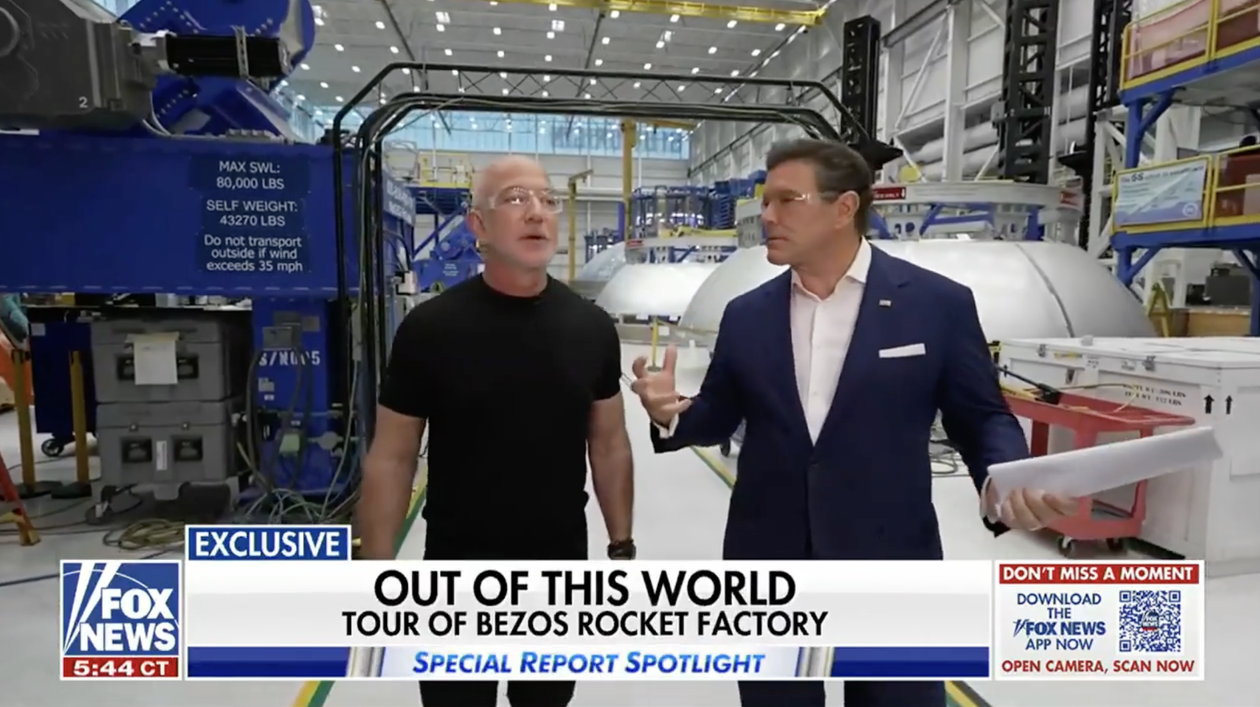
The fluorescent lights of a rocket factory may seem like an odd place for a conversation about the soul of capitalism, but that is exactly where Jeff Bezos chose to make his stand. Sitting on the factory floor at Blue Origin’s Cape Canaveral facility, with the physical machinery of humanity’s next chapter literally surrounding him, Bezos gave Fox News’ Bret Baier an interview that was less about rockets and more about the moral value of ambition. His central message arrived in a single, defiant sentence: “Success is not villainy.” In an age when billionaires are routinely caricatured as greedy overlords, and when the word “wealth” is often spoken with suspicion rather than admiration, Bezos wanted to reset the terms of the argument. He wasn’t apologizing for his fortune. He wasn’t hedging. He was making a case that building something enormous, creating jobs, and changing the world should not be treated as a crime. There is a human layer here, too. Bezos was once a guy starting an online bookstore in a garage, and now he stands among the most powerful people on Earth. His journey from Seattle to Miami, from Amazon CEO to space entrepreneur, has made him a symbol of what free enterprise can produce. But his interview reminded us that symbols are still people. And people want to feel that their life’s work means something. The setting mattered: not a sterile studio, but a place where engineers and technicians were busy assembling the future. It was, in a way, a living metaphor for everything Bezos has spent his career arguing for—that progress is not accidental, it is built, and that building it should be a source of pride, not shame.
Bezos reached for an unexpectedly humble example to illustrate his point: chicken fingers. “There’s nothing wrong with making unbelievably good chicken that people love,” he said, referring to the success of Raising Cane’s and the entrepreneur behind it. Why this example? Because food is something everyone understands. When a restaurant makes chicken perfectly, when the seasoning is right, the fries are crisp, and the service is warm, people keep coming back. They pay their money willingly, often gratefully. The owner gets richer, yes, but not by tricking anyone. He gets richer because he solved a problem and created a small moment of joy. Bezos’s argument is that wealth earned this way is not theft; it is gratitude converted into dollars. The same logic applies to Amazon. When Bezos and his team made shopping effortless, when they built delivery networks that turned “I need it now” into “it’s already here,” they did something people wanted. No one was forced at gunpoint to buy from Amazon. Millions of customers chose it, every single day, because it was better. And yet, in the public conversation, success like that is often framed as a kind of moral failure. The implication is that profit is dirty, that scale is suspect, and that anyone who accumulates billions must have somehow exploited someone along the way. Bezos rejects that worldview entirely. He sees the free market as a conversation between producers and consumers, and he sees wealth as a signal that someone made that conversation work. The chicken example is powerful because it strips away the abstraction. We have all had a meal so good that we told our friends about it. We have all felt that small thrill of finding exactly what we wanted. That experience, multiplied billions of times, is what builds empires. Calling that villainy, Bezos suggests, is not just unfair—it is a fundamental misunderstanding of how human progress actually happens.
No conversation about Bezos can ignore his deep and complicated relationship with Seattle. For more than three decades, Amazon transformed the Pacific Northwest in ways both breathtaking and disruptive. The company now employs roughly 50,000 corporate and tech workers in the Puget Sound region, split between its headquarters in Seattle and its expanding campus in Bellevue. Those jobs brought talent, tax revenue, and a renewed skyline to the city. They also brought rising housing costs, traffic congestion, and a fierce cultural debate about inequality. Bezos himself stepped down as Amazon’s CEO in 2021 and relocated to Miami in 2023, a move that some read as a farewell and others as a sign of frustration with the political climate in Washington state. But his interview suggests he hasn’t left the fight behind. When he says “success is not villainy,” he is speaking, at least in part, to the region that watched him change. Seattle’s story is America’s story writ small: a place where an outsider arrived with an idea, built something enormous, and then found himself both celebrated and resented for it. The resentment is human. When your landlord raises your rent, it is hard to feel affection for the company that made your neighborhood desirable. But Bezos’s point is that the entire ecosystem grew because of the risk and work of entrepreneurs. He did not force employers to offer higher salaries. He did not force families to move to the area for opportunity. He built a platform that created demand, and the demand attracted people, and the people changed everything. To vilify Bezos for that misses the deeper truth: the world is not a zero-sum game. His success did not steal from Seattle; it poured energy into it. The city’s struggles with affordability and homelessness are real, and they demand real solutions. But Bezos insists that scapegoating the people who create wealth is not a solution. It is a way of avoiding the much harder work of governance.
That anger at scapegoating becomes especially relevant in Washington state, where voters are preparing to decide on Initiative 645. The measure aims to repeal the state’s recently enacted tax on high earners and to prohibit future income taxes. It is a battle over the soul of tax policy, and Bezos has stepped directly into it. He was joined by other prominent business voices, including former Starbucks CEO Howard Schultz, in arguing that punishing wealthy entrepreneurs will only succeed in driving them elsewhere. The nuance, though, is important. Bezos did not say that all taxes are evil or that the rich should not pay their fair share. He acknowledged that affordability and social challenges are genuine. What he rejected is the lazy political habit of picking villains and pointing fingers. “If there’s a politician who’s picking villains and pointing fingers, that probably means they don’t have a solution,” he said. It is a devastating line, because it flips the usual script. Politicians often present themselves as protectors of the people against the powerful. Bezos suggests that when a politician needs a villain, it is often because they have failed to find an answer. They distract from their own inadequacy by manufacturing outrage. Bezos then added a particularly personal insight: inside his companies, a leader who blamed others would not survive for long. The standard is simple. You do not get to be the boss if your answer to every problem is someone else’s fault. You have to own the outcome. You have to fix the machine. That is what he wants from politicians, too. Instead of taxing the successful into submission, why not study what makes success possible and try to replicate it? Instead of driving entrepreneurs away, why not ask them to help solve the problems their success created? The interview was not a defense of greed. It was a call for responsibility—from both business leaders and the people who govern them.
But the conversation was not limited to tax policy or even chicken fingers. Bezos has always thought in terms of decades, not election cycles, and he used the interview to sketch a larger vision. He spoke about the impact of artificial intelligence on jobs, a topic that terrifies millions of working Americans. His outlook was neither dismissive nor fatalistic. AI will change how we work, just as electricity and the internet did. Some jobs will disappear. New ones will emerge. The challenge, he suggested, is not to resist the change but to prepare for it, to build an education system and a culture that can adapt. He also returned to his lifelong obsession: space. Bezos argued that the United States needs to beat China in the race to the moon, not out of Cold War nostalgia but because the future of the planet depends on industrial expansion beyond Earth. He envisions orbital data centers, clean energy beamed down from space, and heavy industry moved off Earth so that the precious and fragile environment of our home world can be preserved. This is not vanity. It is a coherent philosophy: if humanity wants to continue growing, we need more room, more resources, more opportunities. And the only way to get that is to push outward. The same entrepreneurial impulse that creates great restaurants and great online stores is the impulse that builds rockets. It is the impulse that says “not yet” instead of “impossible.” It is the impulse that refuses to view the future as a closed door. Bezos’s vision is grand, but it is anchored in his belief that human beings are not meant to be small. We are meant to build, explore, and serve one another through our curiosity and ambition. That is why the phrase “success is not villainy” matters beyond the stock market. It is a plea for a world that recognizes creation over destruction, abundance over envy, and hope over fear.
In the end, Bezos’s interview was less a political manifesto than a personal confession of faith—faith in markets, faith in builders, and faith in the possibility of tomorrow. It is easy to dismiss him because he is wealthy. It is easy to caricature him as a space cowboy or a corporate titan disconnected from ordinary life. But the deeper truth is that his story reflects something almost universally human: the desire to matter, to build something lasting, and to be appreciated for it. When he says there is nothing wrong with making unbelievably good chicken that people love, he is saying that every honest business, from a corner food truck to a global retailer, is an act of service. It is a way of telling the world, “I see what you need, and I have found a way to give it to you.” That should not be a scandal. It should be a cause for celebration. At a time when inequality and anxiety drive so much of our public discourse, Bezos offers a counter-narrative: instead of tearing down the successful, we should learn from them, and instead of punishing ambition, we should channel it. There are real problems in the world. There are workers who struggle, families who worry, and communities that feel left behind. But the answer to those problems is not to demonize the people who create wealth. The answer is to demand that wealth be used wisely, that opportunities be spread widely, and that the engines of innovation keep running. Bezos has already given the world Amazon. He is now trying to give it a future among the stars. Whether you agree with him or not, his words on that factory floor were a reminder that success, at its best, is a gift. And a gift is never villainy. It is generosity, multiplied by imagination, and offered freely to the world.