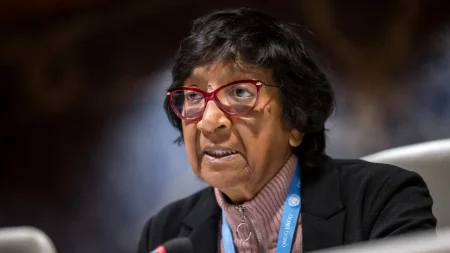



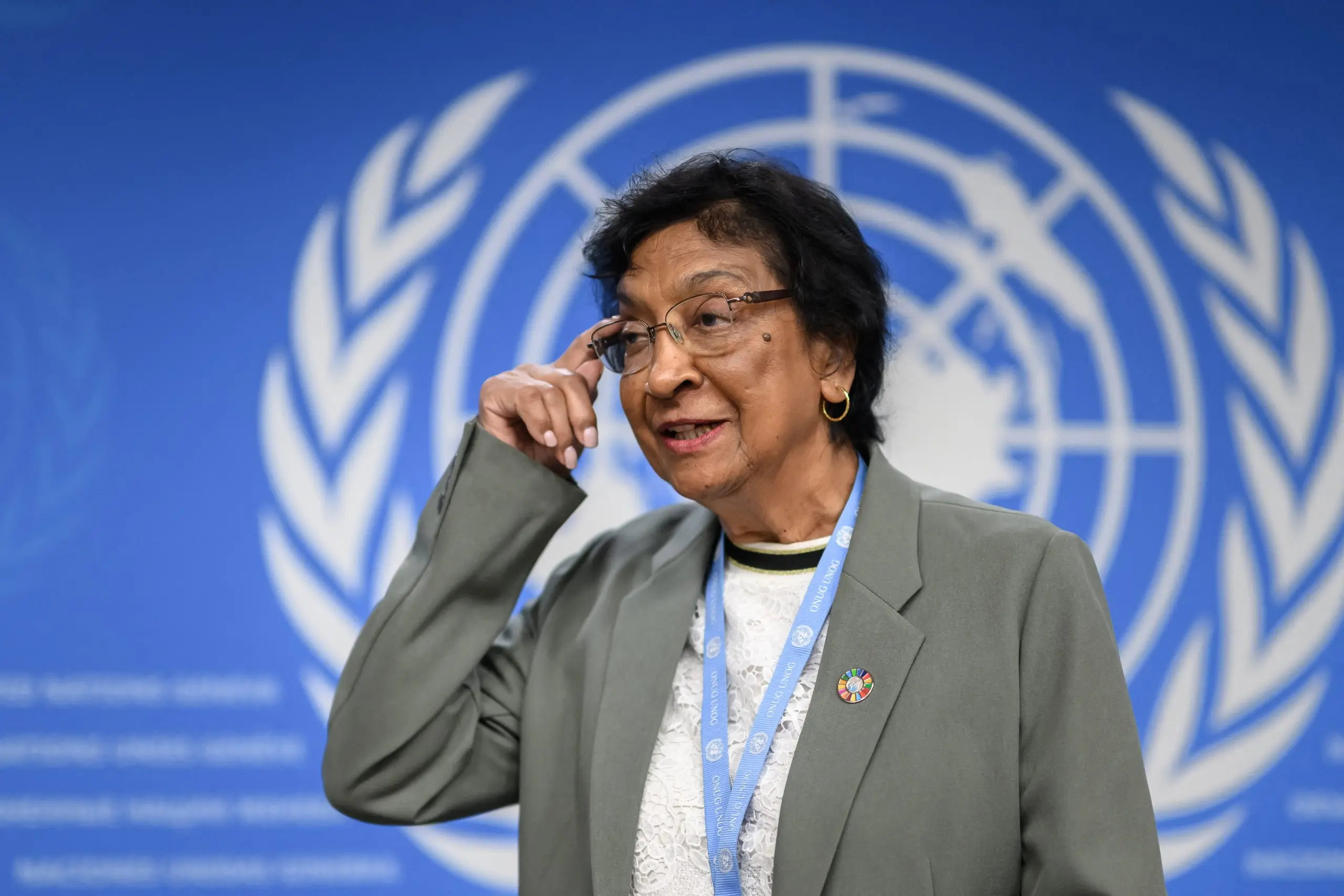
The announcement came without warning, a quiet Friday afternoon suddenly charged with the weight of a decision that would split the world. The Norwegian Nobel Committee had chosen Navi Pillay, the 85-year-old former U.N. human rights chief from South Africa, as the recipient of the 2026 Nobel Peace Prize—a lifetime of work in international law, from fighting apartheid to prosecuting war crimes, recognized at the highest level. But within hours, the phones of journalists began to ring with furious statements. Jewish advocacy groups and U.N. watchdogs were not merely disappointed; they were outraged. They spoke of a woman they believed had spent years perfecting the art of using human rights language to demonize Israel. The contrast was stark: one side saw a courageous jurist who had stood up for the oppressed, the other saw a biased investigator who had given legitimacy to antisemitism. The Nobel Committee’s citation praised her for holding perpetrators of genocide and crimes against humanity accountable. Her critics saw the very opposite—a woman who had, in their eyes, taken the side of those who sought to delegitimize the Jewish state. The mood was tense, and the questions were immediate: who really was Navi Pillay, and why did her award ignite such fury?
To understand the passion behind the praise, one must look at the extraordinary arc of her life. Born in Durban in 1941 to a family of Tamil descent, Pillay grew up under the brutal structures of apartheid. She was the first non-White woman to be appointed to South Africa’s High Court, a breakthrough that was not just a personal triumph but a symbol of resistance against an entire legal system designed to exclude people of color. She went on to serve as a judge at the International Criminal Tribunal for Rwanda and the International Criminal Court, witnessing some of the worst atrocities of the late 20th century and helping to build the framework of international justice. From 2008 to 2014, she served as the U.N. High Commissioner for Human Rights, where she spoke out fearlessly against abuses in countries across the globe. For her supporters, this is the core of who she is: a relentless advocate for the voiceless, someone who has risked her life and reputation to ensure that the powerful are held to account. They point to her decades of work in the most difficult arenas of human rights and argue that no one is more deserving of the Nobel Peace Prize. But her critics do not deny her biography; instead, they see it as a veil that hides a troubling double standard.
The most serious accusations against Pillay revolve around her role as chair of the U.N.’s Commission of Inquiry into the Israeli-Palestinian conflict. Appointed in July 2021, she was tasked with investigating alleged human rights violations in Israel and the Palestinian territories. But before she even took the chair, she had signed a June 2020 manifesto calling on governments to “Sanction Apartheid Israel” and a June 2021 letter urging President Joe Biden to punish Israel after its conflict with Hamas. To her critics, this was a clear conflict of interest; how could an investigator be impartial when she had already taken a position? Yet she accepted the role anyway. In September 2025, the commission concluded that Israel had committed genocide in Gaza—a finding that Israel and many Western nations rejected as politically motivated. Anne Bayefsky, president of Human Rights Voices and director of the Touro Institute on Human Rights, spoke bluntly to Fox News Digital, calling Pillay “an individual at the forefront of the international spread of the poisonous forms of antisemitism that beset the 21st century.” Bayefsky even went so far as to say that Pillay had “perfected the art of perverting legal and universal standards of human rights to demonize and delegitimize Jewish self-determination.” The award, she said, was “a testament to human wrongs,” not human rights.
The controversy deepened with a 2022 incident involving fellow commissioner Miloon Kothari, who suggested that social media criticism of the investigation was controlled by the “Jewish lobby” and questioned Israel’s U.N. membership. His remarks were condemned by U.S. officials, including then-State Department antisemitism envoy Deborah Lipstadt. But Pillay defended Kothari, arguing that his comments had been taken out of context. Kothari later apologized, but the damage was done. Critics saw Pillay’s defense as a clear indication that she was willing to tolerate and even protect anti-Jewish tropes when they came from allies in her inquiry. To make matters worse, in 2009, while serving as United Nations High Commissioner for Human Rights, she attended a U.N. anti-racism conference in Geneva where Iranian President Mahmoud Ahmadinejad delivered a vitriolic speech attacking Israel and questioning the Holocaust. While Western diplomats walked out in protest, Pillay remained seated. Though she later condemned the speech, her critics remember her stillness. Bayefsky, who was present at the time, claims Pillay had been given a copy of Ahmadinejad’s speech in advance and still handed him the microphone as conference secretary-general. The incident has become a touchstone for those who argue that Pillay has a long history of turning a blind eye to antisemitism while expending her energy on the world’s only Jewish state.
But for every critic, there is a defender who sees in Pillay a singularly courageous and independent voice. The Nobel Committee itself defended its choice, crediting Pillay with strengthening international law at a time when the institutions responsible for enforcing it face increasing political pressure. U.N. Secretary-General António Guterres issued a warm statement, congratulating her and praising her “decades-long career in international justice.” He specifically highlighted her leadership of the U.N. investigation into Israel, declaring that she had demonstrated “that the force of law must prevail over the law of force.” For these supporters, Pillay’s career is a testament to the ideals of the United Nations: the belief that even the most powerful nations can be scrutinized, and that human rights norms apply universally. They point out that the commission’s genocide finding has not been ruled on by any international court, and yet they see her job as one of moral courage—to speak the truth as she sees it, even when it is politically inconvenient. They argue that her work in Rwanda and at the ICC shows she is not an anti-Israel zealot but a principled judge who has always stood with victims. The conflict over the award, then, reflects a broader chasm in how the world views international justice: is it a shield for the oppressed or a weapon to be used selectively against certain countries?
The backlash extended far beyond statements. In Germany, Berlin’s mayor withdrew support for a planned event honoring Pillay in 2022, and the event was canceled. The Times of Israel reported the incident, which underscored how this controversy had resonated across Europe. In the United States, critics like Hillel Neuer of UN Watch were blunt: “We are shocked that the Nobel Committee honored Navi Pillay,” he said. “Her troubling record on antisemitism and gross breach of ethics in presiding over a notorious U.N. commission utterly disqualifies her from such an award.” These reactions reveal a deep unease about the Nobel Committee’s decision, which appears to many to be a direct response to the Israel–Gaza conflict and the ongoing war in the region. The committee may have wanted to make a statement about the importance of international law, but it inadvertently reignited a fierce debate over whether that law is applied equally. In a world where the ICC has issued arrest warrants for Israeli leaders and Hamas leaders alike, and where some countries have threatened judges, the Pillay award feels like the latest salvo in a broader political battle. Those who oppose it see it as a reward for delegitimizing Israel; those who support it see it as a necessary reminder that no country is above accountability. The divide is unbridgeable.
In the end, the 2026 Nobel Peace Prize has been awarded, but the controversy around it will not fade quickly. Navi Pillay is a woman who escaped the chains of apartheid and rose to become one of the most respected figures in international law—a feat that deserves recognition in itself. Yet to her critics, she has squandered that moral authority by allowing itself to be wielded as a cudgel against the Jewish state. The accusations of antisemitism are serious, direct, and backed by specific instances—signed manifestos, defended colleagues, and suspicious silences. On the other side, there are those who see her as a champion of the downtrodden in Palestine, a voice for those who have no other champion in international forums. Is it possible that both are true? Perhaps, but the Nobel Committee’s choice forces us to confront the uncomfortable reality that human rights discourse is not always neutral. In the hands of a single person, it can be both a light and a weapon. As the world watches this debate unfold, one thing is certain: Navi Pillay’s legacy will be fiercely contested for years to come. Her face now stares from a Nobel medal, but the question of what she truly represents will be argued by mothers, politicians, and scholars in kitchens and parliaments long after the ceremony ends. And perhaps that is the deepest irony of all—that a prize created to honor peace now serves as a mirror to our world’s deepest divisions.