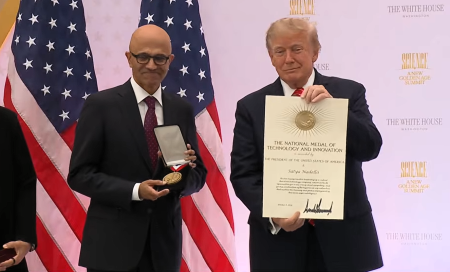


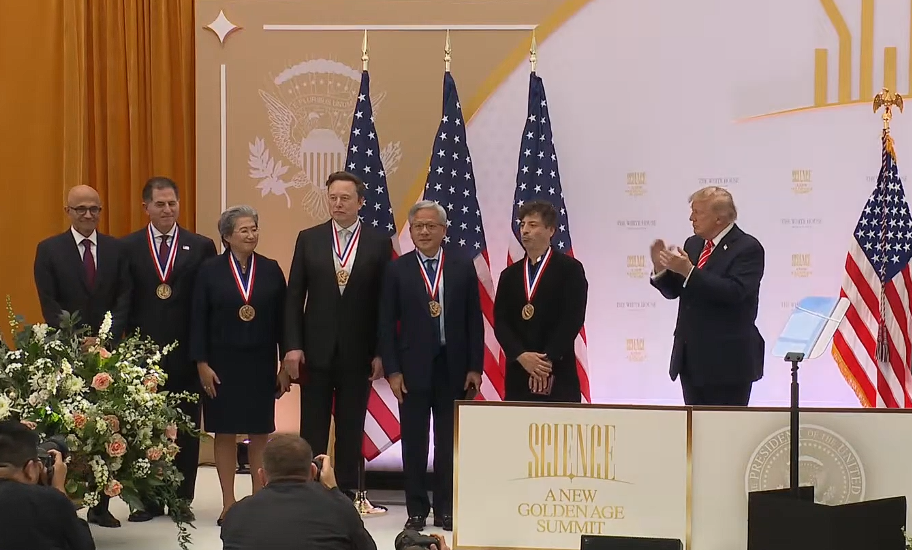
At a White House ceremony on Thursday, President Trump personally handed Satya Nadella the National Medal of Technology and Innovation, honoring a man whose life story embodies the American dream as much as it embodies corporate success. The Microsoft chief executive, born in Hyderabad, India, had first arrived in the United States in 1988, a twenty-something graduate student with a suitcase and a head full of computer science. Over the next thirty-odd years, he traveled a winding road: a temporary visa, then a green card, then citizenship, and finally the corner office at Microsoft—only the third CEO in its history. In his 2017 book, Hit Refresh, Nadella wrote, “I don’t think my story would be possible anywhere else.…I am proud today to call myself an American citizen.” But the ceremony was only half the story. Hours earlier, the Trump administration had suspended Microsoft from PERM, the federal program the company relies on to sponsor foreign workers for permanent residency. Speaking at a White House news conference on visa fraud, Vice President JD Vance had accused Microsoft of laying off American workers while hiring foreign workers, and he used a blunt phrase for H-1B visa holders: “foreign indentured servants.” The tension could not have been sharper: in the same building, the same administration celebrated an immigrant who had reached the top of American capitalism, while officials were tightening the very ladder he had climbed. This is the paradox at the heart of American immigration policy: it wants dreamers, but it fears the system that makes dreams possible.
The honors themselves were a striking testament to how deeply immigration is woven into American invention. The National Medal of Science and the National Medal of Technology and Innovation are not participation trophies; they are reserved for people who have reshaped entire fields. Alongside Nadella, who received the technology medal for what the citation called his “transformative leadership of a critical American technology company, which led to its rejuvenation for a new era of cloud computing,” stood Dell Technologies CEO Michael Dell, who also received the technology medal. The National Medal of Science went to Elon Musk, Google co-founder Sergey Brin, Nvidia CEO Jensen Huang, and AMD CEO Lisa Su. Five of the six honorees were born outside the United States. Nadella came from India, Musk from South Africa, Brin from Russia, Huang and Su from Taiwan. Only Dell was born in America. The medal ceremony was thus a living exhibit of a simple and sometimes uncomfortable fact: the United States has become the world’s innovation capital not in spite of its immigrants but because of them. These are the people who founded or led companies that put GPS in our pockets, connected humanity to the internet, made artificial intelligence a household word, and pushed the boundaries of computing. Nadella, visibly moved, thanked Trump on X, writing that he was “humbled to stand alongside so many giants of American innovation.” The phrase “American innovation” did a lot of work there: it was, he seemed to suggest, an innovation that belongs to everyone who helps build it, regardless of birthplace. For a few hours, the room seemed united around that idea.
To understand what Microsoft lost, it helps to understand two separate systems. The H-1B program is a temporary work visa, typically granted in three-year increments and generally capped at six years, with exceptions. It is overseen by U.S. Citizenship and Immigration Services, and it allows employers to bring in skilled workers for specific jobs. Microsoft uses this program heavily, but it is not the biggest user: Amazon received more than 19,000 approvals for H-1B petitions in fiscal 2025, about three times Microsoft’s total, according to an analysis by the National Foundation for American Policy. Those totals include renewals and extensions, so they do not represent 19,000 individual people. The PERM program, by contrast, is the first step toward permanent residency. Run by the Labor Department, PERM requires an employer to advertise a job, interview qualified candidates, and demonstrate that no available, qualified U.S. worker can fill it. Most PERM applications are filed on behalf of people who are already in the United States on H-1B visas, working for the sponsoring company. Microsoft is the country’s heaviest PERM user: the Labor Department ruled on 3,161 of its applications in the fiscal year that ended in September 2025, more than for any other employer. In the first nine months of fiscal 2026 alone, it had 1,683 applications decided through June. Amazon and Google each filed thousands of PERM applications in 2022 and early 2023, then largely stopped; last fiscal year, the department ruled on just 39 applications from Amazon and its subsidiaries, including Whole Foods, Audible and Zappos, and just three from Google. The suspension, therefore, targeted Microsoft at a vulnerable moment. It did not prevent Microsoft from hiring workers on H-1B visas, but it blocked the path from temporary status to permanent residency. For employees already counting the days on their six-year H-1B clock, this could be devastating: many rely on a timely PERM application to extend their visas beyond the usual limit, and the Labor Department said it would not process Microsoft’s pending applications either. The White House had not, as of Thursday, provided evidence of fraud by Microsoft. Vice President Vance framed it as a matter of fairness: “Our message to Microsoft is you’re a great American company, but you’ve got to hire great American workers.” But for the workers caught in between, the message was more complex: they were already here, already working, already contributing—and suddenly their futures were on hold.
Microsoft responded with the careful, somewhat wounded tone of a company that believes it has been wrongly accused. In a statement posted Thursday, it pushed back on the criticism of its hiring practices and said it looked forward to “providing the Administration with additional information.” Notably, the statement focused almost entirely on H-1B visas and did not directly address the PERM suspension. It argued that about 80 percent of the roughly 6,000 H-1B applications it filed last fiscal year were not for new hires at all, but rather to extend or change the status of people who already worked at Microsoft. “These were not to hire new people,” the company said. The remaining applications were for new hires who were already living in the U.S. legally—a group equal to about 1 percent of Microsoft’s U.S. workforce. “They are not new arrivals to our country,” it said. Microsoft also insisted that it files H-1B petitions only for workers who meet “the rigorous standards of this visa category,” pays them “the same as any other employees doing comparable work,” and offers wages “among the highest of all H-1B filings.” The vast majority of its U.S. employees are Americans, the company said. The Seattle Times reported that some Microsoft employees on H-1B visas were surprised by the news and unsure whether it would affect them. That uncertainty is a kind of punishment in itself: even if the suspension is lifted, even if no one is deported, the psychological toll on employees who have built lives, taken out mortgages, enrolled children in schools—all on the assumption that their paperwork was in order—is real. The company’s statement tried to make the case that its use of these programs was modest, lawful, and consistent with American values. But in the political storm, nuance tends to get lost. The accusation—that Microsoft was replacing American workers with cheaper foreign labor—was repeated in headlines; Microsoft’s rebuttal, buried in data, was less loud. Meanwhile, the employees themselves, the “foreign indentured servants” in Vance’s memorable phrase, were left to wonder whether their contributions counted for anything, and whether their adopted country still wanted them.
Satya Nadella’s own path to citizenship is a reminder that the system has always been strange, even cruel, at the individual level. In Hit Refresh, he tells a story that strips away the CEO biography and reveals how arbitrary immigration law can feel. He was already working at Microsoft when he married his wife, Anu, in India in December 1992. The following summer, her application for a visa to join him in the United States was rejected. Why? Because she was married to a permanent resident. At that time, spouses of permanent residents faced years-long waits, and Microsoft’s immigration lawyer told Nadella it could take five years or more to bring her to the U.S. Nadella was devastated. He considered quitting Microsoft and moving back to India. Then the lawyer suggested a strategy that seemed almost absurd: give up his permanent residency and go back to temporary H-1B status. As an H-1B worker, he would be in a different legal category, and his wife could join him immediately. So in June 1994, Nadella walked into the U.S. embassy in New Delhi, past long lines of people hoping for visas, and told a clerk that he wanted to renounce his green card. The clerk was dumbfounded. Who gives up a green card? But the plan worked. Anu joined him in Seattle, where they started a family, and Nadella eventually made his way back onto the permanent residency track and later became a citizen. His story had a happy ending, but the detour exacted a cost that not everyone survived. Back in Redmond, Nadella became known around campus as the guy who gave up his green card, and colleagues came to him for advice. One colleague, Kunal Bahl, later left Microsoft when his H-1B visa ran out before his permanent residency came through. He returned to India and founded the e-commerce company Snapdeal. Nadella wrote of Bahl’s departure:“Such is the perverse logic of this immigration law.” The law, in other words, forces people to make impossible choices: leave your wife or give up your status; stay in your adopted country or watch your career die. It rewards the wealthy, the patient, the lucky—and sometimes punishes everyone else.
The juxtaposition of Thursday’s events was almost too on-the-nose. In one chamber, a President honored a man who had arrived in America with nothing but ambition and had become a symbol of corporate reinvention. In another, officials from the same administration accused that man’s company of gaming the immigration system. Both things, in a strange way, are true. American immigration policy has always been a tangle of competing impulses: openness and fear, opportunity and protection, generosity and resentment. The H-1B and PERM programs were designed to let American businesses compete for global talent, but they have also been abused by bad actors, and they have created a class of workers with few rights and little stability. Nadella’s own story shows that even the most successful immigrant can find himself trapped in the system’s contradictions. Yet it also shows something else: that resilience, that willingness to navigate absurdity, is precisely what has made American innovation so powerful. The medal recipients did not succeed because the system was fair. They succeeded despite its perversity. Their companies—Microsoft, Google, Nvidia, AMD, Tesla, Dell—are not just monuments to individual brilliance; they are monuments to the contributions of immigrants at every level, from the engineers writing code to the executives deciding strategy. When the government says it wants to protect American workers, it should remember that American workers include people like Satya Nadella, who became an American citizen and built a company that employs tens of thousands of Americans. It should also remember people like Kunal Bahl, whose visa expired and who went home to build Snapdeal—an American loss, in a sense, as much as an Indian gain. The question isn’t whether to have immigration rules; it is whether those rules can be enforced without cruelty, and whether the United States can keep its promise as a country where, as Nadella put it, his story would be possible. On Thursday, the two faces of that promise were on full display: honor for the immigrant who made it, and suspicion for the immigrants still trying. The hope is that, in the years ahead, America can find a way to tell the difference between exploitation and aspiration—and build a system that celebrates both its citizens and its newcomers, without making them choose between family, career, and country. Nadella’s medal, after all, was not just for him. It was for everyone who has ever stood ina visa line, hoping that the door would open.