


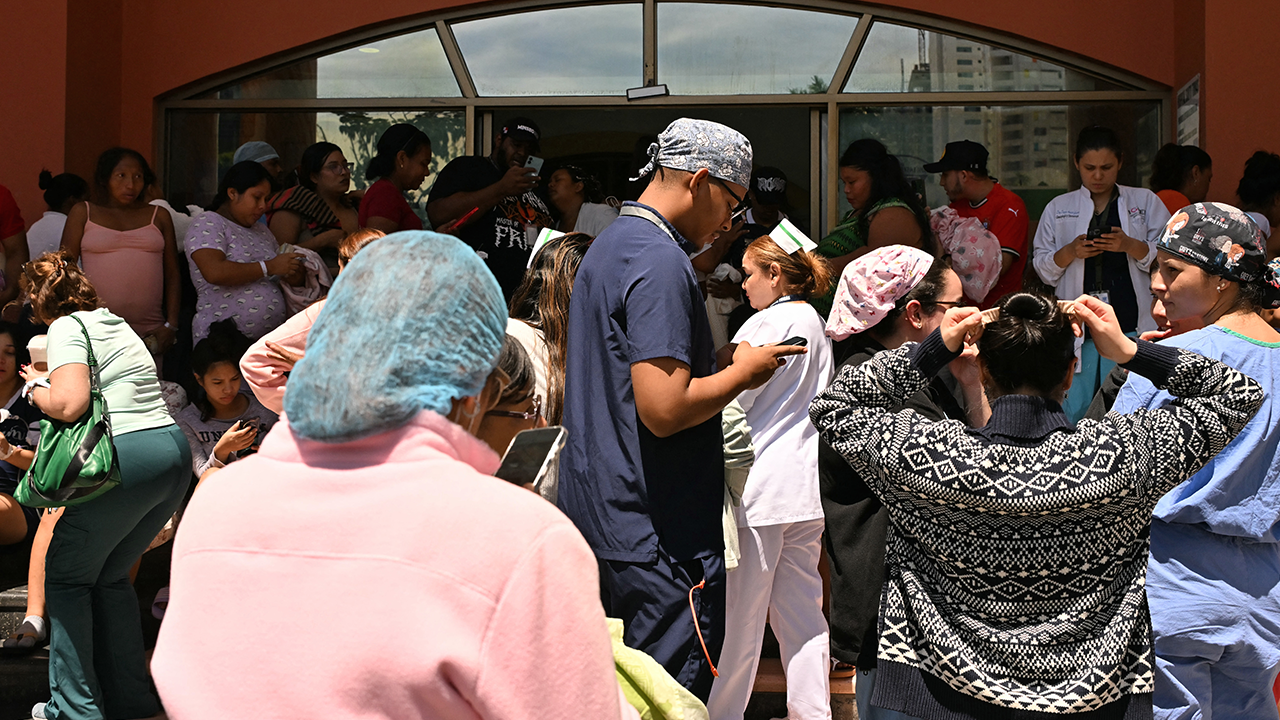
On Friday afternoon, a powerful and terrifying earthquake struck the ocean floor off Panama’s southern coast, sending shockwaves through a region already familiar with the earth’s restless power. The U.S. Geological Survey first measured the event at a staggering 8.0 magnitude, a figure that would have placed it among the most violent quakes of the decade. But after a moment of adjustment, they recalibrated the number to a still-massive 7.7, a distinction that offered little comfort to those who felt the ground lurch and roll beneath their feet. The quake originated at a shallow depth of approximately six miles—a critical factor that amplifies both the shaking and the potential for destruction—near the small community of Pitaloza Arriba, close to the coast and not far from the Pacific shoreline. The timing was particularly jarring: 1:56 p.m. Eastern Time, when thousands of people were at work, at school, or simply going about their daily routines. For those in high-rise buildings in Panama City, the swaying was pronounced enough to send a wave of dizziness and panic through offices and apartments, prompting many to abandon their desks and scramble for stairwells, doorways, and open spaces. It was the kind of event that reminds everyone, irrespective of preparedness, of the raw and unpredictable force that lies just beneath their feet.
The shaking was not confined to Panama alone. In San José, the capital of neighboring Costa Rica, residents felt the tremor distinctly, a testament to the sheer energy released by the 7.7-magnitude event. Reports from both capital cities described moments of acute anxiety—people freezing mid-step, children crying out, pets bolting under furniture—followed by that unique, tense silence that often follows a major quake. In Panama City, where modern glass towers meet the Caribbean and Pacific influences, the collective experience was a breathless pause, as everyone waited to see if this was merely a precursor to something worse. In Costa Rica, where memory of past seismic disasters runs deep, citizens immediately took to the streets, some barefoot, grabbing phones and family members, their eyes scanning the sky for signs of a tsunami or a collapsing building. The quake was a stark reminder that borders do not matter when the earth decides to shift. The shared vulnerability of these Central American nations was on full display, as was the resilience that emerges in the aftermath of such a sudden, visceral shock. Survivors would later speak of the strange sensation of the ground moving like a boat on a swell—a feeling that lingers long after the tremors stop, leaving a psychic residue that makes people jump at the creak of a floorboard or the rumble of a passing truck.
Perhaps the greatest fear that accompanies an offshore quake of this size is the threat of a tsunami. In the immediate aftermath, officials issued urgent warnings, and the Pacific Tsunami Warning Center sprang into action, analyzing data and dispatching alerts. The forecast was sobering: along some coastal areas of Panama, waves could reach between three and ten feet above normal tide levels, enough to inundate low-lying communities, drag boats inland, and cause significant damage to coastal infrastructure. Parts of Ecuador were also placed on alert, with predicted waves of one to three feet that could pose a hazard to beaches and harbors. Even further afield, smaller waves, less than one foot above tide levels, were anticipated for the coasts of Colombia, Costa Rica, El Salvador, Guatemala, Mexico, Nicaragua, and Peru. The warnings carried a simple, urgent message: move away from beaches and seek higher ground. Yet in a piece of reassuring news, officials were quick to clarify that a Pacific-wide tsunami was not expected. The quake’s orientation, location, and the way the seafloor shifted did not meet the criteria for a basin-wide event, sparing the far shores of Asia and the Pacific islands from any threat. Still, for the people hugging the coastline of Central America, the uncertainty was agonizing. Families loaded vehicles and headed inland, unsure if they would find their homes intact when they returned, but certain that material possessions were secondary to survival.
Amid the chaos of aftershocks—including a notable 5.5-magnitude tremor that struck approximately fifty miles east of the original epicenter—the question of damage and casualties loomed large. In the initial hours, no reports had surfaced of significant structural failures or loss of life, but the rugged, remote terrain of Panama’s southern coast makes communication difficult. Villages and towns nestled in jungle-lined bays might be cut off, their only access via sea or air. The 7.7 magnitude event was classified by seismologists as capable of causing serious damage, according to experts at Michigan Technological University, who note that quakes in this range can topple poorly constructed buildings, rupture pipelines, and trigger landslides. The shallow depth amplified the risk, as the energy was released close to the surface, shaking the landscape with far more violence than a deeper quake of the same magnitude. First responders and emergency teams, accompanied by geologists and engineers, prepared to survey the affected areas, but their progress would be slow and painstaking. In the interim, the lack of immediate information was its own kind of torment for those with family in the coastal hamlets, and for the rest of the world watching through the lens of press agencies and social media, waiting for the first aerial photographs or radio reports to reveal the truth of the aftermath.
To understand what this earthquake means, one must place it in a broader context. Magnitude 7.7 is not an everyday occurrence; it is the kind of event that reshapes a region’s collective memory. For comparison, the devastating earthquake that struck Haiti in 2010 was a 7.0, and it killed hundreds of thousands because of poor construction and dense population. A 7.7 releases roughly twice the energy of a 7.0, meaning the potential for destruction is formidable. Yet the eastern coastline of Panama, and the neighboring Pacific coasts, are less densely built than Port-au-Prince, and modern building codes in Panama City and San José have improved significantly over recent decades. The earthquake occurred in a subduction zone, where the Cocos Plate dives beneath the Caribbean Plate—a geological setting that produces the magnificent and terrifying seismic activity of the entire Central American isthmus. This region has experienced a long, punctuated history of quakes and volcanic eruptions, and its peoples have learned to coexist with the earth’s unpredictable nature. Friday’s tremor served as yet another lesson in humility, a reminder that, despite all our sensors and warning systems, we remain at the mercy of forces that operate on timescales and scales beyond human comprehension. There is both awe and terror in that reality, and in the days ahead, as the shaking subsides and the tsunamis recede, that duality will remain in the hearts of those who lived through it.
As night fell over Panama and Costa Rica, the story remained in its early chapters, a fluid and developing situation that kept emergency lines busy and newsrooms staffed. The U.S. Geological Survey and other monitoring bodies would spend hours refining data, analyzing the fault rupture, and updating their assessments. For the residents of the region, the immediate crisis may have passed, but the psychological aftershocks were just beginning. They would sleep lightly, if at all, attuned to every creak and rumble. In the coming days, they would brave the headaches and the anxiety, the endless loops of breathtaking video footage on their phones, and the overwhelming smell of dust and sea salt in damaged neighborhoods. They would rebuild, as their ancestors had done before them, and they would forge new connections with neighbors who had shared the same terrifying moment. And for the rest of us, watching from afar, this event is a profound reminder of our shared planet and its fragile crust. It invites us to hold those we love tighter, to prepare for the unexpected, and to extend our thoughts and solidarity to all who face the fury of nature. This is not the last earthquake, nor the last tsunami warning, but with each event, we learn, we adapt, and we persist. The story from Panama will continue to unfold, and with it, the enduring strength of the human spirit in the face of an impermanent, unpredictable Earth.