

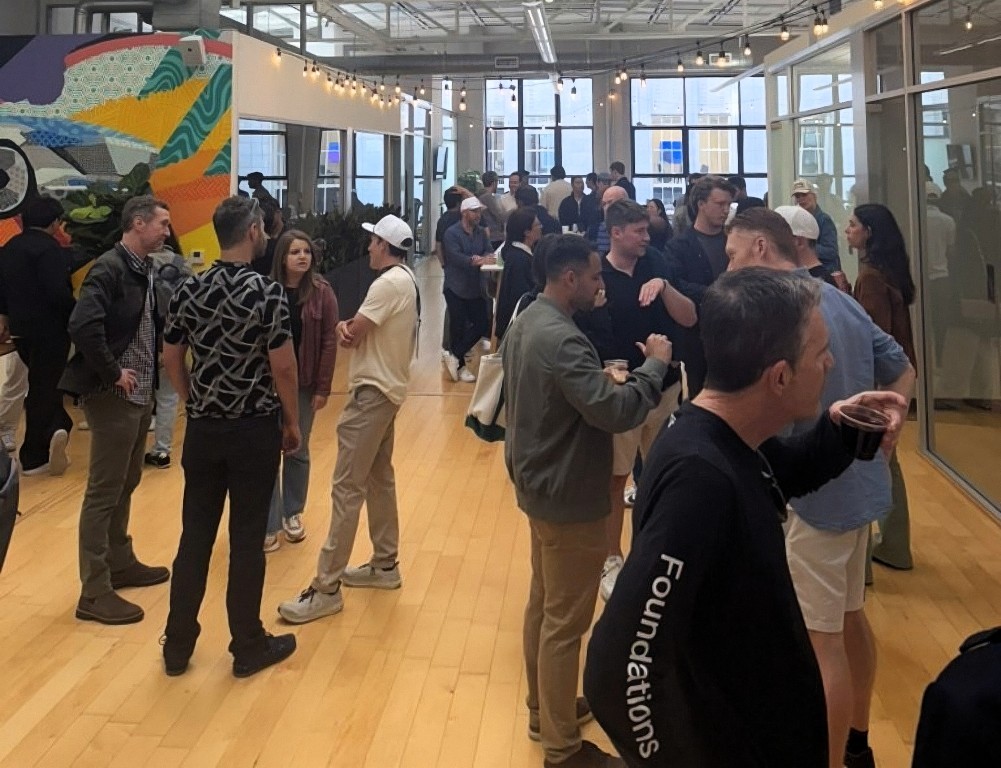
Foundations, the startup community with hubs in Seattle and San Francisco, made a bold move this week by launching a new service called Foundations Design and Engineering. At its core, it is a marketplace that connects businesses with the organization’s members—many of whom are technical founders busy building companies of their own—to help plan, develop, and implement AI systems and applications. The service is partly a survival strategy. Raising early-stage investment has become much harder in recent years, and many talented founders are struggling to pay their bills while they chase the next big idea. By offering their skills to outside companies, they can generate income without giving up on their own ventures. But the launch also reflects something larger about the tech industry right now. AI is making software dramatically easier to build, and startups are beginning to act less like traditional product companies and more like services firms, customizing their work for individual customers. Aviel Ginzburg, the Seattle venture capitalist who co-founded Foundations in 2024, sees this as the beginning of a major shift. “I think the world of traditional consulting and startups is just absolutely going to merge,” he said. This new service is an attempt to get ahead of that convergence and build something that works for both sides.
At first glance, Foundations Design and Engineering might look like a consulting firm, but Ginzburg is careful to explain why it isn’t. There is no staff of consultants clocking hours, no billing by the hour, and no army of people who studied AI from a distance. Instead, work is priced by the project, and the people doing the work are builders who use AI every day. The pitch on the website says it plainly: “Not consultants studying AI. Builders using it every day.” Ginzburg describes the operation as something that “acts more like a router.” A business with a problem might be connected to a member company already building a product in that exact area, or to a founder who knows the customer’s industry well, or to an early-stage founder looking for paid work while trying to get their own startup off the ground. The matching is flexible because the needs are so varied. Some businesses want to spend a couple of hours with a technical founder to talk through possibilities. Others want a full audit of how AI could reshape their operations. Still others want a complete system built and deployed. The pricing reflects that range. Ginzburg said founders in the community have charged $1,000 to $2,000 for a short working session with a company’s team, and as much as $5,000 for an audit of how a business could use AI. Larger projects vary widely. Some of the financial details are still being worked out. Foundations hasn’t settled on a standard cut of each contract; Ginzburg said it will vary case by case, from nothing to a double-digit percentage. It’s also unclear whether a business will sign its contract with Foundations directly or with the individual founder doing the work. That looseness is intentional, at least for now.
The name of the service is a nod to a role that has become increasingly important in the AI industry. FDE stands for “forward deployed engineer,” the term for engineers who embed with a customer to get technology working inside its business. Palantir popularized the role, and companies including OpenAI, Anthropic, Microsoft, and Amazon have adopted variations of it. The idea is that building AI systems isn’t just about writing code; it’s about understanding the messy realities of a customer’s data, workflows, and goals. By naming the service FDE, Foundations is signaling that its members are the opposite of armchair advisers. They are people who have their hands in the code every day. Ginzburg sees this as part of a broader transformation. For decades, startups and consulting firms occupied separate worlds. Startups built products and tried to scale them; consultants sold expertise and implementation help. AI is blurring that line. Because software is becoming easier to build, a small team can do work that used to require a large services organization. And because AI tools are still new and confusing to most businesses, there is enormous demand for people who can help customize them. The result, Ginzburg believes, is that the two worlds will merge. Foundations Design and Engineering is an early experiment in what that merged world looks like. It also has a secondary benefit for the founders involved: by working closely with businesses, they get a front-row seat to the problems companies are actually trying to solve. That can be invaluable when deciding what to build next.
The new service didn’t come out of nowhere. It grew out of a group of about ten founders within Foundations who were already doing consulting work on their own and helped put the offering together. On Tuesday morning, Foundations opened the service to the rest of its members. A veteran Seattle startup founder will run the effort part time at first, though Ginzburg said he wasn’t ready to announce who that person is. The fact that it’s part-time at the start says a lot about the organization’s approach. Foundations is not a giant company trying to launch a new business line; it’s a community of more than 300 founders, with hubs in Seattle and San Francisco and about 30 people in its founder-in-residence program. It is structured as a public benefit corporation, a legal form for companies that want to make money while also serving a public purpose. It doesn’t take equity in the startups that go through its residency program, and Ginzburg said the new service is meant to generate revenue without pulling the organization away from its core mission of making founders successful. That mission matters because the startup world has been through a difficult stretch. Early-stage investment is harder to raise than it was a few years ago, and many talented technical founders are sitting on good ideas but no payroll. Consulting work offers a bridge: it keeps them afloat, keeps them close to real customers, and often gives them ideas for products they wouldn’t have thought of otherwise. Foundations wants to be the platform that makes that bridge easier to cross.
For the businesses that hire Foundations members, the appeal is straightforward. AI is everywhere, but it’s not easy. Companies know they should be doing something with large language models, automation, or data analysis, but they often don’t know where to start. Traditional consulting firms can be expensive, slow, and generic. A startup founder who builds AI tools for a living can offer something more practical: direct experience, speed, and a willingness to get their hands dirty. The arrangement is not charity, but it’s not purely transactional either. Ginzburg hopes it will feel like a partnership. Founders get paid for their expertise, and businesses get help from people who are genuinely at the cutting edge of the technology. There are still open questions. How much should Foundations charge? How much of that should it keep? What happens if a project goes poorly? Should the founder be an employee, a contractor, or something else? Ginzburg doesn’t pretend to have all the answers. He describes the service as a startup in its own right, and startups are messy. The first iteration will probably be imperfect. But the underlying bet is clear: the people who are best equipped to help businesses adopt AI are the same people who are building with it every day. If Foundations can connect those people to the companies that need them, it could become something more than a side project—a new kind of talent network, a revenue source for founders, and a window into the future of work.
In the end, Foundations Design and Engineering is a bet on the idea that the boundaries around startups, consulting, and software products are dissolving. The old model was: raise money, build a product, sell it to many customers. The new model, at least for some startups, may be: build a product, but also sell your expertise, customize your work, and follow the customer’s needs wherever they lead. That can feel like a step backward for founders who dream of building a scalable company. But it can also be a lifeline. It pays the bills. It builds relationships. It teaches founders things they could never learn in a vacuum. And sometimes it leads to a product that wouldn’t have existed otherwise. Ginzburg is careful not to overpromise. Foundations is still figuring out the details, and the service may evolve in ways nobody can predict. But he seems genuinely excited about the possibilities. “This is a startup,” he said. “We’ll see how it goes, but it’s going to be fun.” For the founders in his community, that combination of uncertainty and enthusiasm is exactly what being a founder is all about. The launch of FDE is a reminder that the startup world is not just about venture capital and unicorns. It’s also about people trying to build things, pay their rent, and stay in the game long enough to make something that matters. If this experiment works, it could help a lot of them do just that.