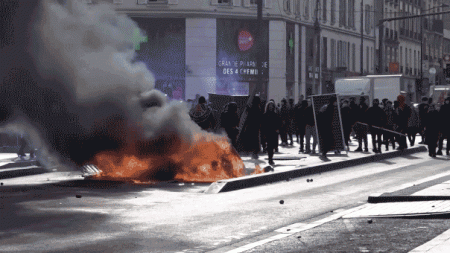



1. The images out of France are hard to ignore: columns of black smoke rising over Parisian boulevards, teenagers in hoodies hurling paving stones at riot police, and teachers standing shell-shocked outside schools that have been reduced to charred shells. What began as a student movement over crowded classrooms and missing instructors has spiraled into one of the most violent convulsions in recent French history, shaking the country to its core and sending a jolt of anxiety through Western capitals. The unrest, now stretching from Paris to Marseille, Strasbourg to Lille, is no longer just about education policy. It has become a flashpoint in a much larger argument over the social contract, national identity, and the consequences of decades of unchecked immigration. For many observers, the scenes are deeply unsettling—not only because of the destruction, but because they feel like a warning. The anger is raw, unfocused, and increasingly destructive, with students who once carried placards now setting cars ablaze and attacking firefighters. The human toll is staggering: hundreds of schools damaged, dozens of principals injured, and thousands of young people arrested. But beyond the statistics is a more uncomfortable story about a generation that feels abandoned by the state, and a country struggling to hold together the seams of a society growing more fragmented by the day.
2. To understand how France reached this breaking point, you have to start in the classrooms. For years, students in working-class suburbs and poorer districts have complained about conditions that would shock many in the developed world: overcrowded classrooms where dozens of teenagers squeeze into rooms built for half as many; chronic teacher shortages that leave subjects without instructors for weeks; and grueling school days that run from early morning to late afternoon, exhausting students before they even begin their homework. The protests erupted in late last month in the suburbs of Paris, where frustration had been simmering for years. Students say the government has ignored their pleas, underfunding the very schools that are supposed to provide a ladder to opportunity. Then came the 2027 budget, which proposed increasing education spending by just 1.7 percent—below inflation, effectively a cut. For students and teachers, it was the final straw. They poured into the streets, first peacefully, with chants and banners, demanding smaller classes and greater investment. But as the movement grew, it changed. What started as a specific, understandable grievance transformed into something broader and more volatile: a rebellion against the government, the political elite, and a system that many young people feel has failed them entirely.
3. The violence that followed has been alarming, even by French standards. Rioters have set buildings on fire, smashed shop windows, and thrown projectiles at police lines. In some cases, they have gone after authority figures directly. According to reports, a school principal was doused in gasoline, and firefighters responding to emergencies were attacked by crowds. The police, overwhelmed and exhausted, have responded with tear gas and rubber bullets, leading to further accusations of brutality. More than 5,000 people have been arrested, and as of Friday, over 400 schools remained closed, their entrances blocked by barricades or their interiors wrecked by vandals. The list of casualties reads like a war report: at least 65 school staff members, including 40 principals, have been injured since the unrest began, along with roughly 170 students. More than 100 high schools have suffered what the education minister described as “severe damage.” It is a level of destruction that goes far beyond a student protest. For the families living in these neighborhoods, the scenes are terrifying. Parents fear for their children’s safety, teachers fear for their lives, and ordinary citizens wonder how a legitimate demand for better schools ended with their streets burning. The anger seems to have become its own fuel, feeding on itself, with each new clash intensifying the rage of the next.
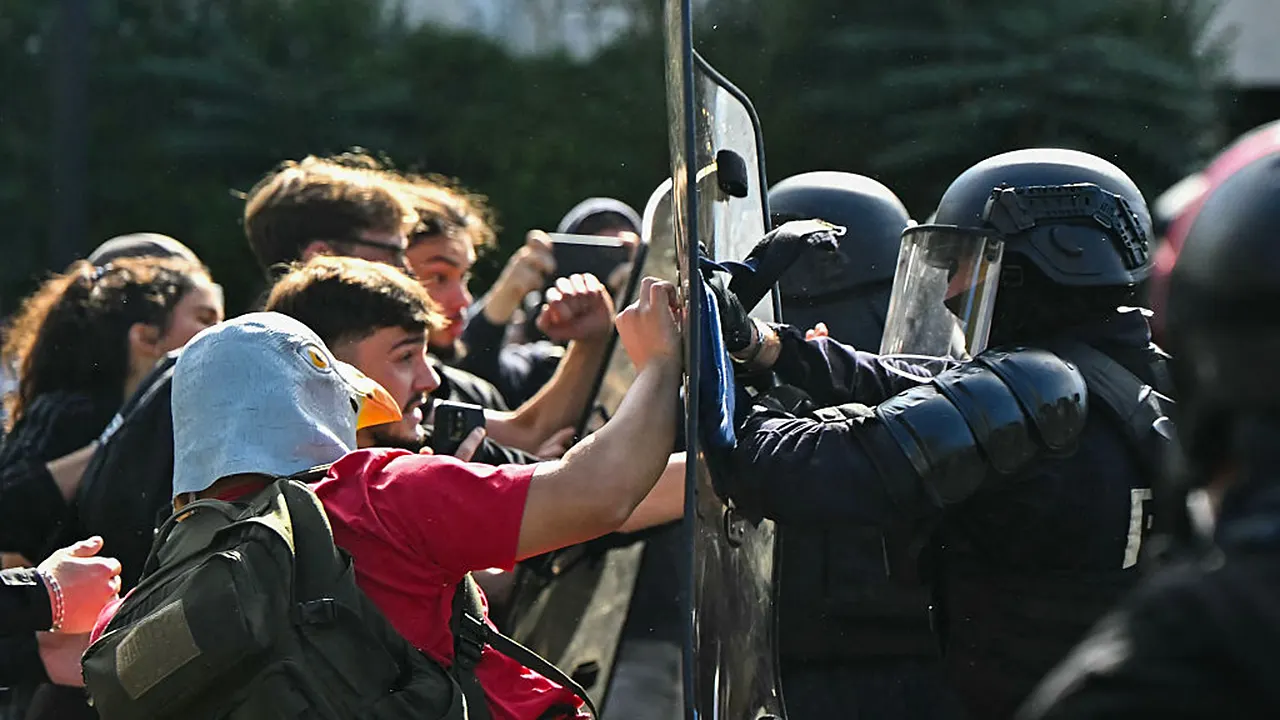
4. French authorities are convinced the movement is no longer spontaneous, and they are pointing their fingers at the far-left political party France Unbowed, known as LFI. At a crisis meeting, intelligence officials told the government that politicians from the hard-left party had helped initiate and steer the protest movement, using the legitimate frustrations of students as a battering ram against the government. LFI has fiercely denied the allegations, calling them a cynical attempt to delegitimize protest and distract from the real issues. The party accuses President Emmanuel Macron’s administration of politicizing the violence ahead of the 2027 presidential election, when Macron will be term-limited and the entire political establishment will be reshuffled. There is a deep cynicism on both sides, and the public can sense it. The expert quoted in the original report, Simone Rodan-Benzaquen, a senior envoy to Europe for the Foundation for Defense of Democracies, put it best: the students’ original grievances were real, but dousing a principal in gasoline and attacking firefighters is not a school meeting gone rogue. She argued that the movement has been deliberately transformed from a fight over education into a much broader confrontation with the state itself. That transformation is what makes it so dangerous—and so difficult to resolve. You cannot fix a political crisis with new whiteboards, and you cannot mend a broken social fabric with a few budget adjustments.
5. Across the Atlantic, the images have reignited a fierce American debate about immigration and national cohesion. On Fox News’ “The Big Weekend Show,” co-host Tomi Lahren stood in New York City and called the French uprising a “cautionary tale,” directly linking the violence to open-border policies that, in her view, destabilize native populations. She argued that Europe, and France in particular, chose to embrace “diversity as their strength” and opened their doors to mass immigration without considering the social consequences. She then connected the issue to U.S. politics, claiming that President Joe Biden pursued similar policies for four years, and that President Trump’s administration is now trying to undo the damage. Lahren’s language was blunt: when you allow too many people to come into a country “leech off your system,” she said, the people who are already there will eventually get angry. She acknowledged that burning things is always wrong, but she insisted that countries that market themselves as “a global home for everybody” end up paying a heavy price—and usually the native-born citizens pay the highest one. Her comments reflect a growing current of American political discourse that looks at Europe’s struggles and draws a direct line to immigration. Not everyone agrees with that linkage, of course. But for many viewers, the haunting images from French streets feel like a vision of what could happen if social cohesion erodes and public institutions collapse.
6. In the end, the French protests are a human story as much as a political one. Behind every burning car is a teenager who feels invisible; behind every injured principal is a public servant who just wanted to teach; behind every arrest is a family wondering what went wrong. The unrest is a symptom of a deeper sickness—a society that has allowed inequality to fester, that has underfunded the institutions meant to lift up the disadvantaged, and that has failed to integrate newcomers and natives into a shared sense of purpose. Immigration is part of that story, but it is not the whole story. France’s problems are also about economic stagnation, geographic segregation, and a political class that seems hopelessly disconnected from the people it governs. For Americans watching across the ocean, the lesson is not necessarily that open borders are the sole villain, but that neglect has consequences. When you ignore the classroom, someone will burn it down. When you dismiss the desperate, they will become dangerous. The challenge for all societies is to find a way to hear the grievances before they turn into explosions—to invest in schools, to build trust, and to create a world where young people feel they have a stake in the future. France’s burning streets are a reminder that this work cannot wait. The only question is whether other nations will learn from France’s pain before they experience their own.