

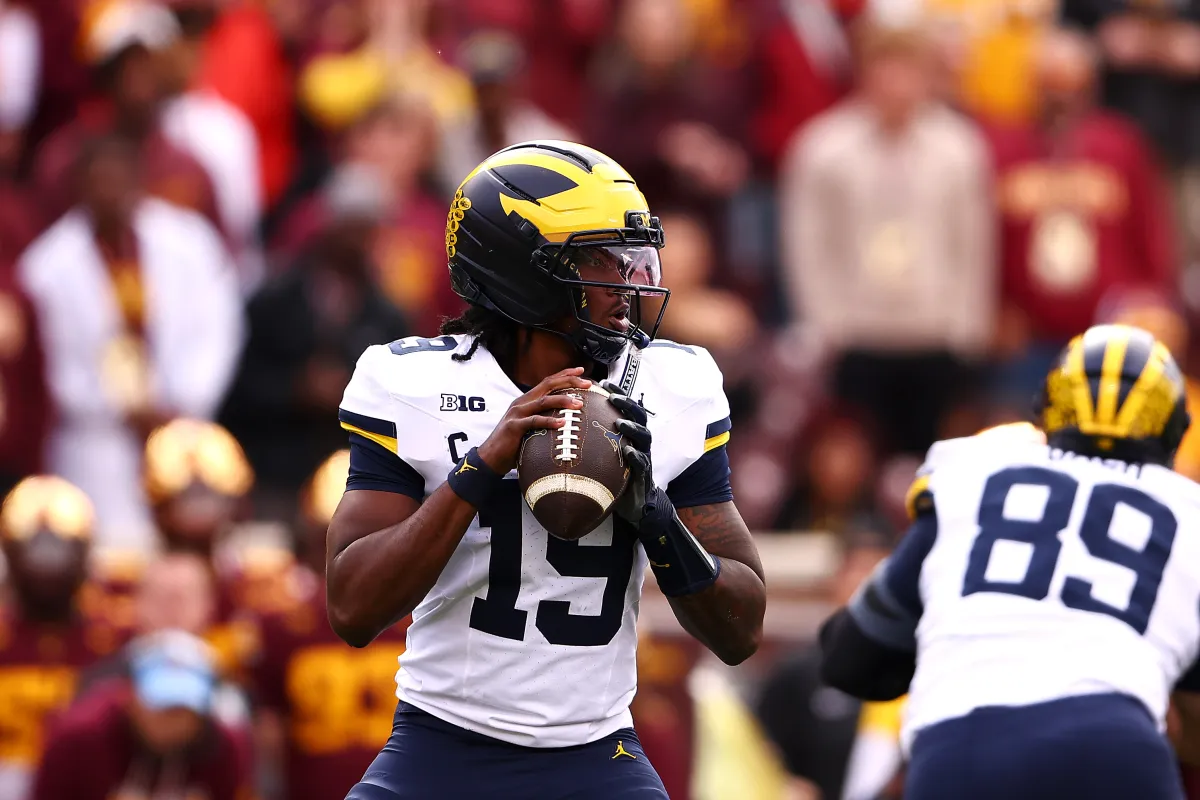
There was a moment not long ago when Michigan football felt magical. The program had climbed back to the top of the sport, won a national championship, and then somehow landed Bryce Underwood, the former No. 1 ranked quarterback recruit in America. He was the hometown kid who turned down LSU, turned down the pull of the SEC, and came home to play for the maize and blue. Fans allowed themselves to dream. They imagined a new dynasty, a bridge from Michigan’s old-school, ground-and-pound identity to a dynamic, modern passing attack led by a prodigy with a golden arm. Underwood was supposed to be the face of that future, the player who would make Michigan impossible to ignore. But football has a way of humbling even the most beautiful story, and Saturday’s loss to Minnesota was a cold splash of reality. Michigan lost again, a second straight defeat, and the offense looked broken. With just 180 total yards, no sustained drives, no explosive plays, and no rhythm, the Wolverines were exposed as a team that simply could not move the ball against a very beatable opponent. Underwood, still just a sophomore and still learning what college football truly demands, completed less than half of his passes and threw for only 101 yards. He had no passing touchdowns and no rushing touchdowns. He looked less like a savior and more like a young man carrying a weight that was too heavy for his shoulders, a kid trying to solve problems that required experience he hasn’t yet earned. The loss dropped Michigan to 3-2 on the year and, more alarmingly, 0-2 in Big Ten play. For a program with Michigan’s pride and history, that is not a bump in the road. It is an emergency, a flashing red light that cannot be ignored. And with games against Indiana, Oregon, UCLA, and Ohio State still looming, there is a real possibility that things could get much worse. That is why Rick Neuheisel, the former Colorado head coach and now a college football analyst, made a suggestion that would have seemed impossible just a few months ago: Michigan should consider moving away from Underwood as its starter, at least for now.
The specifics of Saturday’s performance were painful for anyone who wanted this experiment to work. Minnesota is a solid but not dominant Big Ten opponent, and Michigan simply had no answer. The offense produced just 180 total yards, a number that feels almost insulting for a school with Michigan’s recruiting classes, offensive line tradition, and resources. Underwood was under constant pressure, but he also missed throws he should have made, held onto the ball too long, and never seemed to find a groove. His final stat line—101 passing yards, a 47.6 percent completion rate, and no touchdowns—only begins to explain how disjointed everything looked. There was no timing, no trust, no confidence. When a young quarterback struggles, the offense can sometimes lean on the running game or a short passing attack to ease the pressure, but Michigan couldn’t establish anything. There were moments where Underwood showed flashes of the arm talent that made him a legend in high school—threading a pass into a tight window, escaping pressure with his legs—but those flashes were rare and never turned into points. It is also important to remember that this was not just one bad afternoon. Michigan’s offense ranks 17th out of 18 teams in the Big Ten. That is not a slump; that is a structural problem. Underwood has now played enough games that evaluators can see the game is still moving too fast for him, that the decisions are slow, that the rhythm isn’t there. He is talented, absurdly talented, but talent alone cannot win Big Ten games. And as Michigan looks ahead to a brutal stretch of the schedule, the margin for error has completely disappeared. Penn State is next, and after that the opponents only get scarier. The coaching staff has to make a decision about what to do with the most prized recruit this program has signed in years, and that decision will define the season in one way or another.
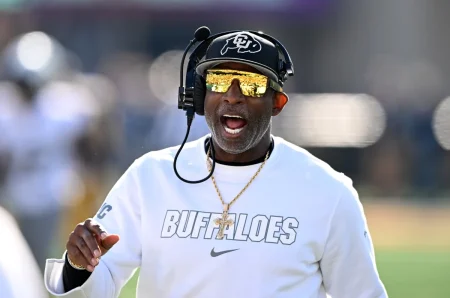
Rick Neuheisel has seen too much football to pretend this is simple, and he did not mince words after watching Michigan’s latest loss. Speaking as an analyst for CBS Sports, Neuheisel made it clear that he still believes Underwood can be a great player. He did not call for a permanent benching or a career-ending demotion. Instead, he argued for something that sounds radical in the age of NIL and instant expectations: a patient step back. Neuheisel suggested that Michigan needs to move away from Underwood as the starter, not because the kid has no future, but because the offense is not working and the team needs to understand that no job should be handed over without accountability. He pointed out that Michigan’s offense is 17th out of 18 Big Ten teams, a number that is completely unacceptable for a program with national ambitions. He also made a broader and more human point: sometimes a young quarterback needs to sit on the sidelines, catch his breath, and see the game unfold from a different perspective. “I still believe Bryce Underwood can be a great player,” Neuheisel said. “But I think it would do him well to stand on the bench and see how this thing works and see that this job can’t be just given to people.” That last part is important, because it cuts against everything that recruit ranking scandals and NIL deals have created. Underwood was not just handed a starting job; he was anointed it before he even arrived. The crown was placed on his head before he had proven anything at the college level. And while that is not his fault, it is also not a reason to protect him from the consequences of struggle. Neuheisel is not saying that Michigan should give up on Underwood. He is saying that the best way to help him might be to take the spotlight away for a little while, to let him rediscover what it takes to lead, to earn, and to grow. It is a tough-love approach, but in a season that is spiraling, tough love may be exactly what this offense needs.
Of course, benching a player like Bryce Underwood is much easier said than done. There are real risks, and they extend far beyond the football field. Underwood was the crown jewel of Michigan’s recruiting class, the quarterback who re-energized the entire fanbase and made the program feel relevant again on a national stage. NIL resources were poured into his recruitment, commitments were made, and the public investment in his success is massive. Sitting him could be seen as a panic move, a betrayal of the promise that brought him home, or a damaging blow to the recruiting momentum the program is trying to build. It could also hurt Underwood’s confidence in a way that slows down his development rather than helping it. But the other side of the argument is just as real. Standing in the pocket and taking hit after hit while the offense sputters is not a great way to build a young quarterback’s confidence either. Watching from the sideline, with a clipboard and a coach in his ear, might actually be better for his growth. He can study defensive coverages without the pressure of the moment. He can see how the game is managed by someone else, how the tempo is set, how a quarterback’s presence affects the players around him. He can remember what it felt like to love football before expectations made it so heavy. Neuheisel’s point is that a temporary step back can be a step forward. It is not about admitting that Underwood is a bust; it is about recalibrating, resetting, and reminding everyone that the starting job has to be earned every single week. From a purely practical standpoint, it also makes sense to see what other quarterbacks can do. Names like Tommy Carr and Brayden Fowler-Nicolosi have been mentioned as possible alternatives. Neither has Underwood’s recruiting pedigree, but they might bring something this offense desperately needs: a fresh set of eyes, a lower pressure level, and perhaps a more mature understanding of how to run an offense. The team needs a spark, not a scapegoat. And while it is possible that the coaching staff decides to stick with Underwood, they owe it to the entire roster to at least explore every option. The season is at a tipping point, and doing nothing cannot be the answer.
Now the burden falls on the man running the Michigan sideline, the coach whose every move is being watched and judged. This is one of the hardest moments a coach can face, because there is no perfect answer. Stick with Underwood, and critics will say you are stubborn, blind, or too invested in a recruit who hasn’t delivered. Bench him, and you risk losing a player who was supposed to be the future of your program. The bye week could not have come at a better time. It gives the staff a chance to study film, evaluate the quarterback room, and have honest conversations behind closed doors. But it also gives everyone time to talk, to speculate, to put more pressure on an already tense situation. Underwood is facing the most intense scrutiny of his young career. Every throw he makes, every expression on his face, every reaction on the sideline will now be magnified. The coach has to block out all of the noise and make a decision based on one simple question: who gives Michigan the best chance to beat Penn State? That might be Underwood. It might be someone else. But the coach has to show his team that standards matter, that performance and accountability are non-negotiable, and that no one is above the team. That message can be more powerful than any play call or game plan. Neuheisel seems to understand this. He is not suggesting that Michigan destroy a young man’s career. He is suggesting that a disciplined reset might be the best way to save both the season and the player. A talented quarterback does not need to be treated with kid gloves; he needs to understand what it takes to lead a college offense. That understanding often comes not in the spotlight but on the sideline, watching, breathing, waiting for another chance. The decision after the bye week will tell everyone what this program values most: continuity or production, loyalty or growth, patience or urgency. It may not define the coach’s entire career, but it will absolutely shape the story of this Michigan season.
At its heart, this is bigger than one game or one player. It is a story about what college football has become in the era of NIL, transfer portals, and instant gratification. Bryce Underwood came to Michigan as a conqueror, the hometown hero who chose his roots over the pull of a national power. He was supposed to be proof that the Wolverines could still recruit and develop superstar quarterbacks, that the program could step into the future without losing its soul. And maybe that is still true. The story is not finished. A difficult sophomore season does not have to be the end of his career, and it might even be the beginning of something stronger. If the coaching staff makes a smart, compassionate decision—whether that means a temporary benching, an open competition, or a renewed commitment to helping him grow—this experience could be the crucible that turns him into a leader. For Michigan, the stakes are obvious: Ohio State looms at the end of the schedule, and losses to Indiana or Oregon could completely destroy the season’s promise. But for Underwood, the stakes are personal. He is a young man who has been celebrated and scrutinized before he truly arrived. He needs room to learn, time to develop, and perhaps a chance to understand that football is not always about being the hero immediately. Sitting on the sideline can be humbling, but it can also be educational. Watching the game from a different angle, seeing what the coach sees, feeling the frustration of not being out there, and then using that frustration as fuel—these are lessons that cannot be taught in practice. The question is whether the coaching staff is brave enough to force that lesson. The fans will have their opinions, and the analysts will have their takes, but in the end this is about the development of a talented young quarterback and the identity of a program that refuses to accept mediocrity. Whether Underwood starts against Penn State or watches from the bench, the next chapter will be written after a well-timed bye week, and all eyes will be on Michigan to see if this team has the courage to change, the patience to rebuild, and the wisdom to understand that sometimes, stepping away is the best way to step forward.