



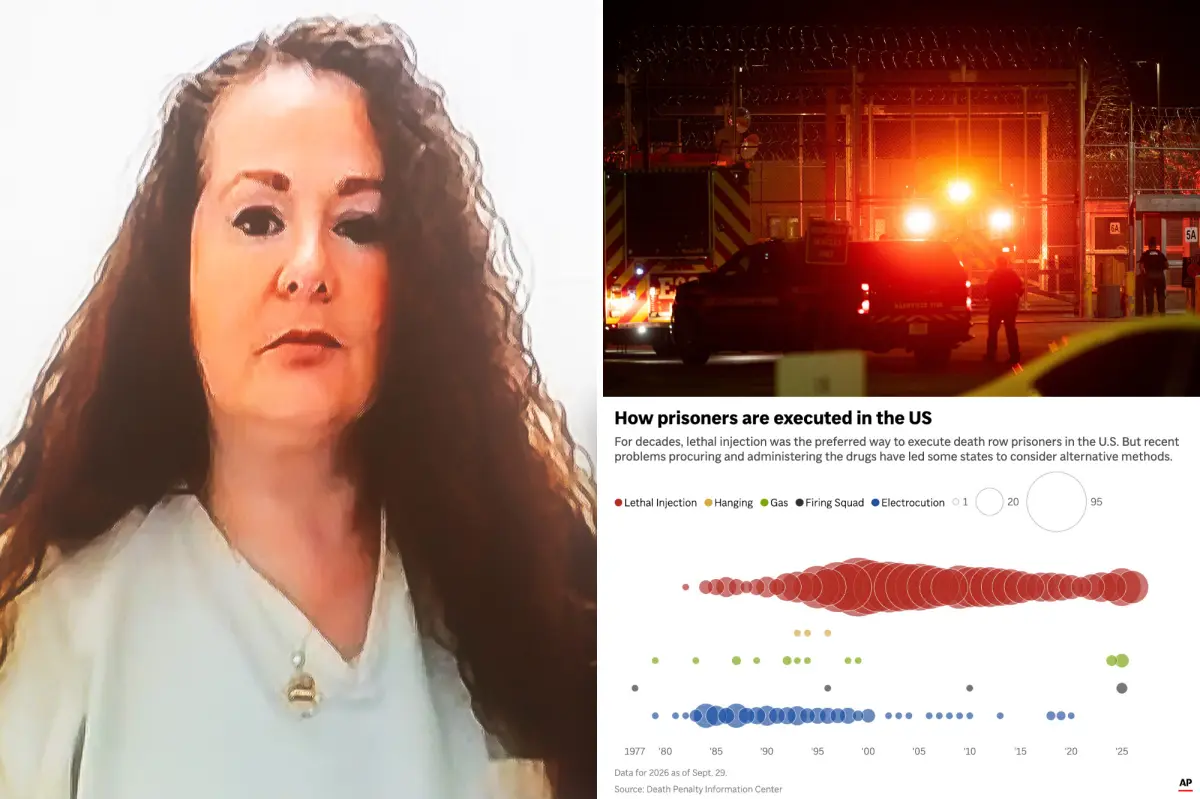
On Wednesday evening, inside the death chamber at Riverbend Maximum Security Institution in Nashville, Christa Pike lay strapped to a gurney and waited for the state of Tennessee to end her life. She was 50 years old, a woman who had spent nearly three decades on death row after being sentenced in 1996 for a brutal murder that still haunts the community. The room was quiet, the kind of quiet that settles when people are waiting for something final. The witnesses had been seated. The family of the victim had come seeking closure that had been denied to them for more than two decades. The clock moved past 7:30 p.m. CDT, and the execution team began its work, administering a dose of pentobarbital, a powerful barbiturate designed to slow her breathing, stop her heart, and bring the long legal saga to a close. But the drug did not produce the intended effect. Her body kept breathing. Her heart kept beating. A second dose was given, and still, against every expectation, she did not die. In that moment, Christa Pike became something the American legal system had never seen before: the first death row inmate to survive a lethal injection. What should have been a solemn, orderly process turned into a scene of uncertainty, with witnesses staring at a woman who had been twice administered lethal drugs and yet remained alive. No one in the room knew what to do next. The execution team, the prison officials, the lawyers, the media witnesses, all of them were suddenly inside a story that had no script, and the silence in the chamber shifted from anticipation to something far more uncomfortable.
The gravity of what had just happened took time to settle in. Death Penalty Information Center executive director Robin Maher, who has spent years documenting the ways executions can go wrong, called the event “singular and unparalleled.” She pointed out that seven other condemned inmates had survived botched executions in which execution teams could not find a vein, but she said no one had ever been given the lethal drug combination and lived. That is what made Wednesday’s scene so shocking. It was not a technical problem with a needle or a delay in finding an injection site. It was the actual mechanism of death being administered not once, but twice, and still failing. The drug was supposed to stop her breathing. It was supposed to stop her heart. Instead, her body resisted, and her life continued. Even seasoned media witnesses, people who had watched executions before and knew the usual rhythm of the ritual, said something felt deeply wrong. They described a scene that did not fit the familiar pattern, a woman still showing signs of life after the state had done everything it was supposed to do to end that life. For those in the room, time seemed to stretch, and the quiet became unbearable. There was no moment of finality, no clear ending, only the raw and unsettling reality that a human being had been put through a procedure designed to kill her, and she had survived it. The state had prepared for many possibilities, but not this one, and the room was left suspended between the authority of the law and the stubborn unpredictability of the human body.
As the reality of the failed execution settled over the death chamber, Pike’s lawyers moved quickly. They filed an emergency motion arguing that she was in “unnecessary agony” and asking a judge to stop the procedure before the state tried again. Judge Clifton L. Corker approved the request, issuing a stay of execution that temporarily spared her life. The legal move did not erase the fact that she had already been forced through a harrowing ordeal, but it did bring the proceedings to a halt. Tennessee Governor Bill Lee, a Republican who has generally supported capital punishment, responded with words that reflected both concern and caution. He ordered a “comprehensive, third-party review to determine exactly what occurred” and suspended the last remaining execution scheduled in the state this year. In his statement, Lee said, “Carrying out a lawfully imposed sentence is among the State’s most serious responsibilities, and the people of Tennessee expect it to be done in a manner that is not only legal and constitutional, but is effective.” The governor’s language was measured, but his decision to pause future executions signaled that even the state recognized something had gone fundamentally wrong. The Tennessee Department of Correction also issued a statement insisting that it had followed every step of the State’s lawful, established execution protocol approved by the Attorney General’s Office. But the explanation did little to quiet the questions. For the victim’s family, the stay of execution meant another delay, another chapter of waiting, another wound reopened. For Pike, it meant she would be led back to her cell, alive, with the future still uncertain. For the state, it meant the beginning of an investigation into how its own machinery of justice had failed in front of witnesses.
To understand the weight of the moment, one must remember why Christa Pike was on that gurney in the first place. In 1996, she was a young woman involved in a case so violent it left permanent scars on everyone who encountered it. Prosecutors said she lured a classmate to a remote area near the University of Tennessee campus with the help of her boyfriend. There, the classmate was beaten and tortured in horrifying fashion. Pike crushed the victim’s skull with a piece of asphalt, a murder that investigators described as one of the most brutal they had ever seen. The victim was just a teenager, with dreams and a future that were violently stolen. Her family has spent decades waiting for justice, carrying grief that no verdict could ever fully ease. Pike was convicted and sentenced to die in 1996, and she has been on death row ever since, navigating appeals, legal motions, and the slow machinery of the justice system. The crime is not easy to think about, and it is not something to romanticize or excuse. But the failed execution forces even those who support the death penalty to acknowledge a difficult truth: the person on the gurney, however guilty, is still a human being, and the state’s attempt to end her life has now become part of the story too. There is no clean way to separate the horror of what she did from the horror of what happened in that execution chamber. Both are real, and both demand to be confronted. The legal system exists to make judgments, but it cannot make the human body obey those judgments without question.
Tennessee’s execution protocol was written with a built-in backup plan. State law says that if the first dose of the lethal drug does not work, a second dose may be administered. That provision exists because the state’s lawyers and medical experts knew that the human body can be unpredictable, that a vein might collapse, or that the drug might not flow as intended. What no one wrote down, and what no one had ever needed to write down, was what should happen if the second dose also fails. There is no blueprint for that. There is no instruction manual, no protocol, no clearly defined next step. The Tennessee Department of Correction tried to project competence in its aftermath statement, saying it had followed every step of the lawful protocol approved by the Attorney General’s Office. But the protocol’s silence on this exact scenario left the state without an answer. The independent review ordered by Governor Lee will need to examine not only what went wrong physically, but also what legal and ethical obligations remain when an execution attempt fails. It will have to confront difficult questions. Can the state try a third time? Should it switch to a different method? Does the Constitution allow another attempt after a condemned prisoner has already survived two doses of lethal drugs? For now, Christa Pike remains alive, the death chamber is quiet, and Tennessee must decide what justice means in a case that no one anticipated. The law can demand a sentence be carried out, but it cannot guarantee that the sentence will work. That simple, uncomfortable truth has now been made visible for everyone to see.
Whatever the investigation finds, the image of Christa Pike lying on that gurney, still breathing after two doses of pentobarbital, is not likely to be forgotten. It is the kind of moment that exposes the rawest edge of capital punishment, the point where abstract rules and legal arguments collide with the unpredictability of the human body. The lethal injection was supposed to make executions clean, painless, and orderly. It was designed to replace the violence of older methods with a quiet procedure that looks more like medicine than punishment. But death is not always tidy, and the body does not always cooperate. The people in that room saw something that made them question the entire enterprise. They saw a woman, condemned and convicted of a terrible crime, still alive after the state had tried twice to kill her. They saw her lawyers rushing to stop the process, a judge stepping in, a governor ordering a review. They saw the machinery of the death penalty grind to a halt in confusion. This is not to diminish the horror of her crime or the grief of the victim’s family. It is not to suggest that Pike deserves sympathy. It is to say that the state’s response must be worthy of the seriousness of such a decision. Justice, no matter how carefully it is defined by law, is ultimately carried out by human beings, on human beings, with all the fragility, messiness, and resistance that reality involves. Until the state can find a way to confront that truth honestly, every execution will carry within it the possibility of another night like this one, another moment when the law meets the limits of the human body and finds itself unprepared.