

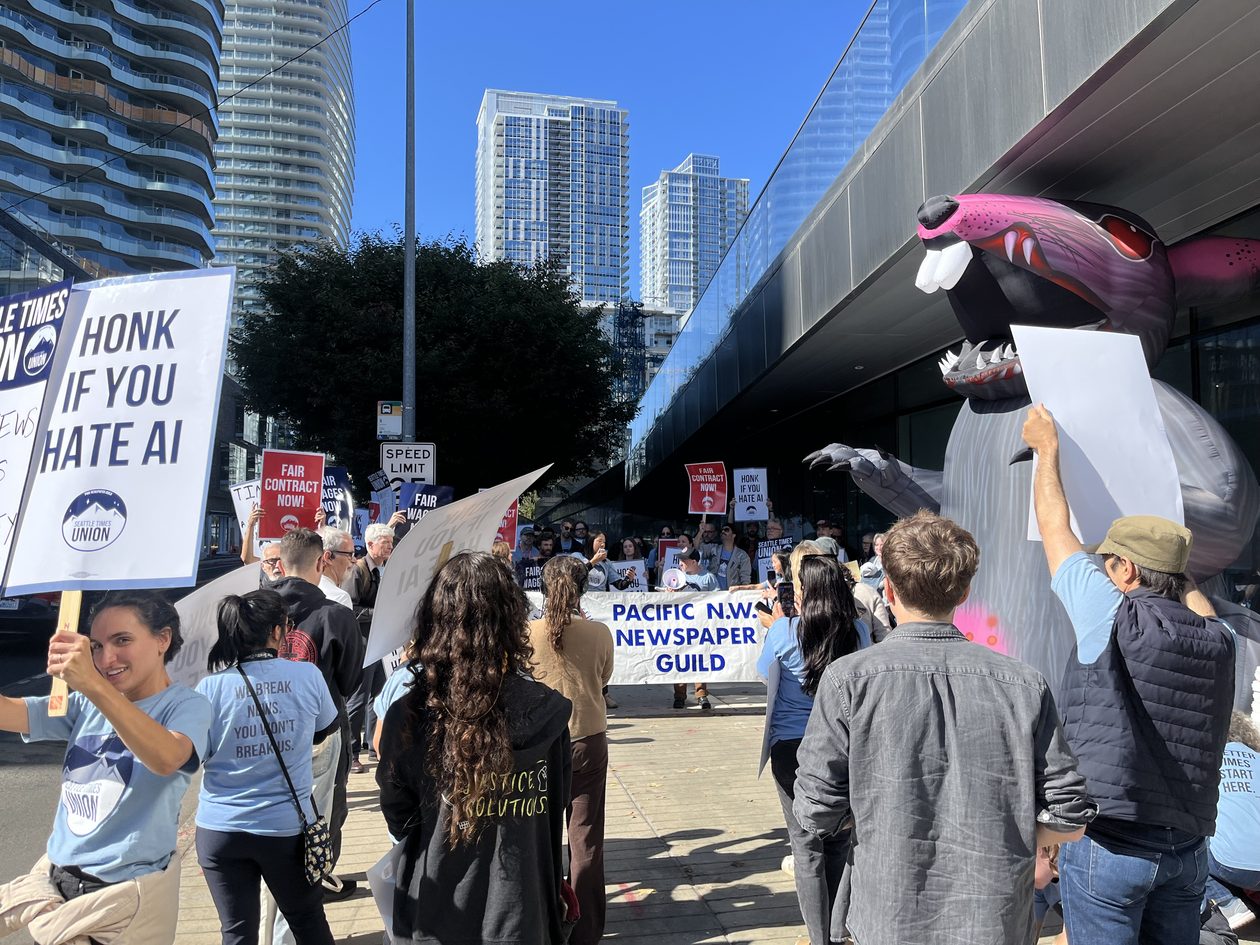
On a bright Wednesday afternoon, the steady rhythm of car horns became a kind of solidarity symphony outside the Seattle Times building. “Honk if you hate AI,” read one sign, and drivers responded with enthusiasm, their horns echoing down the street. For the union members walking the picket line, that sound was both comforting and strange. These were journalists, photographers, copy editors, page designers, and digital producers—people who normally report on picket lines rather than stand on them. They had come together to make a simple but urgent point: artificial intelligence should not be allowed to replace the people who produce the news. The union, known as the Seattle Times Union, has been in contract negotiations with the company for six months, and those negotiations have stalled over two core issues: wages and the role of AI in the newsroom. While the company has agreed not to use AI to conduct interviews or write articles, it has refused to extend that promise to other essential newsroom jobs. That leaves photojournalists, copy editors, social media producers, page designers, graphic artists, and digital producers in a frightening kind of limbo. They do not know if their jobs will exist in five years, or two years, or even next year. The mood on the picket line was not angry, exactly, but it was determined, with an undercurrent of anxiety. Every honk from a passing car felt like a small vote of confidence—a reminder that the public still cares about how its local newspaper is made and who makes it. For the union, that public support is more than just morale. It is evidence that the fight over AI is not a niche concern for journalists; it is a question that resonates with everyone who reads the news, relies on it, and wants to believe that it is produced by humans who care.
At the heart of the dispute is a demand that sounds deceptively simple. The union wants a contract that says “interviewing sources, writing stories, and all other journalistic and production related functions will be done by humans.” The company has accepted the first two parts of that sentence but balked at the rest. In other words, management is willing to promise that reporters will not be replaced by robot writers, but it will not promise the same protection to the people who edit their work, take the photographs, design the pages, and share the stories with the world. The union sees this as a glaring gap. “Management has admitted at the bargaining table that it could use AI to replace jobs,” journalist Alexandra Yoon-Hendricks told the crowd. “All of our members in the newsroom—reporters, photographers, copy editors, page designers, graphic artists, digital producers and more—deserve job security against machines.” Those words hit home for Manuel Villa, a data journalist at the Times. “There is nothing to say that they wouldn’t be completely replaced,” he said, speaking specifically about copy editors. “I trust in them to make my pieces better. I am not sure I trust an AI agent to do that.” His point was not a rejection of technology. It was a recognition that journalism is a craft, not just a process. A copy editor catches subtle errors, improves the flow of a story, questions a shaky assumption, and adds a human layer of care that no algorithm can replicate. A photographer knows that the right photo is not just technically perfect but emotionally truthful. A page designer shapes how readers experience the news, deciding what feels important, what draws the eye, what demands attention. These are not tasks that can be safely automated without changing the nature of the news itself. And behind everything is the question of wages. The union says the contract is also stalled over pay, and that adds another layer of stress. Workers are being asked to imagine a future in which their skills might not be valued, while also trying to make ends meet in a city where the cost of living keeps climbing. It is a difficult position, and the picket line was their way of saying that they will not accept a future that leaves them behind.
The fears are not abstract or hypothetical. The Seattle Times Union is part of the Pacific Northwest Newspaper Guild, and the guild has already seen how AI language can play out in the real world. This summer, the guild won a contract barring McClatchy from using AI to replace staff, decrease pay, or reduce working hours at five newspapers in Washington and Idaho. That victory felt like a model for what the Seattle Times could agree to. But just this month, McClatchy laid off 17 journalists at those same papers as part of nationwide cuts. To the union, that sequence of events was a warning: a contract clause can say one thing, but the underlying economic pressures can lead to something entirely different. Meanwhile, the Seattle Times has tried to reassure the public through its own channels. Executive editor Michele Matassa Flores published a column on Sunday declaring, “The Seattle Times does not publish news stories produced by artificial intelligence. Full stop.” She explained that the paper’s only reader-facing AI products are a weekly News Quiz and an audio player that reads stories aloud. Behind the scenes, she wrote, the newsroom sometimes uses AI to transcribe interviews and analyze large data sets, and it is piloting a program that scans government meeting videos for potential story ideas. Every use of AI, she said, requires approval from newsroom leadership. Publisher Ryan Blethen was quoted telling a reader that “AI should be treated as a tool to aid and assist our journalism, not replace it.” Those are reassuring words, but the union noticed that the column made no mention of the union or the stalled contract talks. And the company’s public stance is made even more complicated by its legal actions. On September 4, the Seattle Times Co. and Newsday sued Microsoft and OpenAI, alleging that the companies used their journalism to train AI models without permission. The union said it supported the lawsuit, but with a pointed caveat: “if the Seattle Times Co. truly cares about the threat AI poses to journalism’s business model, it should protect the workers who produce the copyrighted material at the heart of this case.” That statement cut through the corporate language. It is one thing to defend your intellectual property when your bottom line is threatened. It is another to defend the people who created that intellectual property in the first place. The union believes the two cannot be separated.
The picket line was also an exercise in public conversation. Union members have been reaching out to the community, and they say the response has been deeply encouraging. A petition calling on the company to pledge not to replace any newsroom workers with AI has gathered more than 1,600 signatures from the public. “We’ve been doing a lot of public outreach, and we’ve been hearing sentiments from the community that they don’t want their local paper to be made with AI,” said Brandon Foster, a multiplatform desk editor. “It’s nice to know we’re on the same page as our readers.” That sense of alignment was visible on the sidewalk. Drivers honked, pedestrians slowed down to read the signs, some stopped to ask questions. The union members explained that they were not against technology, that they used data analysis and transcription tools themselves. What they were against was the idea that a machine could replace the judgment, curiosity, and accountability that human journalists bring to their work. They talked about the importance of local news, about the difference between a story written by someone who lives in the community and one generated by an algorithm that has never set foot in the city. A reporter knows which sources to trust, which officials are dodging questions, which details matter to the people who live there. A photojournalist knows that a single image can hold the weight of a community’s grief or joy. A copy editor knows that a small error can erode years of trust. None of that can be reduced to training data. The public seems to understand this intuitively. People may not always follow the fine print of contract negotiations, but they know what it feels like to read a story that has no human voice behind it. They know the difference between a newspaper that cares and one that is simply assembled. That is why the honks kept coming, and why the union members kept smiling, waving, and standing their ground.
For all the strong words and public support, the union says it is not preparing for a dramatic showdown. It is waiting. After Tuesday’s bargaining session, the union is awaiting the company’s response. The next session is scheduled for October 13. In the meantime, the company has offered a carefully worded statement of its own. President and CEO Alan Fisco said, “We understand the Guild’s concerns regarding the development of AI in the workplace, and especially its potential impact on journalism. To that end, we remain committed to negotiating with the Guild toward mutually acceptable contract language regarding AI use at The Seattle Times.” That statement is diplomatic and open-ended. It could mean many things. The union would like to see more specific commitments, but it also says it is hopeful. There is a broader trend of AI skepticism in the industry, and public sentiment has shifted as people have seen the flaws, biases, and dangers of generative AI. High-profile mistakes, copyright lawsuits, and concerns about misinformation have made people more cautious about handing journalism over to machines. The union sees this as a rare opening. Perhaps this is the moment when the industry finally decides that AI should be a helper, not a replacement. Perhaps management is genuinely listening. But hope is not a contract. The workers on the picket line have heard reassuring words before, and they know that promises made in columns and statements are not the same as language in a binding agreement. They also know that even a good contract is only as strong as the people willing to enforce it. So they will keep showing up. They will keep talking to their neighbors, gathering signatures, and asking difficult questions. The uncertainty is exhausting, but so is the work they do every day—the work that makes a newspaper a trusted part of the community. They are not asking for special treatment. They are asking for a guarantee that the people who produce the news will not be treated as disposable.
In the end, this fight is about more than one newsroom or one contract. It is about what we lose when machines replace the human texture of journalism. A copy editor may not have a byline, but that copy editor is the reason a story is clear, accurate, and fair. A photojournalist may not write a word, but that photojournalist’s image can capture a truth that data cannot convey. A page designer shapes the way we experience the news, and a social media producer decides what to share and how to frame it. All of these people are part of an ecosystem that produces something essential: trustworthy local journalism. The Seattle Times has been around for more than a century, and it has weathered many economic storms. But the rise of AI is different. It challenges the very idea of authorship and creativity, of who gets to tell a community’s story. The union is not demanding that the company reject AI entirely. It is asking for a clear boundary: humans will do the journalism. Machines can assist, but they cannot replace the people who ask the questions, check the facts, take the photographs, and make the news their own. The next bargaining session will be a test of whether that boundary can be written into a contract. In the meantime, the picket line will leave its mark, one honk at a time. The workers are not retreating from technology. They are asking a simple question that deserves an answer: if a machine can do our jobs, what will be left of the news we need? That is not a Luddite question. It is a deeply human one, and it will not go away until the people who make the news are given the security and respect they have earned.