

Imagine for a moment that the most essential instrument you own is not something you can hold, tune, or replace. It lives in your throat, in the vibration of two small folds of tissue, in the breath that shapes itself into words, laughter, whispers, and cries. Your voice is the sound of your presence in the world—the way you announce yourself before anyone sees you, the way you reach across a room, a phone line, or a lifetime. You might have saved a voicemail from someone you love, not because the message contained anything important, but because hearing their voice made them feel close, alive, and real. You might have called someone just to hear them say “hello,” to be reassured by the familiar texture of their tone. Voices can soothe a frightened child, inspire a crowd, seduce a stranger, or make a friend laugh until tears stream down their face. They carry our moods, our histories, our identities. But what happens when that voice is suddenly gone? What happens when illness, injury, or disease steals the sound that has always carried your thoughts and feelings into the world? This is not a hypothetical question. For millions of people, the loss of voice is a daily reality—a silence that can feel like disappearing. And yet, in that silence, something remarkable is happening. Scientists, engineers, and artists are finding ways to bring voices back, not by repairing the old ones, but by building new ones from the raw material of memory, data, and even thought itself. Artificial intelligence can now clone a voice from a few recordings. Brain implants can read the neural patterns of speech and turn them into audible words. These technologies are not science fiction anymore. They are being used right now, by real people, in real time, to reclaim a part of themselves they thought was lost forever.
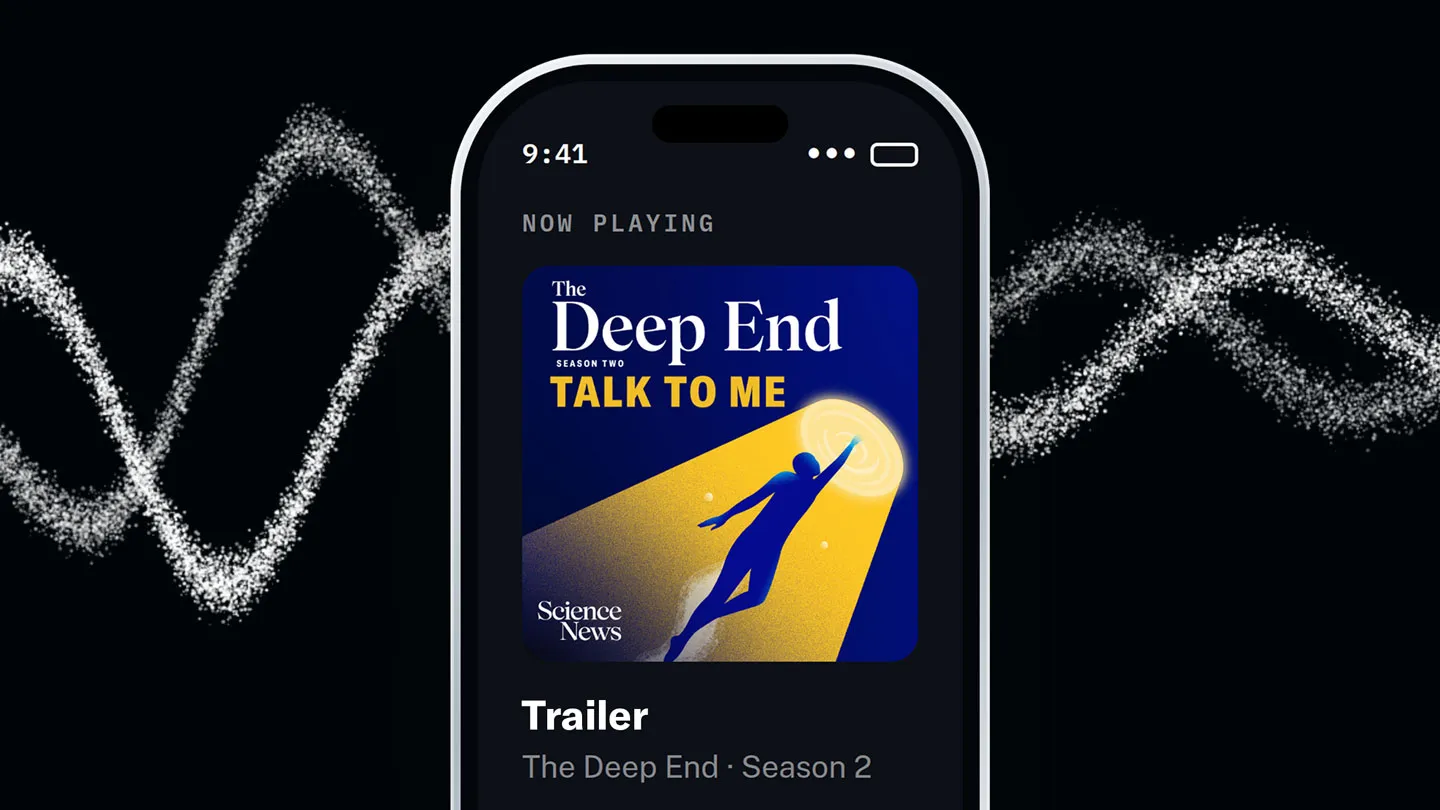
This is the terrain explored by The Deep End, a podcast about our brains and ourselves, hosted by Laura Sanders, a reporter from Science News. In its new season, called Talk to Me, the show dives into the latest scientific research to ask a deeply human question: What happens when a voice is lost, and can it be found again? The season opens with a simple but profound observation: one of today’s most powerful pieces of technology is something we have had all along—the human voice. But the podcast quickly moves beyond the familiar to the extraordinary. Over six episodes, listeners are introduced to a chorus of voices, each with a different relationship to loss and recovery. There is MA Fernandez, who remembers the exact moment she heard the first little crack in her husband’s voice, a tiny sign that something was changing, something that would eventually take his voice away. There is Casey Harrell, who lives with a brain implant that can pull words directly from his thoughts. There is Jules Rodriguez, who performs live comedy using a voice cloned through artificial intelligence. And there is Patrick, a musician who sings with a synthetic voice. Their stories are not just about technology. They are about identity, connection, grief, and the strange, beautiful ways we adapt when the most personal part of our self-expression is threatened. The podcast asks us to listen closely, not just to the voices that are restored, but to what those voices mean to the people who use them—and to what we all lose when we take our own voices for granted.
Among the most striking stories in the season is that of Casey Harrell, a man whose brain implant has given him the ability to speak again by translating his thoughts into words. Casey’s experience is not just a medical breakthrough; it is a profound lesson in what voice makes possible. He speaks about the simple, almost mundane things that most of us never think about—the ability to scream when you are running and want to get out some stress, the ability to say sweet nothings into your partner’s ear. “These are the things that life is all about,” he says. “And when you are robbed of those times, you want them back at all costs.” His words are a reminder that voice is not just a tool for communication. It is a channel for emotion, for intimacy, for the raw, unpolished sounds of being alive. A scream of frustration, a whispered endearment, a laugh that erupts before you can stop it—these are the vocal moments that make up a life. When they are taken away, the silence is not just empty. It is heavy with everything that cannot be said. Casey’s brain implant works by reading the patterns of his neural activity, decoding the intentions of his speech, and turning them into sound. But what makes his story so moving is not the technology itself. It is the way that technology has given him back the small, precious moments that define a human existence. He can joke, he can comfort, he can express joy and anger and love. He can be present in a conversation, not just as a listener, but as a participant. His voice, reconstructed from thought, is a testament to the resilience of the human spirit and the ingenuity of the human mind.
Then there is Jules Rodriguez, whose story takes the idea of a cloned voice in a different direction. Jules performs live comedy sets with a voice that was recreated through artificial intelligence. When Jules first heard the cloned voice, the reaction was overwhelming: “It felt like I reappeared.” That phrase—reappeared—captures something essential about the relationship between voice and identity. When we lose our voice, we can feel like we have become invisible, like the part of us that reaches out to others has been erased. A cloned voice, built from recordings of the original, can bring that presence back. But it is not exactly the same. It is a digital echo, a reconstruction, a version of the self that exists in the space between memory and machine. For Jules, performing comedy with a cloned voice is not just about telling jokes. It is about reclaiming a place in the world, about being heard, about making people laugh with a voice that is both familiar and new. Comedy is a particularly human art form—it depends on timing, tone, and the subtle music of speech. To do it with a synthetic voice is to push against the boundaries of what we think of as authentic. And yet, as Jules demonstrates, the laughter is real. The connection is real. The joy is real. The voice may be artificial, but the person behind it is not. Jules’s story challenges us to think about what we mean when we say a voice is “ours.” Is it the sound of our vocal cords, or is it the intention, the personality, the humor, the heart that shapes the words? The answer, it seems, is both—and neither. The voice is a bridge between the inner self and the outer world, and when that bridge is rebuilt with new materials, it can still carry the weight of who we are.
The season also introduces Patrick, a musician who sings with a synthetic voice. Music is perhaps the most direct expression of the human voice—a way of communicating emotion that goes beyond words. When Patrick sings, his synthetic voice carries melodies that were once his own, or perhaps melodies he has learned to make his own in a new way. His story is a reminder that voice loss does not only affect conversation. It affects art, creativity, and the deepest forms of self-expression. A singer’s voice is their instrument, their signature, their way of touching other people’s hearts. To lose it is to lose a part of one’s artistic soul. But Patrick’s synthetic voice allows him to continue making music, to continue sharing something beautiful with the world. His singing is not a replacement for what was lost; it is a transformation, a new chapter in a musical life that refused to end in silence. The podcast also touches on even stranger possibilities: AI voices that can speak at their own funerals, delivering messages from beyond the grave. This idea is both comforting and unsettling. It suggests that our voices can outlive us, that the sound of who we are can persist after we are gone. But it also raises questions about authenticity, consent, and the nature of identity. Is it really “you” speaking if the words are generated by an algorithm? Or is it just a simulation, a ghost in the machine? The Deep End does not pretend to have easy answers. Instead, it invites us to sit with the questions, to listen to the stories, and to consider what we value most about the human voice. Like it or not, the story of the voice is changing. The boundaries between natural and artificial, organic and digital, are blurring. And in that blur, we are discovering new things about what it means to be human.
What emerges from these six episodes is not just a portrait of cutting-edge science, but a meditation on why our voices matter in the first place. We often think of voice as a means to an end—a way to convey information, to ask for what we need, to get through the day. But when voice is lost, we realize how much more it is. It is the sound of our presence, the proof that we are here, the thread that connects us to other people. It is the vehicle for our laughter, our tears, our anger, our love. It is the instrument of our humanity. The technologies featured in The Deep End—brain implants, AI clones, synthetic voices—are remarkable achievements of science and engineering. But they are also mirrors, reflecting back to us the deep importance of something we usually take for granted. They show us that a voice is not just a physical phenomenon. It is a social one, an emotional one, a spiritual one. It is how we say “I am here” and “I matter” and “I am like you.” The people in this podcast have lost their voices and found them again, in new forms, through new means. Their stories are not just about recovery. They are about transformation, about the endless human capacity to adapt, to create, and to connect. Laura Sanders and her team at Science News, with support from the Burroughs Wellcome Fund and in partnership with PRX, have crafted a series that is both intellectually rigorous and deeply moving. The Deep End: Talk to Me is an invitation to listen—really listen—to the voices around us, and to the voices within us. It is a reminder that every time we speak, we are doing something extraordinary. And it is a call to appreciate the fragile, powerful, irreplaceable gift of our own voice, while we still have it. Episodes drop on Tuesdays, starting October 6, wherever you get your podcasts. Let’s talk about it.