



It was a Sunday evening unlike any other on Cornell’s campus. The air inside the packed hall was thick with anticipation, the kind of electric hum that comes when a crowd of roughly two thousand young people believes it is part of something bigger than a typical political rally. They had come to see Representative Alexandria Ocasio-Cortez, the New York Democrat whose name has become a lightning rod in American politics. But before she arrived, the stage belonged to the hosts: the Cornell University Young Democratic Socialists of America. The group’s president, Mina Petrova, and co-chair Zoe Reisman stood before the sea of faces, their voices carrying a mix of defiance and idealism. They led the crowd in a chant that has become one of the most controversial political slogans of our time: “From the river to the sea.” For many in the audience, it was a cry for Palestinian liberation, a shorthand for a future where Palestinians and Israelis live in a single, free state. For others, it was a call to dismantle Israel itself, a phrase so loaded that even some of their own allies flinch. But on this night, there was no hesitation. The room roared in unison, and then Reisman added another phrase that sent a shiver through the political establishment: “Long live the student intifada.” The word intifada, Arabic for “uprising,” carries its own weight, evoking past Palestinian uprisings that many Israelis and their supporters remember as waves of violence. To the students in that room, though, it was a badge of honor, a declaration that their generation would not stay silent.
The speeches that followed were steeped in a worldview that sees America’s institutions as engines of oppression. Petrova did not mince words. “Cornell is fundamentally a capitalist institution that prioritizes billionaires and profit over students and community and is controlled by CEO trustees that are profiting off of genocide and war,” she told the crowd, and the applause that followed was immediate and thunderous. It was a sweeping indictment, one that painted the university not as a place of learning but as a cog in a global machine of exploitation. Reisman picked up the thread, framing the evening in grand, moral terms. “Here we stand as anti-imperialists and believe that nobody is disposable,” she said. “We have a responsibility to stand in solidarity with oppressed peoples everywhere.” Then she doubled down on the revolutionary rhetoric: “Student activism is not dead. Long live student resistance, and long live the student intifada.” For the young socialists in the room, this was not just about a foreign conflict. It was about connecting dots: the university’s investments, the billionaire trustees, the wars abroad, and the struggles of students at home. They saw themselves as part of a global movement, one that refuses to separate the fight for justice in Ithaca, New York, from the fight for justice in Gaza, the West Bank, or anywhere else. The YDSA did not immediately respond to a request for comment from Fox News Digital, but the silence itself seemed to speak to a group that prefers its actions to speak louder than its press releases.
When Ocasio-Cortez finally took the stage, she did not offer an apology for the chants that had preceded her, nor did she distance herself from her hosts. Instead, she wrapped herself in their energy, turning the evening into a broader lesson about power and censorship. “Whether it’s the issue about Palestine or many others, whether it’s about people trying to fire those who are forming a union in their workplace, whether it’s people trying to speak up about a number of different issues, we have to respond to that first crackdown,” she said. Her words were met with nods and murmurs of agreement, the audience hanging on every syllable. She went further, offering a kind of revolutionary comfort: “When we come out in numbers, they cannot take us all.” It was a line that could have been lifted from any number of protest movements, and it fit perfectly with the evening’s theme. The event was billed by her campaign as a “Students vs. Billionaires” town hall, a framing that made clear who the heroes and villains were supposed to be. For Ocasio-Cortez, the appearance was part of a broader effort to boost voter turnout in Democratic strongholds, especially among young people who might otherwise stay home on Election Day. But her decision to stand with the YDSA, a group that has been increasingly controversial even within Democratic circles, was a calculated risk. She seemed to be betting that the energy in that room, the passion of these young activists, was worth more than the approval of moderate voters who might be turned off by slogans like “from the river to the sea.” In that moment, she was not just a congresswoman; she was a movement figure, validating the very people who had spent the evening pushing the boundaries of political speech.
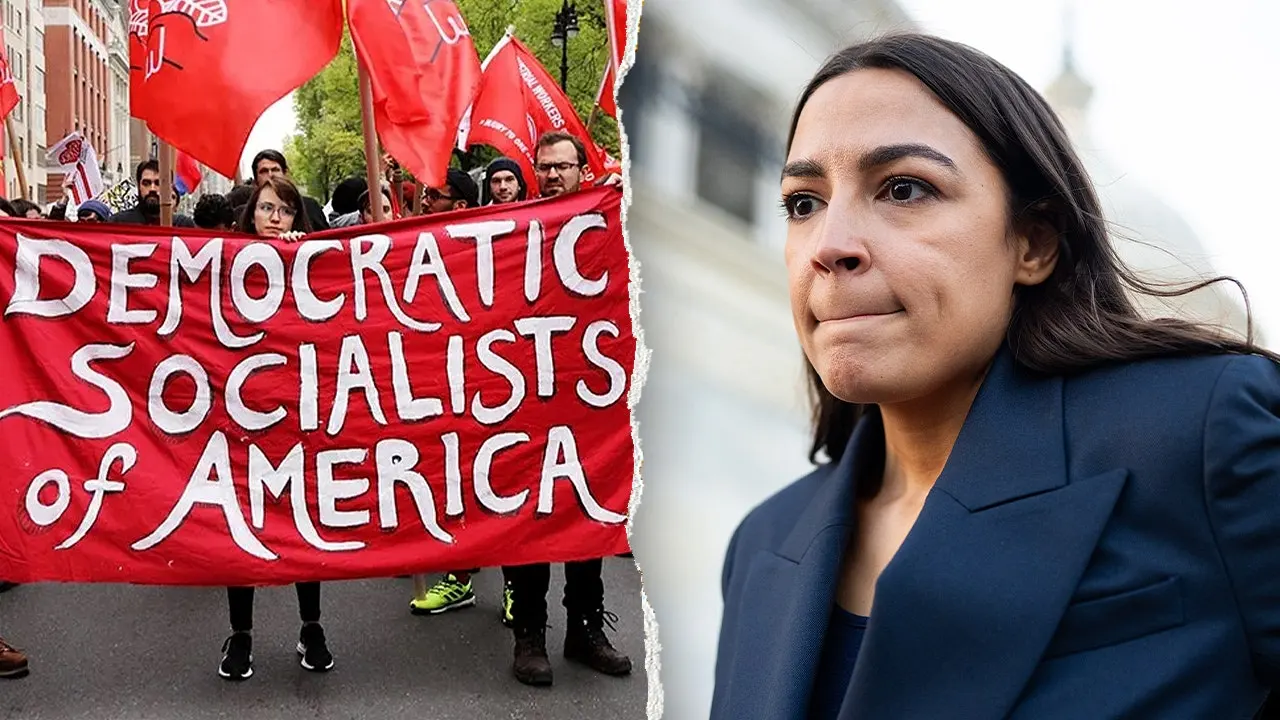
The scene at Cornell, however, exists within a larger and more complicated reality. While the students in that hall may have felt like the vanguard of a new moral order, the broader American public remains deeply skeptical of the movement they represent. According to a recent Fox News Poll, 55% of registered voters hold an unfavorable view of the Democratic Socialists of America, while only three in ten see the group in a positive light. That is a striking gap, one that suggests the enthusiasm of the crowd in Ithaca is not shared by most Americans. The DSA has certainly gained traction among Democrats, particularly younger ones who are more comfortable with socialist ideas than their parents or grandparents were. But the national numbers tell a different story, one in which the word “socialist” still carries a heavy burden. For many voters, the DSA is not a symbol of hope but a warning sign, a reminder of failed experiments abroad and a threat to the American Dream. The Fox News Poll is just the latest in a series of national surveys to show this divide. It reveals a country that is, at best, split along generational and ideological lines, and at worst, deeply polarized about the very meaning of justice and fairness. The students at Cornell may see themselves as heirs to a proud tradition of activism, from the civil rights movement to the anti-war protests of the 1960s. But their critics see a different legacy, one that prioritizes ideology over pragmatism and division over unity.
The political implications of this divide are not lost on Republican strategists. For years, the GOP has tried to make socialism a central issue in American elections, and the recent polling appears to validate that approach. The midterm playbook, as described by many Republican insiders, is to turn what might otherwise be a referendum on the party in power into a choice election, one where voters are forced to decide between two very different visions for the country. By highlighting the DSA and its influence on Democrats like Ocasio-Cortez, Republicans hope to paint the entire party as too far to the left, out of step with mainstream values. This strategy has already taken concrete form in Washington. House Republican lawmakers have introduced resolutions aimed at putting Democrats on the record over their association with the DSA, forcing them to either defend the group or distance themselves from it. It is a political trap, but one that only works because the underlying numbers are so favorable to the GOP. When a majority of voters view the DSA unfavorably, every Democratic politician who shares a stage with the group becomes a potential liability. For Ocasio-Cortez and her allies, this is an acceptable price to pay. They argue that the future belongs to the young, and that the energy of movements like the one at Cornell will eventually win over the skeptics. But for now, the gap between the activists in that room and the broader electorate remains vast, a chasm that no amount of chanting can easily bridge.
In the end, the event at Cornell was more than just a town hall or a campaign stop. It was a snapshot of a country in flux, a moment where the passions of youth collided with the anxieties of age. The students who filled that hall left with a sense of purpose, their voices hoarse from cheering, their hearts full of conviction. They had heard their leaders speak their language, validate their anger, and promise that change was possible. But outside those walls, in the living rooms and coffee shops of middle America, the same evening was being seen through a very different lens. For many, the images of young people chanting “from the river to the sea” and celebrating a “student intifada” were not inspiring but alarming, proof that the left had gone too far. The divide between these two perspectives is not just about policy; it is about identity, about how we see ourselves as a nation and what we believe we owe to one another. The activists at Cornell believe they are on the right side of history, that their willingness to speak uncomfortable truths will be vindicated by future generations. Their critics believe they are dangerously naive, playing with fire in a world that is far more complex than slogans and chants. Both sides are convinced of their own righteousness, and neither seems willing to budge. That is the real story of this moment, a story that will continue to unfold in the months and years ahead, as the young people who filled that hall grow older, vote, organize, and eventually take the reins of power. Whether their vision will prevail, or whether it will be tempered by the realities of governing, remains to be seen. But for one night in Ithaca, they were not thinking about the future. They were living in the moment, singing their song, and believing with all their hearts that they were part of something that would change the world.