


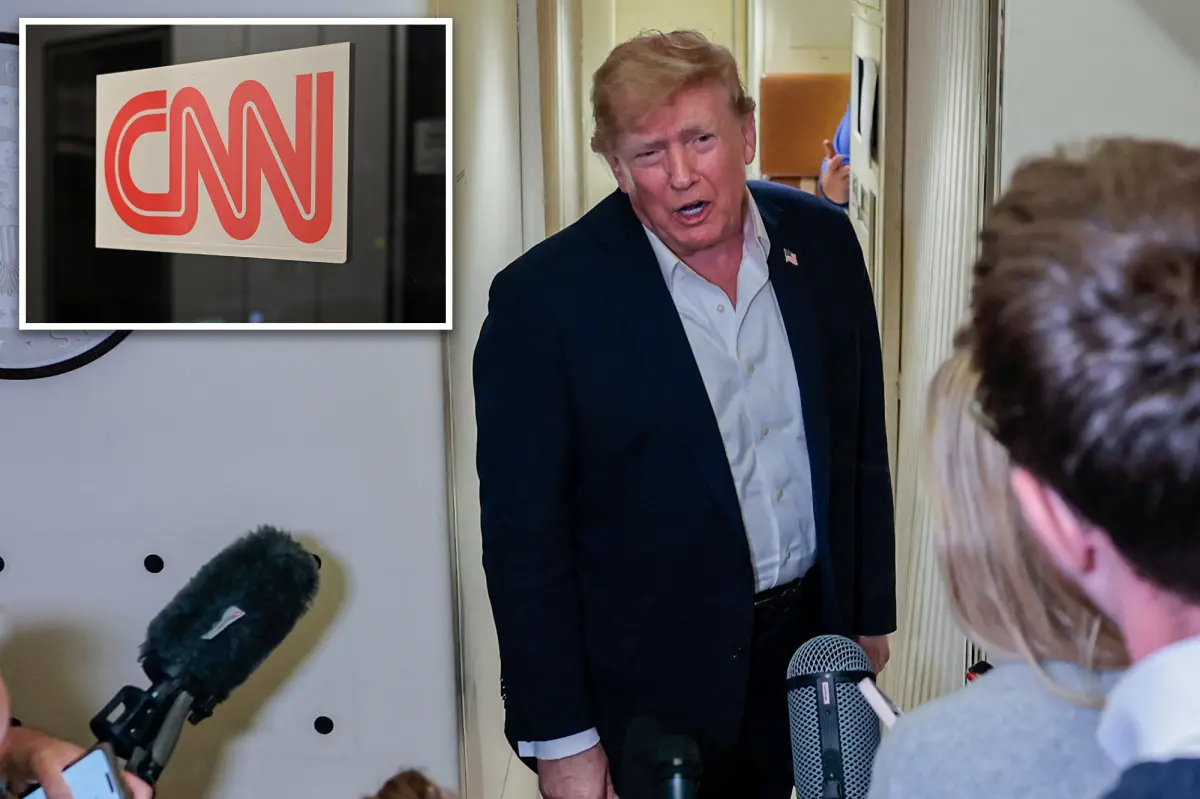
Late Friday night, the White House made a quiet but pointed decision: CNN would not be on Air Force One for President Donald Trump’s trip to Knoxville, Tennessee, on Saturday. In the world of presidential coverage, that is not a minor logistical detail. It is a signal—another deliberate restriction in an escalating standoff over media access that has raised serious First Amendment concerns. According to White House guidance, the seat typically reserved for the network pool would instead go to Real America’s Voice News, a conservative outlet that is not part of the traditional rotation of major broadcasters. Trump was scheduled to attend a college football game between the University of Tennessee and the University of Texas at midday, but the real contest, in a sense, was over who would be allowed to witness and report on the journey. For journalists, the Air Force One pool is not just a perk; it is a carefully arranged system that ensures the public has an independent, physical record of the president’s movements. When a news organization is removed from that seat, the message is unmistakable: access is not a right but a privilege, and it can be taken away from outlets the administration dislikes. The move came on the heels of an extraordinary few days, during which three news organizations were banned from White House grounds, a federal judge intervened, and the usually invisible machinery of the press pool suddenly became a national story. By Friday night, the dispute had moved from the briefing room to the tarmac, and the question hanging in the air was whether the legal system would catch up to the administration’s decision—or whether the seat on the plane would remain a flashpoint for a broader battle over press freedom.
The night’s signal was all the more striking because it came just after journalists from the three outlets that had been banned from White House grounds—CNN, MSNBC, and Politico—had returned to the executive complex with cameras, laptops, and microphones. A judge had temporarily struck down the ban in an overnight ruling, and for a moment it seemed as if the crisis might be easing. The reporters walked back into the building they had been barred from only days earlier, carrying the tools of their trade and, no doubt, a certain wariness. But the judge’s order was narrow. It addressed the White House grounds and said nothing directly about the press pool, the shared group of reporters and camera operators who cover the president on a rotating basis. Nor did it mention Air Force One. So even as the three outlets reappeared inside the executive complex, there was no guarantee that the old rules applied elsewhere. The temporary relief, in other words, was real but incomplete. For the journalists themselves, the day must have felt like a whiplash of legal progress and practical uncertainty. They had won a small victory in court, but the administration had already found another way to make its point. The pool, which is designed to be colorless and routine, had become a fault line. And the decision to replace CNN with Real America’s Voice News was a direct challenge to the idea that the traditional media should have a privileged seat in the presidential entourage.
To understand why this matters, you have to understand the pool. It consists of five major U.S. broadcast outlets that take turns shooting and sharing video of the president, so that all news organizations—large and small, friendly and critical—can have access to a common feed. It is an arrangement built on trust and cooperation, and it is one of the quiet ways American democracy keeps an independent eye on its leaders. When the White House banned CNN, which belongs to that pool, along with MSNBC and Politico, the other four pool providers refused to step in. In a rare show of solidarity, they declined to participate, which meant that, for a period, the usual video from presidential events simply was not available. That kind of blackout is almost unheard of. It was a collective decision by the press to push back against the administration’s attempt to pick and choose who would document the presidency. And for a while, it worked in a limited way: the administration was left without the standard pool feed, and the dispute became painfully visible to anyone paying attention. But the absence of video also meant the public lost a measure of transparency. The pool is not about giving journalists a comfortable seat; it is about giving the American people a witness. When the White House tries to swap a traditional pool member for an outlet more ideologically aligned with the president, it undermines that witness. It replaces an independent, shared record with something closer to partisan coverage. That is why the seemingly technical question of who sits on the plane is, in fact, a question about the health of the democratic system.
The seat that was meant for CNN on Saturday’s flight has long been reserved for a member of the U.S. network video pool—and Real America’s Voice News is not a member of that pool. So the substitution was not just a one-day change in seating arrangements; it was a break with a longstanding practice. The judge’s temporary order, which had allowed the three outlets back onto White House grounds, did not directly address this new situation. The legal fight, it seemed, was now moving from the building to the airplane. Theodore Boutrous Jr., the lawyer representing the news outlets, did not immediately respond to requests for comment on Friday night. But earlier in the day, on CNN’s “The Lead with Jake Tapper,” he had made the plaintiffs’ position clear: they believed the recent ruling by U.S. District Judge Timothy Kelly also covers the issue of pool access. In other words, the same principle that protected the outlets from being banned from the White House should protect the pool seat on Air Force One. Whether a federal judge would agree, and whether the administration would back down, remained to be seen. What was already clear was that the administration was willing to push the boundaries of executive power over the press, testing how far it could go before the courts drew a line. For the White House, the decision to place Real America’s Voice in the pool seat was a way of saying that the traditional media’s claim to access was not sacrosanct. For journalists, it was an ominous sign that access could be granted or withheld based on political loyalty.
For a while earlier Friday, there had been signs that the standoff might be easing. The U.S. network video pool was back in operation for the first time since the three outlets were banned, and by noon CNN was able to show live footage of Trump and Chinese President Xi Jinping touring the National Archives, accompanied by Melania Trump and Peng Liyuan, Xi’s wife. The banner along the bottom of the screen read: “Trump and China’s Xi Visit National Archives.” It was a routine report from a state visit—except that CNN had not aired live video of Trump in several days. The images felt almost normal, which made them remarkable. “As of now, all systems are go,” said a person familiar with the pool, speaking on condition of anonymity because of the fluidity of the situation. But even that relief was tangled. There remained a deep sense of caution: even with the legal ruling in hand, the customary pool coverage did not simply snap back into place. The other providers had held the line in solidarity, and it was unclear whether they would resume. Eventually, for a while, the feed went live, but the networks continued to refrain from covering Trump as part of the pool in certain ways, even as reporters from the three outlets were allowed back into the White House. CNN, for its part, was not commenting directly, referring instead to its editorial coverage. But in a post on X, the network’s media analyst, Brian Stelter, noted that CNN had a pool assignment at the National Archives event and that the White House had approved the network’s credentials. That approval was an acknowledgment, however grudging, that the court’s ruling had at least temporarily forced the administration to accept the news organization’s presence. Yet by Friday night, that same administration was once again excluding CNN from a presidential trip. The day had begun with hope and ended with a reminder that the fight was far from over.
At its heart, this is not a dispute about one television network or one seat on a plane. It is about the principle that the press should be able to cover the president without fear of punishment. The administration’s actions—banning outlets from the White House, then replacing a traditional pool member with a friendlier outlet for a presidential trip—are part of a pattern that critics see as an assault on the First Amendment. Supporters might argue that presidents have always had some leeway in deciding who travels with them, and that the White House has the right to choose its own press options. But the pool exists precisely to prevent that kind of arbitrary selection. It is a shared, nonpartisan mechanism that ensures the public gets a reliable, independent record of presidential activity, regardless of which outlets the president likes or dislikes. When the White House begins to hand pool seats to sympathetic media, it is not just punishing individual journalists; it is eroding the entire ecosystem of news coverage. The legal questions are likely to continue in the coming days, as the outlets press for a clearer ruling on whether the judge’s order extends to Air Force One and the pool. But the human question is already visible: What does it feel like to be a reporter told that your presence is unwelcome, that your reporting is so threatening that you cannot be allowed to do your job? And what does it mean for the rest of us when the only witnesses allowed near the president are those who already agree with him? The answer is not just about CNN. It is about the kind of country we want to live in—one where leaders can be watched, questioned, and held accountable, or one where the official record is written by the powerful themselves.