


Let’s be honest: travel is supposed to be one of life’s greatest pleasures, but the run-up to a trip can sometimes feel like a second job. Between comparing flight prices, hunting down hotels that won’t break the bank, and trying to pack light, adding a mountain of visa paperwork on top can make even the most seasoned adventurer want to stay home. There’s something uniquely draining about filling out long forms, gathering bank statements, and paying extra fees just to step foot in a country you’re already spending money to visit. That’s why visa-free travel is such a gift. It strips away the bureaucracy and leaves you with the good stuff: the excitement of planning, the thrill of arrival, and the freedom to be spontaneous. A new study by Passport Reports has taken a close look at exactly which passports offer that freedom, ranking countries by how many destinations their citizens can enter without prior permission. They considered not only true visa-free access, but also electronic travel authorisations (ETAs) and visas on arrival, all of which make life easier. At the other end of the scale, they counted destinations where you still need to apply for a visa before you fly. The result is a clear picture of global mobility and a helpful reminder of just how much our little maroon or navy booklets shape our travel horizons.
The study’s strongest passport on Earth belongs to the United Arab Emirates, with Singapore close behind in second place. These two nations have been trading places at the top for years, and it’s not hard to see why. Travellers from the Emirates and Singapore enjoy access to an extraordinary number of countries with minimal fuss. For citizens of the UAE, a huge chunk of the world is effectively open at the airport counter. Singaporeans aren’t far behind, and their passport has long been a symbol of freedom and global connection. It’s a status that comes from diplomatic relationships, economic stability, and careful international negotiation. But for the average traveller, what matters is the feeling of being able to say “yes” to an hour-long flight deal, or to hop on a plane for a weekend city break, without first submitting your passport for weeks on end. In third place overall sits Malaysia, which might surprise some, but in recent years its passport has climbed the ranks thanks to expanding visa waivers and regional agreements. These top three are followed by a European duo and a couple of others, but the real headline for European readers is that Spain is now the continent’s most powerful passport, and the third strongest in the world.
Spain’s placement at the top of the European chart is a lovely source of national pride, but for regular Spanish citizens it’s also a practical privilege. According to the study, Spanish passport holders were given a mobility score of 174. That number reflects every corner of the globe they can reach either without a visa, with a visa on arrival, or with an electronic authorisation that you can often get online in a matter of hours. Specifically, Spanish travellers can enter 121 countries completely visa-free, which is an incredible amount of freedom. Another 42 destinations will happily issue a visa when you land, meaning you just turn up, pay a small fee, and walk through immigration. There are still 11 countries that require an ETA, which is a slightly more modern version of a visa but usually less painful, and 24 destinations that demand a traditional visa beforehand. All in all, Spain’s position means that a Spanish family dreaming of the beaches of Mexico, the temples of Southeast Asia, or the markets of North Africa can often book their flights and figure out the details later. For those of us who grew up with the older system of queuing at embassies, this is a genuine cultural shift. It turns the world into something closer to a common neighbourhood, where borders are less barriers and more like doorways waiting to be opened.
Not far behind Spain is Luxembourg, a small country with a mighty passport. In fifth place globally, Luxembourg scored 173 for mobility and offers its citizens access to 122 destinations without a visa, which is actually one more visa-free destination than Spain, even though Spain ranks slightly higher overall. Luxembourg passport holders can also enjoy 41 countries that offer visas on arrival, 10 that require an ETA, and 25 that still require a traditional visa. For a country with a population of around 650,000, that’s an astonishing level of global access. It’s a reflection of its strong diplomatic ties, affluent economy, and membership in the European Union, which gives Luxembourgish citizens the right to live and work across the bloc. And just below Luxembourg, we find Belgium and France tied for sixth place. Each of these passports allows access to 121 visa-free destinations, 41 visa-on-arrival destinations, 11 ETA countries, and 25 that require a visa. For French and Belgian travellers, this means that a weekend trip to somewhere exotic is often no more complicated than a Sunday stroll. The emotional impact of this cannot be overstated. When the hardest part of a holiday is deciding which airline to take and whether to check a bag, the world becomes a far more inviting, far less intimidating place. It encourages curiosity, cultural exchange, and the kind of spontaneous travel that creates the best stories.
The real crowd, however, gathers just below that. Six European nations share seventh place, each with a mobility score of 173: Denmark, Finland, Germany, Italy, the Netherlands, and Sweden. Citizens of these countries can travel to 120 destinations visa-free, with an additional 42 welcoming them with a visa on arrival. They’ll need an ETA for 11 countries and a traditional visa for 25. It’s a wonderfully even spread, which speaks to the collaborative nature of European diplomacy. Whether you’re from the cycling streets of Amsterdam, the lakes of Finland, or the pasta-filled piazzas of Rome, your passport essentially carries the same weight. Greece stands alone in eighth place, while Portugal and Switzerland tie for ninth, followed by Austria in tenth, Norway in eleventh, Ireland in twelfth, Japan in thirteenth, Malta in fourteenth, and Hungary and Poland sharing fifteenth place. The full ranking of the world’s strongest passports reads like a who’s who of travel-friendly nations, with the United Arab Emirates, Singapore, Spain, Malaysia, Luxembourg, Belgium, France, Denmark, Finland, Germany, Italy, the Netherlands, Sweden, and many more all sitting near the top. It’s a list that invites daydreaming, especially if you happen to hold one of those passports. But it also serves as a reminder that not everyone enjoys the same privileges, and that global mobility is far from equal.
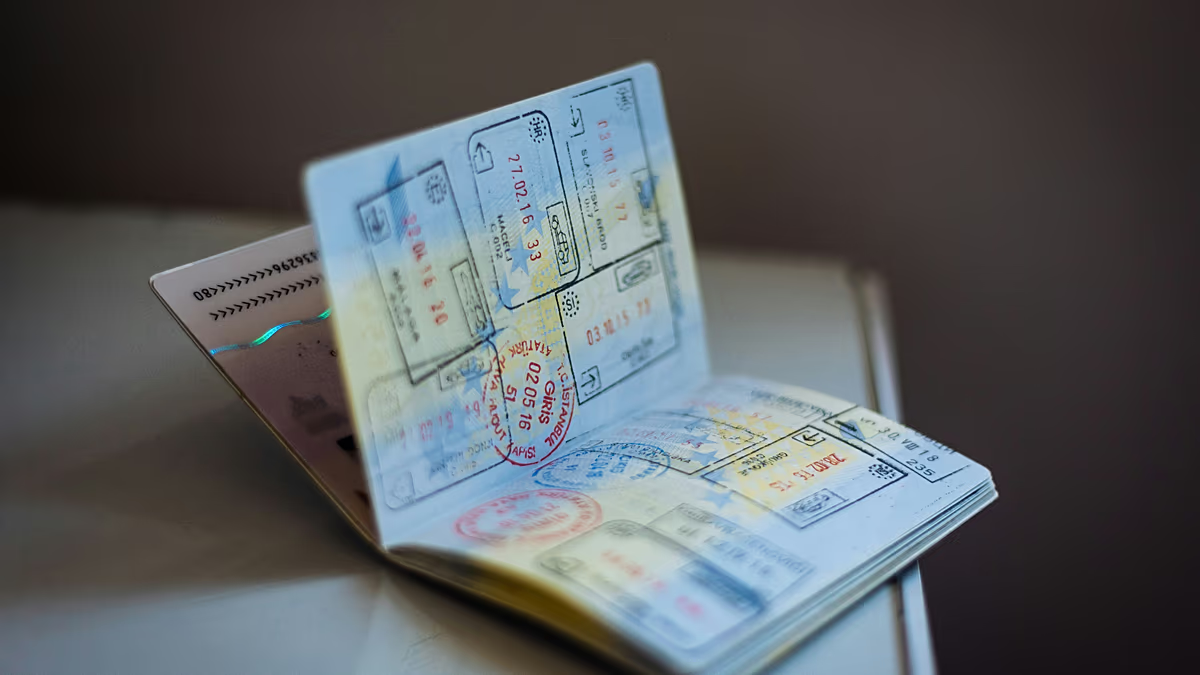
So what does all this mean for you, the traveller? For one thing, it pays to know exactly what your passport offers before you plan your next getaway. Even if your country doesn’t make the top fifteen, you might be pleasantly surprised by the number of places you can visit without the headache of a traditional visa. The study’s inclusion of electronic travel authorisations and visas on arrival reflects a broader global trend toward simplification. Governments are realising that tourism and business travel are easier, cheaper, and more pleasant when visitors aren’t drowning in paperwork. The result is a slow but steady opening of the world. For the citizens of the top-ranked countries, this is an invitation to explore more boldly. For everyone else, it’s a sign that borders are becoming more porous, and that the joy of spontaneous international travel might be closer than you think. In the end, a passport is much more than a travel document. It’s a key, a story, and a privilege all rolled into one. And while rankings and scores can tell us a lot, the true measure of a passport is the experiences it makes possible: the sunrise you never expected to see, the conversation you never planned to have, and the place that started as a dot on a map but ended up feeling like home. So dust off your passport, check your mobility score, and start dreaming. The world is waiting, and in many cases, no visa is required.