


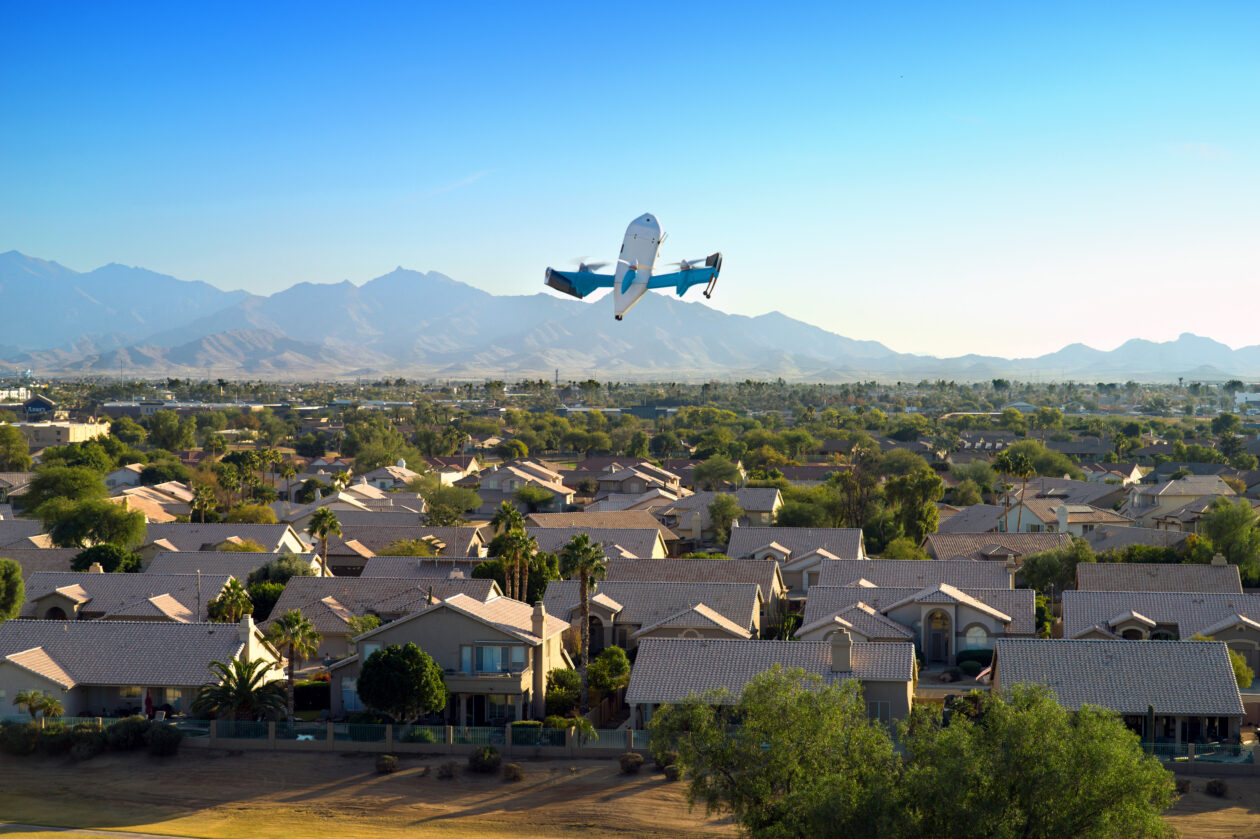
It was supposed to be the future arriving with a soft whir: a sleek, autonomous drone descending from the sky, gently depositing a package at your doorstep, and vanishing back into the clouds—all in under thirty minutes. Amazon’s Prime Air program has long been the tech giant’s most visible bet on that future, a gleaming vision of convenience where the tyranny of traffic is erased by algorithms and battery-powered rotors. But for the people living in the quiet, tree-lined neighborhoods of Richardson, Texas, that future has not arrived as a marvel of modern engineering. It has arrived instead as a persistent, droning intruder, a mechanical swarm buzzing overhead from morning until night, turning private backyards into public airspace and peaceful suburban afternoons into a nerve-jangling exercise in endurance. Residents describe the sound as a hive of bees, a low-flying lawnmower, a never-ending hum that seeps through walls, interrupts conversations, and makes sitting on a porch feel like standing under a highway. The gap between Amazon’s marketing and the lived reality of those beneath its flight paths has never felt wider, and in this Dallas suburb, the future is not something to be celebrated—it is something to be endured, questioned, and, increasingly, fought against.
The scope of the disruption is difficult to grasp until you actually start counting, and some residents have done exactly that. Stephanie Puri, a Richardson homeowner, told reporters that she logged 52 drone passes over her home in a single day—and that, by her own description, was a “slow day.” The flyovers are not a distant droning lost among ambient city sounds; they are loud enough to penetrate her home even with the television on, forcing residents to choose between constant background noise and the eerie silence of staying indoors with everything shut. This is not a stray delivery or an occasional novelty. It is a regular, industrial-scale operation happening directly above a residential neighborhood. Amazon’s Prime Air fleet, including the newer MK30 hexacopter designed to carry packages weighing up to five pounds, operates out of local fulfillment centers and flies directly to designated drop zones. The Richardson facility, located near a major Amazon hub, has become a key launching point for the company’s aggressive expansion. Amazon has announced ambitious plans to scale drone deliveries to nearly 500 U.S. cities and towns by the end of 2026, and North Texas, with its favorable weather, sprawling suburbs, and business-friendly incentives, has become the testing ground for this aerial experiment. For the company, the numbers look like progress; for the people below, they look like an invasion.
Amazon’s official response to the complaints has been predictably polished and reassuring. A company spokesperson emphasized that customer feedback for Prime Air has been overwhelmingly positive, with fewer than one percent of inquiries this year related to noise. The company maintains that the sound of a drone on the ground is minimal, short-lived, and comparable to a low window fan or a passing car. But for residents living directly beneath the designated flight paths, statistics and corporate analogies offer cold comfort. The sound of a car passing is transient, a moment fading into the distance; the sound of a window fan is a choice, easily switched off. What these residents describe is neither brief nor optional. It is a rhythmic, repetitive presence that punctuates their days with mechanical regularity, disrupting conversations in the garden, startling children at play, and shattering the kind of stillness that suburban homeowners have spent their lives trying to cultivate. Nikki Anderson, another Richardson homeowner, told the Times that the relentless low-altitude flyovers had ruined an outdoor space her family once considered a peaceful sanctuary. What was once a refuge has become a place to be abandoned, a spot where you can no longer relax without waiting for the next buzz. Anderson’s words capture the emotional toll of what is happening: “Some people might think, wow, this is really, really cool, and the technology is really cool,” she said. “But people around here, we’re thinking, ‘Ugh, is there anything we can do to stop this?’ We can’t live like this.”
The frustration is compounded by lingering anxieties about safety and privacy that go far beyond the noise. Earlier this year, a Prime Air drone crashed into an apartment building in the Richardson area—an incident Amazon attributed to a GPS glitch before temporarily pausing high-rise deliveries. The crash was a stark reminder that the machines buzzing overhead are not just noisy nuisances; they are physical objects with real weight and real potential for failure, flying over homes where children sleep and families gather. For many residents, the crash validated their unease. They watch the drones through flight-tracking apps, monitoring how close the machines come to their rooftops, their yards, their windows. The sense of being watched is hard to shake, even when the drones are only carrying household goods. The technology may be designed to deliver toothpaste and batteries, but it also brings with it a new form of surveillance—an ever-present aerial eye that can hover, observe, and record without asking permission. Residents are not just losing quiet; they are losing the unspoken assumption that the space above their homes belongs to them. In a country where homeownership is synonymous with privacy, dominion, and control over one’s own slice of land, having to sit beneath a continually buzzing flight path feels less like progress and more like dispossession.
What makes the situation particularly maddening for those affected is the realization that they have almost no power to change it. Municipal governments, they have learned, have virtually no authority to regulate the skies above their own neighborhoods. The Federal Aviation Administration holds sole jurisdiction over national airspace, which means local officials cannot restrict flight paths, set noise limits, require higher altitudes, or even meaningfully challenge Amazon’s routing decisions. The city of Richardson, like every other municipality in the country, is largely powerless in the face of federal preemption. This has turned the debate into an uneven fight: a multibillion-dollar global corporation with high-powered lobbyists and a friendly federal regulatory framework against a group of homeowners armed with decibel readings, flight logs, and a growing sense of injustice. And Richardson is not alone. Across North Texas, commercial drone delivery has exploded, with the region becoming ground zero for what some have called an aerial “drone arms race.” Amazon is locked in intense competition with rivals like Walmart, Alphabet’s Wing, and DoorDash, all of whom are actively testing and expanding suburban drone drop-offs across the Dallas-Fort Worth metroplex. The companies see a goldmine of consumer convenience; the residents see an uncontrolled experiment conducted above their heads without their consent.
Feeling that they have no choice but to mobilize, a group of affected neighbors has formed what they call the “drone warriors.” They use flight-tracking mobile apps to meticulously document the overhead traffic, noting patterns, frequencies, and times, and they have begun urging municipal leaders to push back within the limited levers available to them. They want stricter local enforcement, higher flight altitudes, and stronger accountability measures—not as a rejection of technology, but as a demand for balance. Their larger goal is to serve as a warning to other communities before the skies over their own neighborhoods are similarly opened up. Scott Bratcher, the Richardson resident who compared the sky above his house to a beehive, summed up the group’s frustration and resolve on TODAY: “They need to do a lot more research, they need to hold Amazon accountable, we need to have rules,” he said. “And if they don’t follow the rules, take away their toys, turn them off.” It is a sentiment that cuts through the corporate chatter about innovation and convenience, landing instead on something more fundamental: the right of people to live peacefully in their own homes. No one is asking for a ban on drones, exactly—what they are asking for is recognition that neighborhoods are not testing grounds, that residents are not guinea pigs, and that the future of delivery cannot be built by sacrificing the sanctity of home life. Until Amazon and the FAA are willing to listen, the skies over Richardson will remain contested, and the hum overhead will keep reminding everyone below of the price they are being asked to pay for a convenience they never asked for.