



Come on Barbie, let’s go latke! For generations of Jewish children, the holiday season has been a complicated mix of joy and longing. While their friends unwrapped dolls dressed as Santa’s little helpers or angels with tinsel in their hair, Jewish kids often found themselves improvising, dressing their Barbies in scraps of fabric that vaguely resembled a dreidel, or simply accepting that their favorite toy’s world didn’t include Hanukkah. That changed this week when Mattel debuted its first official Hanukkah Barbie as part of the legendary toy brand’s Holiday Sweaters collection. The $28 doll joins two Christmas Barbies—one blonde, one Black—dressed in red-and-green sweaters that light up with the press of a hidden button. Those dolls have all the classic Barbie hallmarks: swishy hair, shiny lips, Malibu-approved full smiles, wide eyes, and button noses. Hanukkah Barbie, though, is something else entirely. She is not just a holiday accessory slapped into a familiar mold. She is a different kind of dreamhouse resident, one who seems to have been designed with a specific cultural identity in mind. And as soon as her photos hit the internet, she sparked a conversation that is at once tiny and enormous, superficial and profound, about what it means to see yourself in a plastic icon, and what happens when the image staring back at you is both beautiful and complicated.
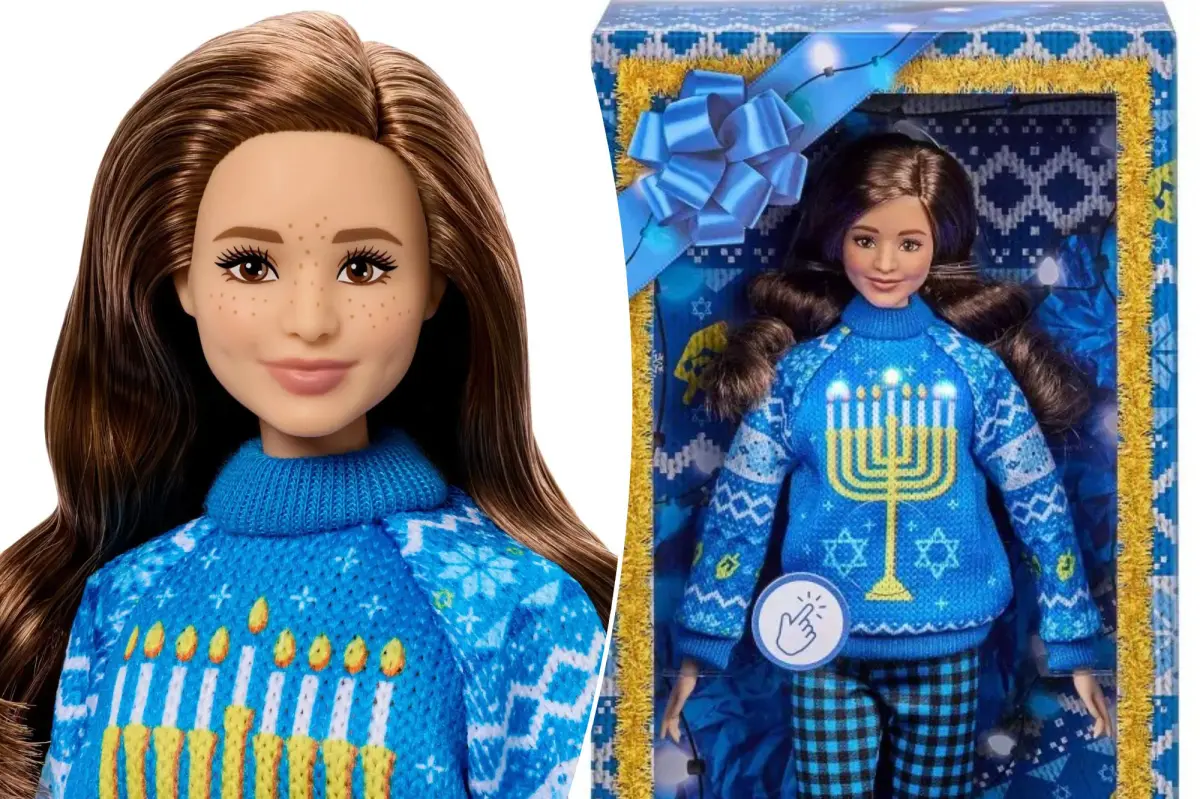
At first glance, Hanukkah Barbie is a feast of wintery blue joy. She wears a cobalt sweater printed with a giant menorah, baby blue dreidels, tiny snowflakes, and blue Stars of David, a festive homage to the eight-night holiday. Her legs are wrapped in blue checkered leggings, and her feet are tucked into miniature Ugg boots—adorable, practical, and probably the first thing she’ll lose during an epic “summer camp color war” playroom battle. But her face is where the real story begins. This Barbie has olive-toned skin, a thick mane of babka-brown hair, and a closed half-smile with a matte finish. She doesn’t have the glossy, open-mouthed grin of her Christmas counterparts. She seems quieter, wryer, a little more knowing. And then there is the nose. It’s noticeably more pronounced than the noses on her red-and-green neighbors, an angular, jutting bridge that gives her profile a distinctive character. According to observers, the doll appears to be an update of Barbie’s “Violet” mold, first created in 2018, but her punim—her face—has been reshaped in ways that echo a certain Jewish archetype. For some, that nose is a welcome dose of authenticity, a tiny plastic rebellion against the homogenized California-girl standard. For others, it trips alarms, evoking centuries of caricature in which Jewish features were exaggerated into grotesque stereotypes. It’s strange to think that a children’s toy could carry so much cultural weight, but Hanukkah Barbie doesn’t just represent a holiday. She represents a people, with all their history, pride, and anxiety.
Online, the reaction has been fiercely divided. On Reddit, where the doll was first spotted and scrutinized, users debated her facial features with the intensity of art critics and the passion of family members at a holiday dinner. “The nose seems to have more of a bump to mimic more ‘Jewish’ facial features,” noted one Redditor. “She looks different,” mused another commenter. “Her nose appears more prominent.” But some went further, using the word “hooked” to describe her profile. That adjective has a dark history: for centuries, the hooked nose was used to vilify and “other” Jewish people, appearing in anti-Semitic propaganda, Nazi caricatures, and even as a template for Disney’s Wicked Witch in “Snow White.” For many Jewish viewers, seeing that shape on a doll intended to celebrate their heritage feels less like representation and more like a trigger. “She deserved better,” grumbled one Barbie fan online, criticizing not only the nose but also her “printed, cheap” outfit. Alexis, a 45-year-old Upper West Sider, told The Post, “I love that a Barbie celebrates Hanukkah, but why does she have to have a different nose? It’s so small in the scope of things, and obviously it’s not meant to be harmful. But I can’t unsee it.” There is something painful in that admission: the desire to be delighted, undermined by a nagging sense of unease. No one wants to think that the first official Jewish Barbie might accidentally reinforce the very stereotypes that have been used to hurt Jewish people. And yet, there she is, her nose asking uncomfortable questions about assimilation, prejudice, and self-image.
But for every skeptical voice, there are others who see Hanukkah Barbie as a cause for celebration, even joy. Conservative Rabbi Yael Buchler of Riverdale, a Jewish educator who runs the creative Midrash Manicures account on Instagram, is thrilled that the doll resembles members of her congregation. “Ruth Handler was Jewish, and I think she would be kvelling to know there’s a Hanukkah Barbie,” she said, using the Yiddish word for beaming with pride. “I’m sure generations of kids have had Barbie celebrate Hanukkah long before Mattel made Hanukkah Barbie. Now Hanukkah is officially part of Barbie’s world, and that feels so special.” Her point is powerful: Jewish children have long practiced a kind of imaginative labor, adapting mainstream toys to fit their own traditions. Now, the company created by a Jewish woman has made that adaptation official. Daphna Michaelson Jenet, executive director of the David Merage Foundation for Confronting Antisemitism, also weighed in, acknowledging the nose while pushing back against the alarm. “I do think the nose looks larger on this Barbie,” she told The Post. But she noted that larger can be beautiful, as long as it’s rendered with respect. She regularly holds workshops for brands and media studios to help them avoid anti-Jewish tropes, and she sees no malicious intention here. The new Hanukkah Barbie, she said, “has a beautiful face. It’s nothing little Jewish girls would be ashamed of.” Her comment cuts to the heart of the debate: What does it mean to be ashamed of a feature? And what does it mean to be proud of it? For many Jewish women, the nose is a site of deep ambivalence, an inherited feature that has been mocked, minimized, and surgically altered for generations. A doll that simply allows that nose to exist—without apology, without exaggeration—might be more radical than it seems. Mattel representatives were asked whether members of the Jewish community were involved in the making of the doll, but they did not provide comment by press time. That silence leaves a question hanging in the air: Was this a thoughtful collaboration, or a well-intentioned miss?
The broader context matters here. Barbie has evolved enormously since her 1959 debut. In recent decades, Mattel has introduced dolls of different races, body types, abilities, and styles, from hijab-wearing Barbies to dolls with vitiligo and prosthetic limbs. These efforts are often praised, sometimes criticized, and always scrutinized. Jewish identity, however, is more difficult to represent than skin color or physical disability because it exists at the intersection of religion, ethnicity, culture, and history. There are Jews of every race; there are secular Jews, observant Jews, Ashkenazi Jews, Sephardic Jews, Mizrahi Jews. There is no single “Jewish look,” but there is a loaded cultural imagery around certain features—especially the nose. For centuries, the Jewish nose was used as proof of otherness, a visible marker that supposedly revealed a person’s true nature. In Nazi Germany, Jewish schoolchildren were taught to measure their noses against anti-Semitic diagrams. In America, Jewish actresses underwent rhinoplasty to “de-Semite” their profiles, a rite of passage that many saw as a betrayal and many others saw as survival. Ruth Handler herself, the Jewish woman who created Barbie, understood something about assimilation and aspiration: she named the doll after her daughter and modeled her on a German adult novelty toy, intentionally crafting an idealized figure that would appeal to American consumers. Would she recognize herself in Hanukkah Barbie? Would she be proud of that prominent nose, or would she wonder why it had to be so noticeable? We can’t know. But the questions feel important, not because they have easy answers, but because they reflect the ongoing struggle of a community that is too often invisible in mainstream representation, and when finally noticed, too often reduced to stereotype.
In the end, Hanukkah Barbie is both a toy and a Rorschach test. To a young Jewish girl, she might be a miracle: a doll that celebrates her holiday, wears her colors, and shares her grandmother’s nose. To a parent who has spent a lifetime hearing jokes about Jewish features, she might be a source of complicated feelings. Neither reaction is wrong. The doll’s existence is a milestone—a sign that Jewish life is no longer relegated to the margins of the holiday aisle. But her design is also a reminder that representation is not a destination; it’s an ongoing conversation. The fact that we are arguing about a nose on a $28 doll says less about the doll herself than about how much unhealed history we carry in our features. We want our children to see themselves as beautiful. We want them to feel that they belong. And we want the world to recognize them without caricature. Hanukkah Barbie does not resolve those desires. She cannot. She is, after all, just plastic and paint and printed fabric. But she has done something remarkable: she has made millions of people talk about Jewish identity, about beauty, about prejudice, and about the simple, profound power of seeing a menorah in Barbie’s hands. Maybe that’s the real miracle of Hanukkah. Light is not found in grand gestures but in small, stubborn acts of visibility and hope. So yes, come on Barbie, let’s go latke. Let’s celebrate. Let’s critique. Let’s ask questions. Let’s keep the conversation going—because the holiday teaches us that even a tiny amount of light can push back against a great deal of darkness. And in her own quiet, babka-haired, slightly more prominent-nosed way, this Barbie is holding up a candle.