


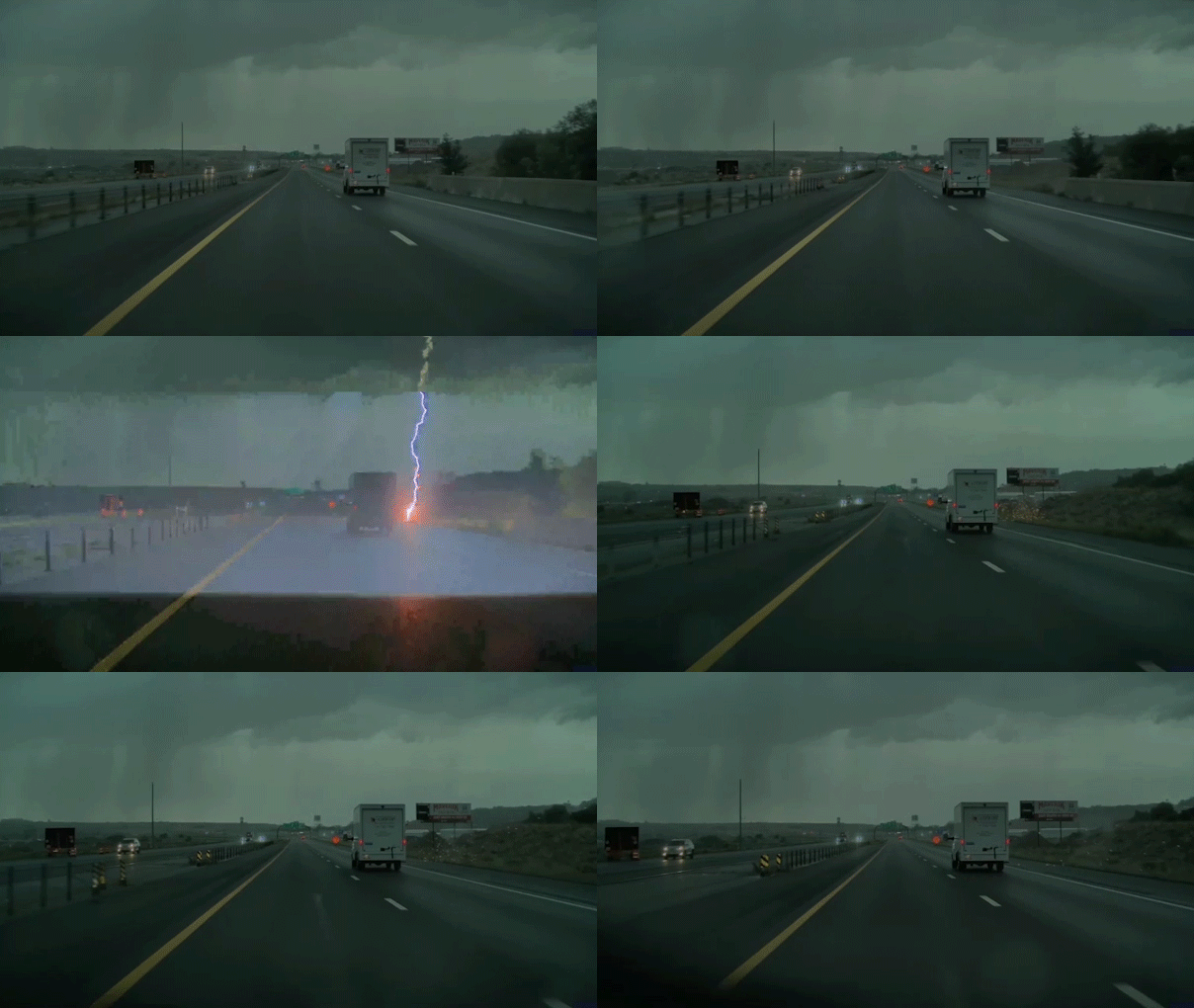
It was just another Tuesday night commute along Interstate 84 in Utah, the kind of drive thousands of people make without a second thought. The sky had turned an ominous shade of gray, and the first rumbles of thunder echoed through the Weber Canyon as a cold front swept through the region. Tucker Ralphs, a motorist heading home after a long day, had his dashcam running. What he captured was a moment of sheer, terrifying luck. As a truck drove along the freeway, a bolt of lightning slammed into the pavement just feet away from the vehicle—an explosion of light so intense that it momentarily erased the surroundings. Ralphs later described the experience as “louder than you can imagine, with a very sharp ‘crack’ and ‘boom.’ Super bright, then gone in an instant.” The National Weather Service later confirmed that the flash marked a direct lightning strike on the side of the freeway, hitting at around 9 p.m. local time. The truck driver never even knew how close he came. He kept rolling, probably oblivious to the fact that in a fraction of a second, the full fury of the sky had nearly reached him.
There is something uniquely humbling about lightning. It is one of nature’s most brilliant and violent phenomena, capable of delivering temperatures hotter than the surface of the sun in a single, blinding burst. And yet it is also wildly indiscriminate. It doesn’t care about your schedule, your worries, or whether you are a good person. It simply strikes wherever the atmosphere allows, often choosing the most unlikely places—a lonely stretch of highway, a golf course, a walking path, even a towering dinosaur statue in a roadside attraction. For the truck driver in Utah, the margin between life and death was measured in mere feet. His story, captured on video, became a reminder of how fragile we all are, even when we think we are safe inside a metal vehicle. The dangers of lightning are often underestimated, because it seems like such a rare event in our daily lives. But for those who have witnessed a close strike, the experience leaves an indelible mark. The air crackles with electricity, the smell of ozone fills the nostrils, and every hair on the body stands on end. In that moment, you understand that you are not in control—you are just a tiny creature standing under a sky that holds unimaginable power.
The Utah close call was just the latest in a string of lightning-related incidents that made headlines this month, each one a sobering reminder of how deadly a single bolt can be. In a different part of the country, a young man named Matthew Eric Jenkins had just begun a new chapter of his life. At just 20 years old, he had packed his bags and moved from Michigan to Central Florida to start an internship program at Walt Disney World—a dream opportunity for a young person looking to make his mark in the world. Days after his arrival, Jenkins was out on a walking path when he was apparently struck by lightning. Despite the desperate efforts of witnesses who performed CPR on the scene, the young man did not survive. His death was a devastating blow to his family, who had watched him take the brave step of moving to a new state, excited for the future. There is no way to prepare for that kind of loss. His story, heartbreakingly ordinary and profoundly tragic at the same time, shows that lightning doesn’t just produce close calls and dramatic videos—it can also take lives in an instant, leaving behind deep sorrow and a community searching for answers.
These stories often surface in clusters, and the past few weeks have been no exception. There was the incredibly lucky golfer in Ohio who survived being struck by lightning while filming himself on the course—his video showing the exact moment the bolt hit him, a testament to both human resilience and the bizarre randomness of fate. Then there was the spectacle of a 100-foot dinosaur statue turning into a raging fireball after a lightning strike, a surreal image that stunned onlookers and went viral. On the surface, these stories might seem like nothing more than internet curiosity—oddities to be shared and mocked or marveled at. But taken together, they paint a more profound picture. Lightning is both a creator of spectacle and a marker of human vulnerability. It can be captured on camera, studied by meteorologists, and predicted with some degree of accuracy, but it can never be controlled. That unpredictability is what makes it so fascinating and so frightening. We like to believe that we have mastered nature, that our buildings, cars, and smartphones have placed us above the raw forces of the earth. But when a bolt strikes a few feet from a truck on an interstate, all that modern confidence is stripped away. We are reminded that there are still forces in this world that hold the ultimate power of life and death.
Perhaps that is why so many people are drawn to these stories—not because they want to gawk at tragedy, but because they recognize themselves in these moments. The truck driver was just going home. The young intern was just taking a walk. The golfer was just doing something that made him happy. None of them were doing anything reckless or unusual. They were simply living their lives in a world where nature does not always follow the rules we think we understand. And yet, there is also something profoundly hopeful about these stories. The truck driver survived. The golfer survived. Their close calls are stories of grace, of a hand of fate turning just the right way. For Jenkins, the outcome was different, and his tragic death is a reminder that survival is never guaranteed. When the rain starts to fall and the sky darkens, we are all equal. We all have to make the choice to take shelter, to respect the storm, and to remember that a few seconds of exposure to the elements can change everything. In the aftermath of these incidents, meteorologists and safety experts often repeat the same advice: when thunder roars, go indoors. It’s a simple phrase, but it carries weight. Many lightning victims are struck outdoors, often in open spaces where they feel exposed yet somehow invulnerable—a beach, a park, a golf course, a walking path. The human tendency is to assume that nothing bad will happen, that the storm will pass, that the odds are in our favor. But lightning is a numbers game, and all it takes is one strike.
As the footage from Utah continues to circulate online, people will watch it with a mixture of awe and disbelief. They will see the bright flash, the crack of energy hitting the asphalt, and the truck driving through the chaos as if nothing had happened. And they will wonder, perhaps, what they would have done in that situation. Would they have slammed on the brakes? Pulled over? Kept going? The truck driver’s reaction—or lack of one—may seem surprising, but it is also a reminder of how insurance and instinct work together in moments of crisis. He kept his focus on the road, and the storm passed. In many ways, the image is a perfect metaphor for life itself: the storms come, the lightning strikes, but we keep moving, carrying hope and determination forward even when the world around us seems to be exploding. These stories are not just about weather; they are about what it means to be human. They are about the fragility of our bodies and the strength of our spirit. They are about the families left behind, the witnesses who tried to help, and the strangers whose fate could have been so different. They are about the shared experience of living in a world that is beautiful, terrifying, and completely out of our control. And in that shared experience, there is a quiet connection that binds us all—a reminder to hold on to each other, to cherish each ordinary moment, and to step into each new day with the awareness that the sky above us is vast, powerful, and always watching. The same sky that almost took a truck driver in Utah can also deliver the calmest sunset, the softest rain, and the promise of a new morning. It is a force to be respected and never taken for granted. So as you go about your own commute, or walk through your neighborhood under an uncertain forecast, remember the stories of those who have faced lightning and lived, and those who did not. Remember the young man in Florida who had a bright future ahead of him, and the truck driver who was simply trying to get home. Their stories are a testament to the fragile, miraculous nature of human existence—a reminder that every safe arrival home, every normal day, and every breath we take is, in its own way, a gift. And when the next storm rolls in, let it be a prompt to slow down, seek shelter, and appreciate the profound, mysterious, and ungovernable world we live in.