


Albania’s tourism story is unlike any other. For most of the second half of the twentieth century, this small Balkan nation was sealed off from the world under the iron grip of Enver Hoxha, a dictator who built tens of thousands of bunkers to defend against an invasion that never came. Foreign tourists, when they were allowed in at all, were rare and carefully scrutinized. After Hoxha’s death and the eventual fall of communism, the doors creaked open, and a slow trickle of curious travelers began to arrive. Economists and travel insiders watched with cautious curiosity. Would anyone want to visit a country that had spent decades cultivating suspicion of outsiders? The answer, it turns out, was a resounding yes. Today, Albania’s tourism figures are staggering. In 2025, arrivals hit 11.9 million, a modest 3.3% increase over the previous year but a jaw-dropping 93.6% jump compared with 2019. The phrase “Maldives of Europe” has been splashed across travel magazines, including Euronews Travel, and the world has responded by booking flights, renting cars, and filling ferry seats. But there is no single explanation for Albania’s meteoric rise. Rather, a constellation of factors has aligned: a hunger for authenticity, a global desire for affordability, and the simple, magnetic allure of a place that was once forbidden. There is something about a country that was locked away for decades that makes it endlessly fascinating. We want to see what we were once not allowed to see, and Albania offers that discovery in spades.
The boom is deeply tied to the ever-shifting whims of travelers who are always searching for the next hidden gem. A decade ago, Croatia—and Dubrovnik in particular—became a bucket-list destination, thanks in large part to Game of Thrones. With dragons and kings came crowds, and crowds inevitably led to the search for somewhere quieter. Tourists began drifting down the Dalmatian coast, discovering Montenegro’s bay-filled shoreline. And now, the wanderers have pushed further south still, crossing into Albania, where the Ionian Sea shimmers in impossible shades of turquoise and blue. The Albanian Riviera, with its pebbly coves, citrus groves, and seaside villages, has become the answer to the question every traveler asks after a crowded summer: where can I go that still feels undiscovered? But it’s not just the beaches that have fueled the rise. The relative ease of moving around the region by bus has turned Albania into a natural stop on a longer multi-country itinerary, with visitors traveling from North Macedonia, Kosovo, and Montenegro. For those flying directly, the expansion of Tirana International Airport helped, but the real game-changer came in 2020 when Wizz Air established a base there, suddenly connecting Albania to the rest of Europe with cheap, direct flights from Barcelona, Budapest, London, Madrid, Rome, and Stockholm. Affordability matters enormously. Albania offers prices that feel like a throwback, a place where your euros stretch further than they have in years. But perhaps the biggest factor is the sheer variety of experiences packed into such a small country. You can hike through alpine peaks in the morning, swim in the Mediterranean by afternoon, and eat lamb cooked under a copper bell for dinner. Albania doesn’t just give you one reason to visit; it gives you a dozen, and each one pulls you deeper into its complicated, beautiful story.
Tirana, the capital, is the perfect gateway into that story. It is a city of contrasts, where Ottoman-era mosques stand beside hulking communist-era apartment blocks and gleaming glass towers rise from the rubble of old industries. Begin at Skanderbeg Square, named for the 15th-century national hero who resisted the Ottomans and whose statue stands proudly at its center. The National Historical Museum, though closed for renovation until 2028, still offers a visual history lesson through the enormous mosaic that covers its exterior: an Illyrian warrior, a fighter from the Albanian National Awakening, the solemn figure of Mother Albania, and a determined communist worker. Standing there, you can feel the weight of centuries compressed into tile and stone. For those, like me, whose curiosity about communist-era Albania runs deep, the House of Leaves is unmissable. Hidden behind an unassuming facade, this museum was once the headquarters of the Sigurimi, Albania’s notorious secret police. You can wander through former interrogation rooms, listen to wiretapped recordings, and stare at surveillance photographs, all of which paint a chilling portrait of a society watched by its own people. Hoxha’s paranoia left another legacy scattered across the countryside: hundreds of thousands of concrete bunkers, about 5.7 per square kilometer. Most lie derelict, overtaken by moss and graffiti, but some have been repurposed. Near Skanderbeg Square, Bunk’art 2 takes visitors into a labyrinth of tunnels that once sheltered the political elite, now filled with exhibitions about life under the shadow of the secret police. The larger Bunk’art 1, located on the outskirts of town, is a sprawling underground complex that covers Albania’s history from the 1930s through 1990. If you take the Dajti Mountain Cable Car up into the hills for panoramic views, you can easily visit Bunk’art 1 on the way back down. For lighter entertainment, Tirana Castle, also known as the Fortress of Justinian, has been transformed into a lively maze of independent restaurants, cafes, and craft shops tucked within its ancient walls. Tirana is famously cheaper than city breaks in neighboring countries, and that has helped birth a thriving nightlife scene. The Blokku district, once a restricted area for party officials, is now the heart of the action. Try Hemingway for live jazz and rum-heavy cocktails, Radio Bar for a more alternative vibe, or Ruka’s Bar 1991 for a cold beer. And at some point, you must drink raki, the fiery local spirit, preferably in the company of someone who will toast your health with a gravelly “gëzuar!”
From the restless energy of Tirana, it is a short journey to the calm of Shkodër, a town that feels suspended in time beside Southern Europe’s largest lake. The lake is shared between Albania and Montenegro—Lake Shkodër on the Albanian side, Lake Skadar on the Montenegrin side—and it is a place of immense, quiet beauty. You can explore the town on foot, wander through the cobblestone streets, and climb to Rozafa Castle for sweeping views over the water, but the best way to experience the lake is to rent a bicycle and follow the winding paths along its shore. This is not a place for rushing. It is a place for long lunches, lingering conversations, and watching fishermen mend their nets in the late afternoon sun. I stayed at Hotel Tradita, a boutique property housed in a building that dates back to 1694, once the home of the Albanian poet Filip Shiroka. The rooms are adorned with traditional textiles, antique furniture, and photographs that seem to whisper of another era. Even if you are not staying there, you should make time to visit its restaurant, where you can sample slow-roasted meats, savory byrek, local cheeses, and house-made wine, all accompanied by raki and, on many evenings, live Albanian folk music that echoes through the wood-beamed courtyard. From Shkodër, you can also set out on popular day trips to the Shala River and Lake Koman, the latter often described as one of the most beautiful boat journeys in Europe, with steep forested gorges and impossibly blue water. This is also the starting point for adventures deeper into the Albanian Alps, where the road ends and the trails begin. Shkodër reminds you that travel is not always about crossing things off a list; sometimes, it is about slowing down enough to let a place settle into your bones.
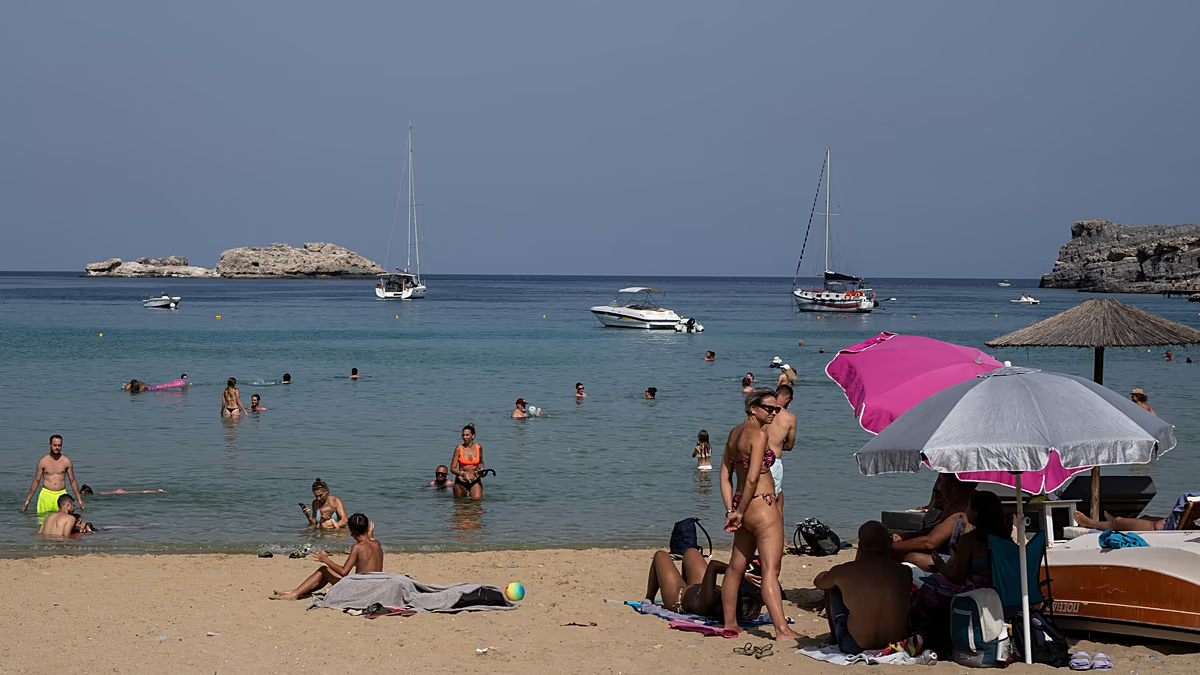
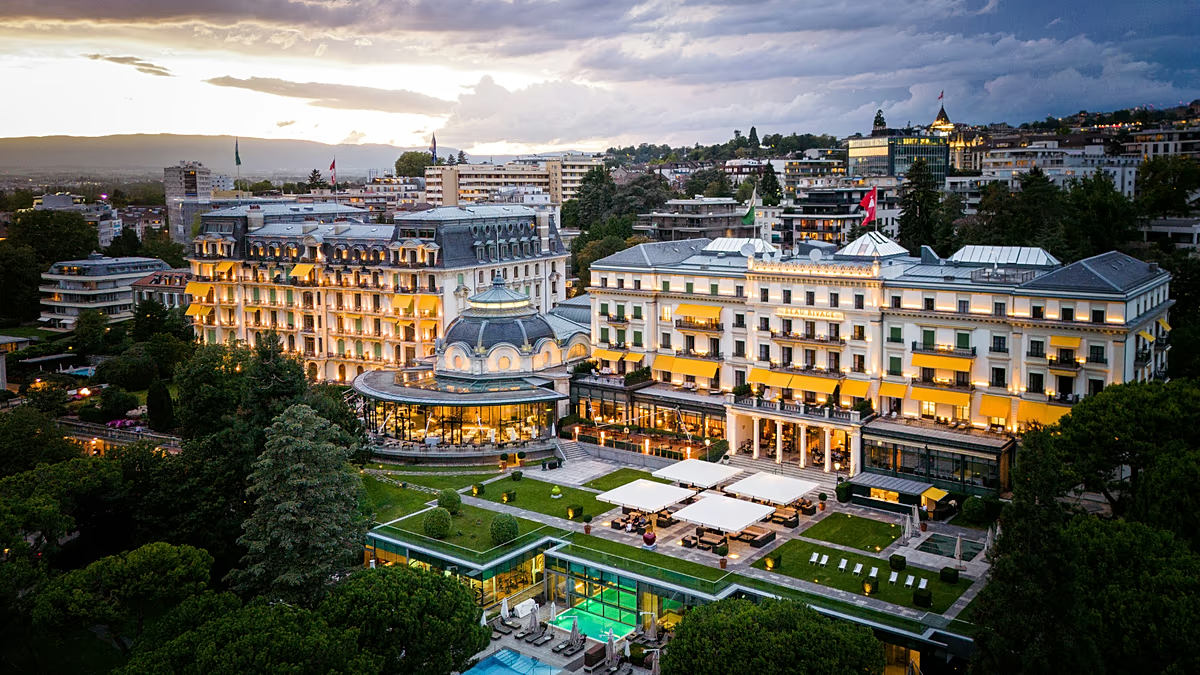
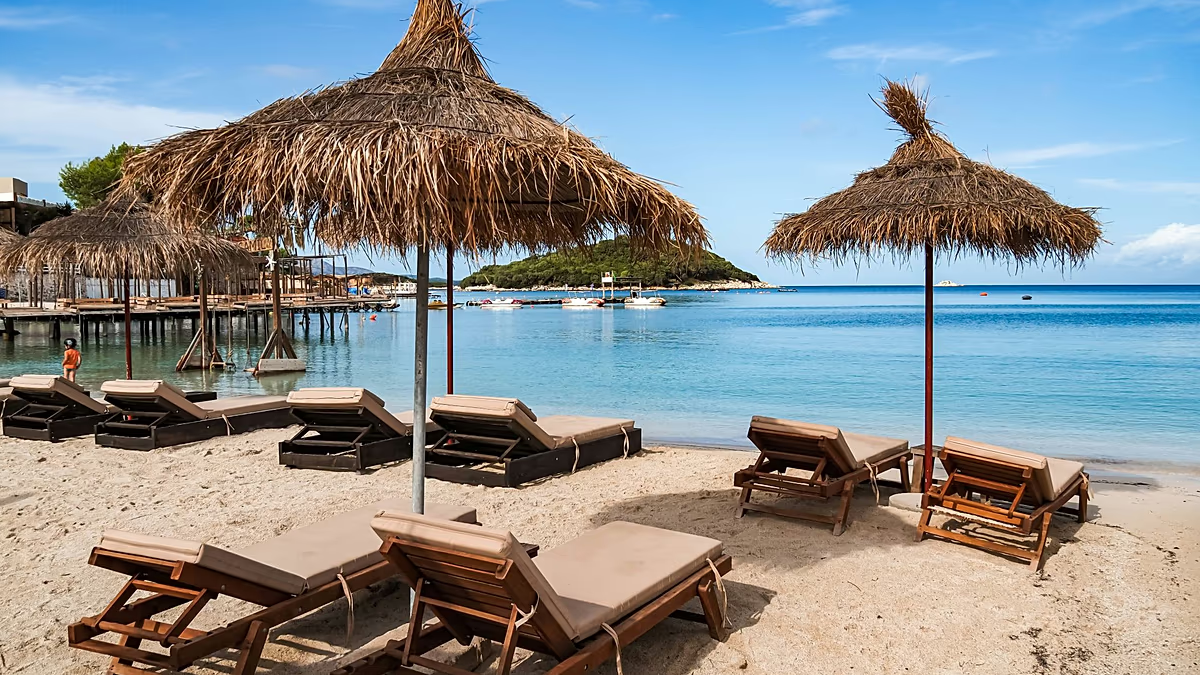
For those who prefer their landscapes wilder, the Albanian Alps offer some of the most dramatic hiking in Europe. The Valbona Pass is the crown jewel, a legendary trail that connects the remote villages of Valbona and Theth. It is roughly 12 kilometers long and takes between seven and ten hours to complete, depending on your pace and how often you stop to take photographs, which you will do constantly. The path climbs through pine forests, skirts sheer cliffs, and eventually opens onto a high mountain pass where the views are nothing short of breathtaking. In early summer, the meadows are speckled with wildflowers, and sheep bells ring out in the distance. It is a demanding hike, but every step feels earned. At the far end, the village of Theth welcomes weary trekkers with guesthouses, cold beer, and homemade bread. There is a genuine sense of accomplishment that comes from completing this route, a feeling that you have truly seen Albania’s rugged heart. Then, of course, there is the coast, the place that has earned all the hype: the Albanian Riviera, the so-called “Maldives of Europe.” The name is a little over the top, but to be fair, the water really is that clear, and the beaches really are that soft. Vlorë, Albania’s third-largest city, has seen the biggest influx of visitors, its long beachfront now lined with umbrellas and seafront bars. Further south, the villages of Dhërmi, Sarandë, and Ksamil offer a more laid-back vibe, with hidden coves, olive groves, and islands just a short boat ride away. The tourism boom has also brought waves of investment. Five-star hotels have begun to appear along the coast, including Green Coast Hotel – MGallery Collection, which opened in June last year; Crowne Plaza Durres by IHG, which opened earlier this year; and Miamar Luxury Hotel & Spa. Yet the real magic of the Albanian Riviera remains in its unpolished moments: eating grilled octopus at a wooden table on the sand, snorkeling in a quiet bay, and watching the sun turn the Ionian Sea into a sheet of molten gold.
Getting to Albania has never been easier. Tirana International Airport is well connected to major European hubs, with direct flights from London, Frankfurt, Amsterdam, and Istanbul, though many of these are seasonal, so it is wise to check schedules before planning your trip. For those who prefer to travel overland, there are regular buses to Tirana from nearby cities such as Skopje and Ohrid in North Macedonia, Podgorica and Budva in Montenegro, and Pristina and Prizren in Kosovo. The relative simplicity of reaching Albania is a sign of how far the country has come. But the real journey begins once you arrive. Albania will not always be comfortable. The roads can be bumpy, the signs sometimes confusing, and the wifi occasionally unreliable. But that is precisely the point. In a world where so many places have been polished into theme-park versions of themselves, Albania remains gloriously, authentically itself. It is a country that has lived through isolation, survived painful transitions, and emerged with a fierce pride and an open heart. Whether you come for the history, the mountains, the beaches, or simply the chance to say you were there before it became fully mainstream, Albania will meet you with warmth, feed you until you cannot move, and send you home with stories you will tell for years. The boom may bring change, but it cannot erase the spirit of a place that waited so long to welcome the world. Go now, or go later, but go—and when you do, raise a glass of raki to the strange, beautiful miracle of Albania.