


For many of us, pets are not just animals; they are family. The idea of boarding a plane and leaving a beloved dog or cat behind can turn the excitement of a holiday into a source of guilt and stress. Happily, in Europe, travelling with pets is possible, but it is never a simple matter of adding an extra ticket. AirAdvisor, a global flight and baggage compensation service, recently reviewed the pet policies of 22 European airlines to see which carriers deserve the tail-wagging seal of approval. The results show a deeply varied landscape. Some airlines happily accept a small cat or dog in the cabin, where your companion can sit at your feet and you can whisper reassurances during take-off. Others require larger pets to travel in the hold, which is a separate and often anxiety-inducing section of the aircraft. A few airlines even allow pets to accompany their owners into branded airport lounges, making the wait before a flight feel less like a chore and more like a shared adventure. But alongside these warm gestures, there are restrictive rules: weight limits, breed bans, age minimums, codeshare complications, and entire countries where pets must be shipped as freight. Picture yourself trying to plan a Mediterranean escape with a golden retriever, a soft-sided carrier that barely fits under the seat, and a dozen tabs open on your laptop. The question “Can I take my dog with me?” turns out to be a labyrinth of fine print. The truth is that every pet owner can find a workable route, but only if they understand the map.
Let’s start with the most common rule. Across Europe, the magic number for in-cabin pet travel is usually 8kg, including the carrier. If your pet and carrier together weigh less than that, many airlines will let your furry friend ride in the passenger cabin, tucked under the seat in a soft-sided carrier. If your pet weighs more, you may be asked to place it in the hold, where the temperature and pressure are controlled but the environment is much less comforting. The good news is that “hold” does not have to mean “careless”; many airlines have dedicated, climate-controlled compartments. Still, it can be frightening for an animal that is used to being near you. The AirAdvisor study also found that certain breeds, especially bulldogs and pugs, may face extra restrictions or outright bans because their short noses make breathing difficult at altitude. Puppies and kittens younger than 12 weeks are usually not permitted to fly, and some airlines require a vet’s certificate for animals under 14 weeks. Premium and business class cabins are rarely pet-friendly, regardless of how much you paid for your own seat. Codeshare flights, where another airline operates the plane, are another hurdle: the airline that actually carries your pet sets the rules, not the airline you booked with. Connections involving different carriers can be even more challenging, since each leg may come with its own policy. And destination matters as much as departure: the UK, USA, Australia and Hong Kong often require pets to travel separately as freight, with additional paperwork, quarantine and costs. The emotional takeaway is obvious—your pet is not a suitcase, but some airlines have not fully realized that yet.
If you are setting your sights on Greece, Aegean Airlines stands out as a genuinely welcoming choice. It allows a dog or cat to travel in the cabin, provided the pet and carrier weigh no more than 8kg together. The cost is refreshingly reasonable: €35 on domestic flights within Greece and €65 on long-distance intercontinental routes. For those with larger pets, Aegean also offers a hold option, with direct domestic flights costing between €50 and €90 and direct international flights between €110 and €180. The exact fee depends on the pet’s weight, and if you have a connection, there is a small additional charge. Aegean also lets pets into its branded lounges as long as they remain in their carriers, so you can enjoy a coffee and a pastry with your companion quietly beside you. Perhaps the most important thing about Aegean is the clarity of its policy; there is no confusing maze of conditions. Just a straightforward plan for cabin, hold and lounge. Across western Europe, Air France and KLM offer similarly robust options. Air France allows one dog or cat per passenger in the cabin, with a maximum weight of 8kg. Pets between 8kg and 75kg can travel in the hold, but any animal over 75kg is not allowed on board at all. International flights require pets to be at least 15 weeks old, although within France and Corsica, or on routes to Guadeloupe, Martinique and Réunion, pets from eight weeks can travel in the cabin. The fees are not cheap—€70 to €250 for in-cabin and €100 to €750 for hold—but the airline is clear that only soft-sided carriers are accepted and that pets are welcome in the lounge if they stay inside their carrier. KLM mirrors many of these policies, with fees ranging from €70 to €500 each way. For travellers who want reliable infrastructure and consistent customer service, this group is a strong contender.
Austrian Airlines is another pleasant surprise, especially if you have two small pets. It permits two cats or two dogs in the cabin as long as the combined weight does not exceed 8kg, which is likely to mean two tiny companions sharing one carrier. The fee ranges from €65 for domestic flights within Austria to €125 for long-distance intercontinental flights. Austrian requires a soft, bite-proof carrier, and pets must stay in that carrier in the cabin and in the airline’s lounges. This is a sensible rule, but it also means your pet will have a comforting den-like space during the journey. Brussels Airlines takes a similarly practical approach. Up to two small cats or dogs can fly in the cabin, with the 8kg weight limit including the carrier. The cost is between €80 and €115 depending on the route. For those with unusual companions—rabbits, fish, rodents, birds—Brussels Airlines requires them to travel as cargo in the hold, with fees from €100 to €380 depending on carrier size. That may feel impersonal, but at least the option exists, and it is clearly explained. Finnair, meanwhile, is a dream for travellers who want flexibility and a touch of Nordic open-mindedness. Cats and dogs can travel in the cabin or hold on all routes, and the airline also accepts hedgehogs, tortoises and rabbits from any EU country in either the cabin or the hold. Ferrets can travel in the hold from any country. You can bring two pets of the same species in one carrier, as long as the total weight remains under 8kg. Fees are €60 within Europe and €120 for intercontinental flights in the cabin, while hold fees are €140 within Europe and €650 for intercontinental journeys. Booking at least seven days before departure is cheaper, and Finnair lounges welcome pets in carriers. This kind of creativity makes Finnair particularly appealing to people who share their lives with pets beyond the usual cats and dogs.
Further east, LOT Polish Airlines is another contender to keep on your radar. It allows cats, dogs and ferrets to travel in the cabin or the hold, with a cabin limit of two animals of the same species and a weight ceiling of 8kg. The fees are very humane: €44 for domestic flights within Poland, €70 for short-haul European routes, and €100 for long-haul. What makes LOT extra special is its lounge policy: pets are allowed to roam around under the constant supervision of their human. If your animal is well behaved, this can be a joyful release before a long flight. Lufthansa, one of Europe’s aviation giants, also makes room for pets. It allows up to two pets per passenger, in the cabin, in the hold, or even separately as cargo. In-cabin fares vary by route and animal size, ranging from €50 to €110 one-way, while cargo hold fees start at €80 and climb to €380. Lufthansa’s lounges are pet-friendly, but pets must remain in their carriers at all times. SAS Scandinavian Airlines is another fantastic option for northern travellers. You can bring up to two pets, with a cabin weight limit of 8kg. Pets must be at least eight weeks old, and if they are younger than 14 weeks, a vet’s certificate is required. In-cabin fees start at €55 for domestic flights within the inter-Scandinavian network and go up to €149 for routes to China; hold fees range from €90 for domestic flights to €725 for long-haul China routes. SAS lounges also accept pets in carriers, so your companion can stay close until boarding. TAP Air Portugal rounds out the list with a simpler, no-frills policy. Only cats and dogs are accepted, but passengers can bring up to two pets aged at least 10 weeks. The cabin weight limit is 8kg, while the hold limit is a generous 32kg. Prices are attractive if you book online: €40 for domestic Portuguese flights in low season, €170 for intercontinental flights in high season, and €78 to €247 for hold transport. TAP doesn’t advertise lounge access for pets, so if that matters to you, be sure to check before assuming.
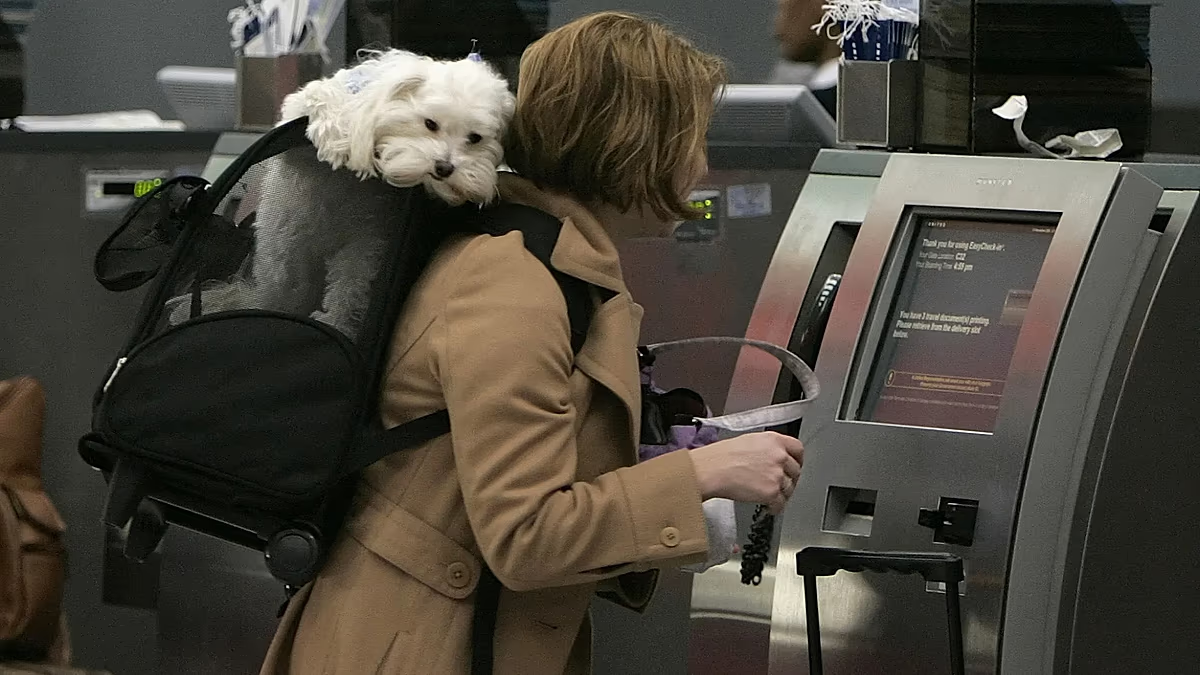
With so many options, choosing the right airline can feel overwhelming, but it also means that most pet owners can find a way to travel together. The first step is to know your pet’s exact weight in its carrier. If it fits under 8kg, the cabin is your best bet; if not, look for an airline with a kind hold policy and a fee you can afford. Book early, because there are usually limits on how many animals can fly in the cabin, and some airlines offer lower rates for bookings made at least a week in advance. Double-check age requirements, especially for international travel, and ask about vet certificates. Pay attention to your destination: the UK, USA, Australia and Hong Kong have particular regulations that may require your pet to travel as freight, with all the additional paperwork and cost that implies. Try to avoid codeshare flights and itineraries that change airlines halfway through, as each segment may have its own rules about carriers, weight and documentation. And if you want to share a lounge with your pet, investigate the airline’s policy before you arrive—some will ask you to keep the carrier closed, while a rare few, like LOT, may allow supervised roaming. Also, don’t be shy about asking your vet for advice on flying with your particular pet. Some animals simply do better in the cabin, while others may find the hold too stressful; your vet can help you make a responsible decision. At the end of the day, the best airlines are those that treat your animal as a living being, not as cargo. They make fees transparent, communicate restrictions clearly, and offer small comforts like lounge access and soft-sided carriers. They know that the person sitting by the window with a carrier under the seat is not just a passenger; she is someone who loves an animal and wants to include it in her life. That is the real test of a pet-friendly airline. With careful research, a dose of patience, and perhaps a favourite blanket in the carrier, you and your pet can head off into the sunrise together. And when the plane lands, you will both be ready for the adventure—because the best holiday memories are the ones we share with the ones we love, even the four-legged ones.