



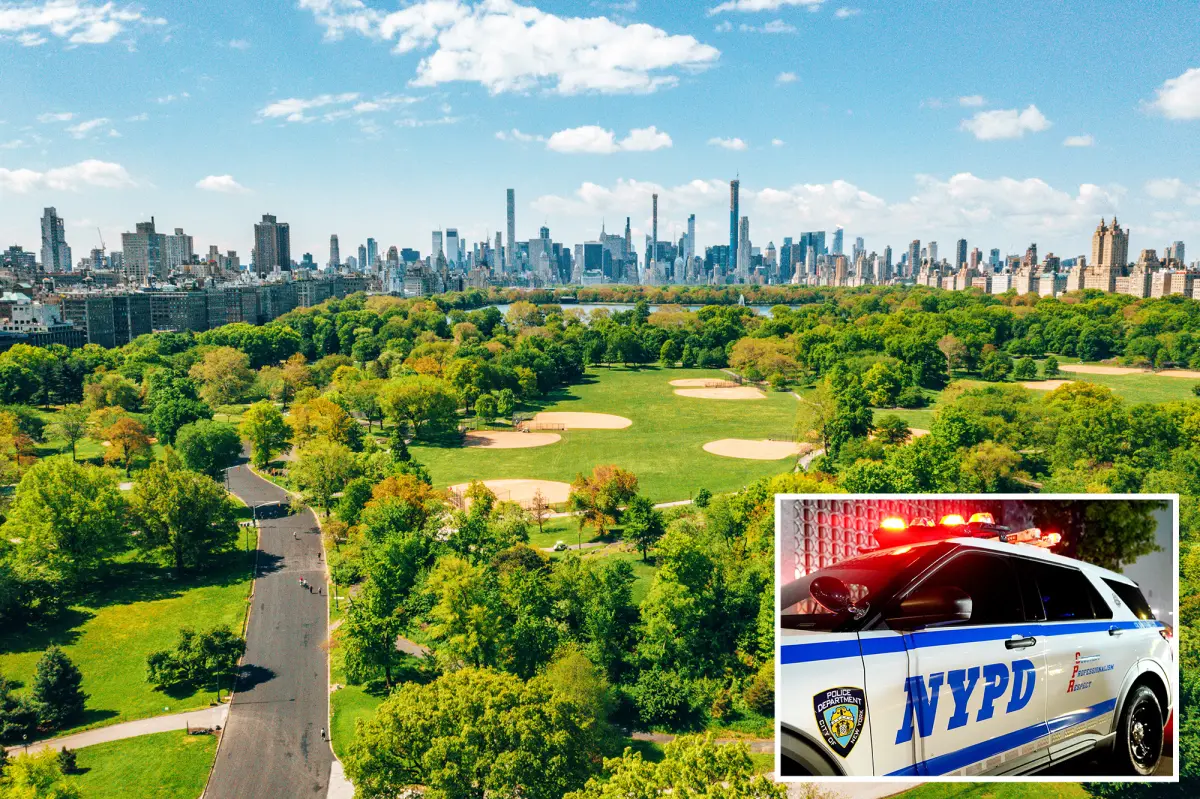
Central Park is often described as the lungs of New York City—a sprawling, living patch of green where the noise of traffic fades into birdsong and the skyline appears only above the trees. For generations, New Yorkers have gone there to run, to walk, to sit on a bench and think, to escape the pressure of the streets. But on Thursday night, that peace was violently interrupted. Police say a group of gun-toting thugs terrorized parkgoers along East Drive, robbing six people at gunpoint in four separate incidents over roughly one hour. The victims were targeted for their cellphones, the quickest and most valuable prize a mugger can grab in the dark. The first robbery was reported at 8:41 p.m. near East 79th Street and East Drive. A 28-year-old man told officers he had been approached by three unknown males. One of them flashed a gun. Before he could react, his phone was gone, and the three men pedaled away on bicycles, vanishing east through the park. It was a frighteningly efficient crime: no struggle, no warning, just a sudden presence, a gleam of metal, and a life turned upside down in seconds. Police were still investigating Friday, and no arrests had been made. Detectives were not yet certain whether all four robberies were committed by the same crew, though the timing and description pointed to a coordinated operation. For anyone who loves Central Park, the news landed like a cold splash of reality: the sanctuary has cracks, and Thursday night exposed them.
The first victim’s ordeal is a window into the terror that unfolded. A 28-year-old man, perhaps out for an evening jog or a walk to clear his head, found himself surrounded by three strangers near East 79th Street. In the dim light, the park must have felt quiet, familiar, safe. Then one of the men produced a gun. The victim later told police that the weapon was displayed, not fired, but the message was unmistakable: comply or risk everything. His phone was snatched from his hand, and the trio was gone, their bicycle wheels cutting through the darkness. In that moment, the victim lost more than a device. He lost the easy assumption that bad things happen to other people, in other neighborhoods, on other nights. He likely spent the next hour trembling, calling police, retelling the story to officers, and wondering what he could have done differently. The answer, of course, is nothing. This was not a crime of personal anger; it was a robbery of opportunity, calculated and cold. The muggers did not need to speak much. A gun does the talking. For the victim, the image of that weapon probably replays in his mind every time he closes his eyes. The phone can be replaced, but the sense of safety cannot. What happened to him was not just theft; it was a violent reminder that public space can turn hostile in an instant. And the fact that it happened in Central Park, a place so woven into the city’s identity, made it feel even more personal for everyone who heard the news.
About fifty minutes later, the same script played out again, this time near East 109th Street and East Drive. A 46-year-old man was approached by three males, one of whom displayed a firearm before grabbing his phone. This victim was older, perhaps someone who remembered a different era of the city, or perhaps someone who had moved to New York recently and was still learning the rhythms of the park after dark. Either way, he was caught off guard. The geography matters here: East 109th Street is not the heart of the tourist trail. It is a quieter stretch, where locals walk their dogs and runners push themselves along the loop. The attackers knew that. They moved northward, away from the busiest areas, hunting for people who might be less likely to resist and less likely to be heard. The 46-year-old man handed over his phone. What else could he do? A firearm in the park is not a negotiation; it is a command. After the robbers fled, he was left standing in the shadows, heart pounding, trying to process what had just happened. He may have felt embarrassed, angry, or ashamed, even though none of it was his fault. The police arrived and took his report, but the suspects were already gone. The night air, which had felt so refreshing at the start of his evening, must have felt heavy and dangerous as he walked home. He was one of six people targeted in the span of an hour, but to him, the crime was singular, deeply personal, and life-changing.
Just fifteen minutes after that, the robbers struck again, and this time they hit two groups at the same location. Police were called to East 106th Street and East Drive, where a 22-year-old man and a 20-year-old woman told officers they had been confronted by three males, including one who displayed a gun. Their phones were taken. Almost at the same moment, two 43-year-old men flagged down police and said the same thing had just happened to them: three males, a gun, stolen cellphones. Imagine the chaos of that scene. Officers arriving to find multiple victims, some pointing in the direction the suspects fled, others still shaking with adrenaline. The two younger victims might have been friends taking a late-night walk, talking about work or school, when the shadows produced three figures. The two older men might have been colleagues, finishing a long day, deciding to cut through the park because it seemed safer than the crowded sidewalk. In both cases, the gun changed everything. There is something uniquely degrading about being robbed in a group. You look at the person next to you, and you both realize you are powerless. The robbers knew exactly what they were doing. They isolated no one; they didn’t need to. They had the weapon, and everyone knew it. The victims handed over their phones, hoping that would be enough. Perhaps they even said “take it, just don’t hurt us.” The suspects, according to police, fled east toward Fifth Avenue after the final robberies. They left behind a trail of shocked, hollowed-out people and a neighborhood suddenly alert to its own vulnerability.
The police investigation continued into Friday, with detectives trying to piece together a timeline and determine whether the same group of three males was responsible for every robbery. The evidence strongly suggested a single crew, moving on bicycles, using the park’s winding paths as escape routes. But without confirmed identifications, investigators had to keep an open mind. They likely pulled surveillance footage from park cameras and nearby buildings, interviewed each victim multiple times, and combed the area for any discarded item or overlooked witness. The fact that the suspects were on bicycles made them harder to track; they could duck into the park’s many entrances and exits, disappear into the city’s grid, and regroup somewhere else. For the public, the uncertainty was almost as unsettling as the crimes themselves. If the police couldn’t say whether it was one group or several, how could anyone know whether the danger had passed? The incident also revived familiar questions about safety in Central Park after dark. The park has always been a place of contrasts: beautiful and serene by day, shadowy and unpredictable by night. Most nights, the darkness is peaceful. But Thursday night was a reminder that the same trees that block out the city also block out witnesses. The same winding paths that make a run feel adventurous can also conceal a mugger. Community leaders and local residents began to murmur about increased patrols, better lighting, and the need for witnesses to come forward. The NYPD urged anyone with information to call their tip line. But the deeper message was simpler: no one should have to fear for their life while walking through Central Park. The victims did nothing wrong. They were in the wrong place at the wrong time, but the wrongness belonged entirely to the robbers.
In the aftermath, the city is left to wrestle with a painful truth. Central Park remains a treasure, a place of healing and recreation, but it is also part of a city where crime can erupt without warning. The six victims are not just statistics; they are people who will carry this night with them. The 28-year-old man may never run that stretch of East Drive again without glancing over his shoulder. The 46-year-old man may start walking with his phone tucked deep in his pocket. The two young people and the two older men may find themselves replaying the moment the gun appeared, wondering if they could have screamed, run, or fought back. The answer is that they did the right thing by surviving. A phone is not worth a life. The robbers, whoever they are, may feel powerful tonight, but they have made themselves the center of a citywide hunt. They may have escaped on bicycles, but they cannot outrun their own faces on surveillance footage or the memories of their victims. The hope is that they will be caught, that justice will be done, and that Central Park will feel safe again. It will take time. The park’s beauty has not diminished, and its paths still offer solace to millions. But for those who were there Thursday night, the park will never look quite the same. What happened was a crime, but it was also a warning. In a city that never sleeps, danger can wake at any moment. The best response is not fear, but vigilance—and the determination to reclaim the places we love.