



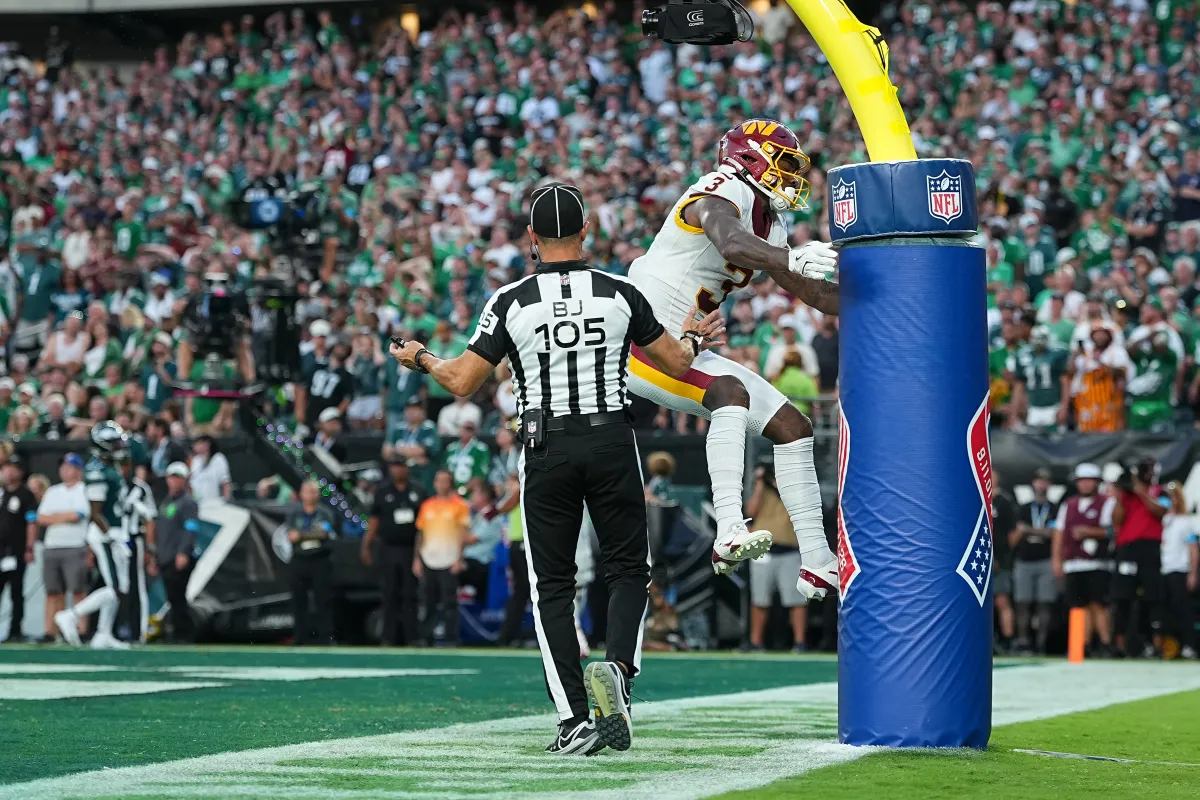
The opening Sunday of the 2026 NFL season was supposed to be a fresh start, a chance for the Washington Commanders to walk into Lincoln Financial Field and stake their claim as a team that no longer needed to apologize for anything. Instead, they left Philadelphia with the quiet, hollow ache that only a two-point loss to a division rival can leave behind. The final score read 24-22, and on the surface, it looked like a gritty, hard-fought road game against a tough Philadelphia Eagles team. But the details were crueler than the number suggested. Washington had matched the Eagles’ physicality for most of the afternoon. They had moved the ball, made big stops, and answered when the game seemed to be slipping away. Yet in the end, the difference between victory and defeat was not a miraculous scramble or a last-second field goal. It was an unforced error, a moment of celebration that turned into a penalty, a decision that shifted the game’s momentum and left everybody in the visiting locker room wondering what might have been. For a franchise desperate to turn years of underachievement into a new era of respect, losing in Week 1 was disappointing. Losing to the Eagles by two points after having a real chance to tie was heartbreaking. Losing because a veteran wide receiver jumped on a goal post felt almost absurd, the kind of mistake that turns into the lead story on sports radio the next morning.
The moment came in the fourth quarter. The Commanders were clawing their way back into the game, and Stefon Diggs, the veteran receiver who has made a career out of big plays and emotional fire, caught a touchdown pass that cut Philadelphia’s lead to 17-15. For that split second, Lincoln Financial Field felt like it might actually belong to the visitors. The play was everything the Commanders had hoped for when they brought Diggs into their world: experience, route-running brilliance, and the ability to deliver in a critical moment. What happened next was not part of the game plan. Diggs was so caught up in the emotion of the moment—the roar, the relief, the blood still pumping from the drive—that his body acted before his brain could catch up. He jumped onto the goal post, wrapped his arms around it, and hung on with the kind of unself-conscious joy that used to be part of football’s personality. He didn’t do it to taunt the Eagles or to disrespect the crowd. He did it because that’s what his instincts told him to do. Almost immediately, the flag came out. Unsportsmanlike conduct. Fifteen yards. The celebration that had felt so natural was now a wound of Washington’s own making. Afterward, Diggs was honest about what happened in that blur of adrenaline. “As soon as I wrapped my arms around it, I was like, ‘Oh, I forgot,’” he told reporters. “Back in the day—I’ve been playing for a long time—you used to be able to do that. I’ve got to be better.”
It was the kind of confession every football fan can understand, because everyone has done something impulsive in a moment of high emotion and immediately wished they could take it back. But in the NFL, you can’t take it back, especially when the score is tight and the game is on the line. The penalty was not just a symbolic mistake; it changed how the Commanders could approach the most important possession of the game. Head coach Dan Quinn, who had begun his tenure with a culture built on accountability and physical toughness, revealed after the game exactly how close Washington had come to a game-altering decision. If Diggs hadn’t been penalized, Quinn said, the Commanders would have gone for a two-point conversion. They would have tried to tie the game at 17, steal possession of the momentum, and put the Eagles on notice. But the penalty turned that calculation into something far riskier. A 15-yard loss on the try made a two-point play considerably less appealing, so Washington was forced to settle for the extra point instead. Diggs’ touchdown had pulled the team within a point, but the scoreboard stayed stuck at 17-16 rather than equalized. In a game that would ultimately be decided by two points, that single lost opportunity was enormous. Quinn didn’t throw his receiver under the bus, but he also didn’t sugarcoat the situation. He stated the facts, explained the decision, and made it clear that the team understood the stakes of every play, especially in a division where the margins are never comfortable.
By the time Tuesday rolled around, the snapshot of that goal post jump had become the defining image of the Commanders’ first week. Diggs, who has always been a player with a loud internal voice, responded in the way that felt most authentic to him: through social media. “No more tweaking 3…” he wrote on Instagram, a line that felt cryptic to outsiders but pointed directly to his own frustration. It sounded like a man making a private promise—to his teammates, to his coaches, to himself—that he would not let another emotional surge cost the team again. The post was not an apology tour or a carefully crafted PR statement. It was a raw, half-spoken declaration of intent, the kind of thing a player writes at the end of a long, quiet night when he can’t stop replaying the penalty in his head. Diggs did not blame the crowd. He didn’t blame the officiating. He didn’t say the rule was outdated or unfair, even though he had a point when he talked about how celebration rules have changed over the years. He simply accepted responsibility. There is something almost humanizing about a veteran athlete saying “Oh, I forgot” in a moment like that. It reminds you that these players are carrying years of muscle memory, old habits, and emotional wiring that doesn’t just switch off when a new rule is introduced. Diggs has spent more than a decade playing football at the highest level, and in that tiny space between a touchdown and a penalty, he was not a calculating professional. He was just a player who had made a play and reacted the way his body had always reacted.
What made the mistake feel even heavier was the larger story surrounding it. The Washington Commanders are a team in transition, a franchise that has been through more than its share of dysfunction and disappointment. Every game feels like a referendum on whether they have finally turned the corner. Diggs was brought in to be a stabilizing force, a veteran who could make big plays and help the younger players understand what it takes to win at a high level. And in the most critical moment of the opener, he made a big play—only to give part of it back with the kind of mistake that usually belongs in a comedy sketch, not a season opener. But the loss was not solely his fault. Football is never that simple. There were other moments, other plays, other decisions that could have swung the result in Washington’s favor. The offense had chances to convert on third downs. The defense gave up points that could not be taken back. And at the end of the day, the final score was 24-22, a margin so thin that any single moment could be blamed. Still, it is human nature to look at the one obvious error and wonder what might have been. If Diggs had simply run to the sideline and high-fived his teammates, the Commanders would have had a chance to tie the game. If they had tied the game, the fourth quarter might have felt completely different. Instead, they were forced to play catch-up, and the two-point deficit they carried at the end felt like a direct result of one split second of forgotten rules. The beauty and cruelty of football is that emotion is both its fuel and its fire. It can lift a team to impossible heights, and it can burn them in the most avoidable ways.
Now the Commanders must find a way to move forward. There is no time to wallow in what happened in Philadelphia, because Week 2 brings the Dallas Cowboys, another fierce rival with its own expectations and no concern for Washington’s bruised feelings. The NFL does not reward moral victories or valuable lessons. It puts a new challenge in front of you and asks whether you are tough enough to flush the previous one. Dan Quinn will meet with his players, watch the tape, and point out where things went wrong without turning the meeting into a public execution. He knows that Diggs is not a bad teammate and not a selfish player. He knows that sometimes the same competitive fire that produces a touchdown also causes a player to jump on a goal post. The goal will not be to dull that fire, but to teach it to live inside the rules. Diggs, for his part, will show up to practice with the same intensity he always brings. He will run his routes, catch passes, and maybe share a quiet joke with a teammate about never touching another goal post again. And when Sunday arrives, he will have a chance to turn the page. The opening loss is a reminder that discipline is not just about avoiding penalties; it is about understanding that every extra yard you give away is a yard you may need desperately in the final minutes. The season is long, and one game is never the end of the story. But for a team trying to prove it belongs in the conversation, the start of the story matters. The Commanders cannot be a team that excuses mistakes because of enthusiasm. They have to be a team that learns from them, owns them, and refuses to repeat them. The pain of a two-point loss will fade. The lesson should not. If it doesn’t, the opening Sunday of the 2026 season will become more than a footnote. It will become a warning—and for Washington, this season is too important to let one electrifying, forgetful moment define who they are.