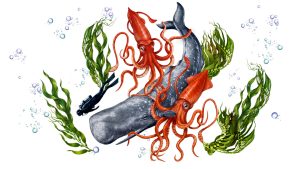



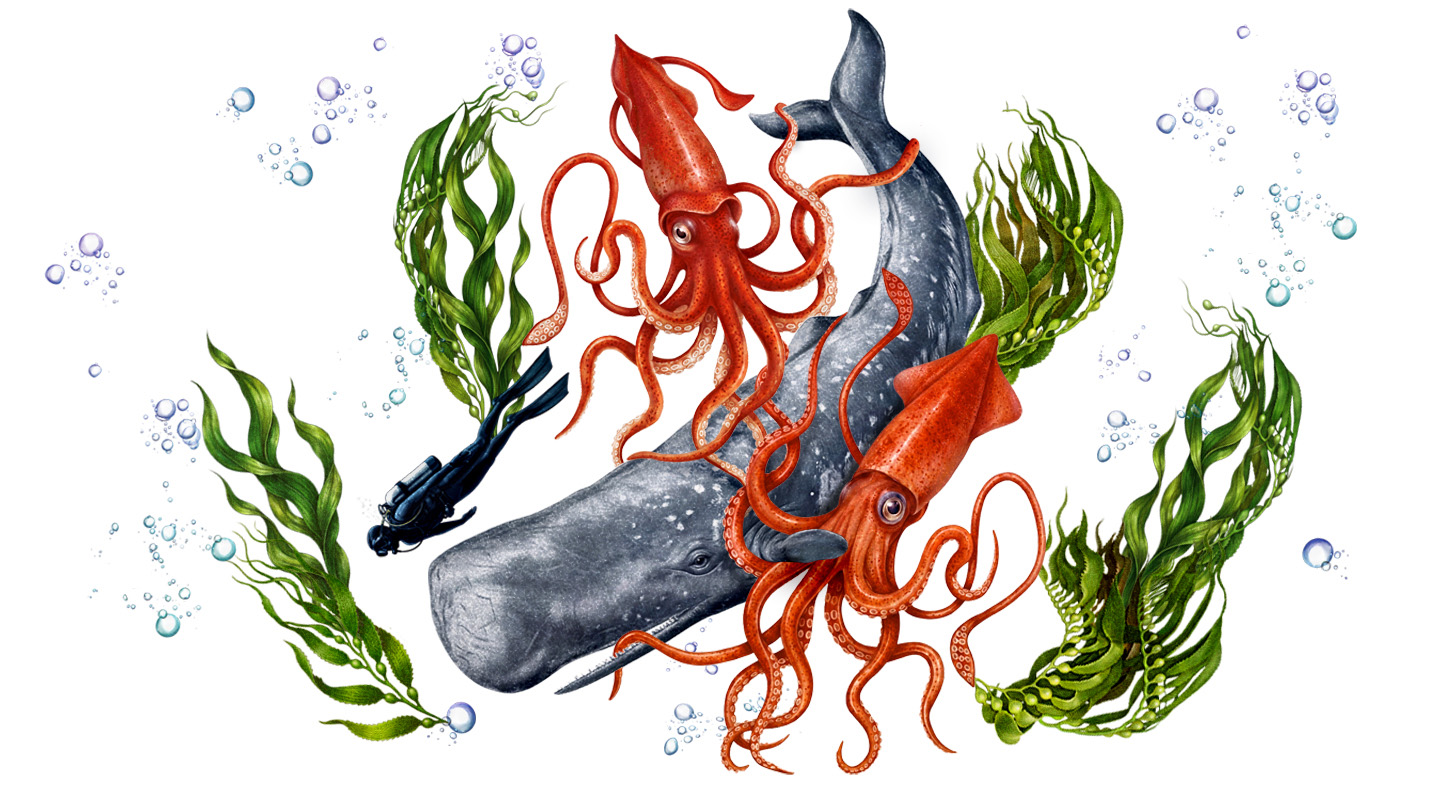
In the movie Whalefall, the ocean is not a backdrop; it is a doorway. Imagine a scuba diver floating in cold, blue water, hearing only the rhythm of his own breath, when suddenly the light vanishes. There is a pressure like a mountain falling, a wall of slick flesh, and then the diver is sliding headfirst into a darkness so complete that his eyes are useless. This is the premise of the story: a sperm whale, hunting in the depths, accidentally swallows a human being. Not out of malice, not out of hunger for anything familiar, but simply because the diver is in the wrong place at the wrong time. It is one of the oldest nightmares we have, the fear of being swallowed alive, the fear of disappearing into something too large to fight. We have told this story for thousands of years, from Jonah in the belly of the whale to the children who dream of monsters under the bed. But Whalefall does something different. It takes the myth and makes it intimate. The whale is not a symbol of punishment or a fairy-tale beast. It is a real animal, and the diver is a real person, with a past, a pulse, and a desperate need to live. The sentence at the heart of this content—”It’s technically possible, but unlikely to play out in real life”—sounds like a scientific footnote. But it hides a deeper truth. The real unlikeliness is not that a whale swallows a person. It is that a person, once swallowed, would find the clarity to think, the courage to stay calm, and the stubbornness to keep moving toward the light. The whale is an accident. The will is everything. And that is why the story feels so human, even when it is outrageous. It turns our oldest fear into a survival manual for the soul.
At its core, Whalefall is a thought experiment. The story says: a sperm whale accidentally swallows a scuba diver. It is technically possible, but unlikely to play out in real life. Let’s sit with that sentence for a moment. “Technically possible” is a phrase we use for things that do not break the laws of nature but also should never happen to anyone. It is technically possible to be struck by lightning while holding a winning lottery ticket. It is technically possible for a piano to fall from a window and land on a car just after you step out. In the same way, a sperm whale could, in theory, take a human into its mouth. Sperm whales are the largest toothed predators on Earth. They dive deeper than almost any mammal, hunting squid in the black abyss, and their bodies are built for enormous gulps and swallowing prey whole. They have been found with strange things in their stomachs: plastic bottles, fishing line, a roll of wire, even a small rubber tire. This means their digestive tract can accommodate objects that are not squid. A human being is made of meat and bone, not so different in size and density from a large seal or a young giant squid. So yes, the mouth can open wide enough. The throat can stretch. The stomach could receive a person. The word “accidentally” is the most important part. The whale would not choose to eat a diver. It would be a mistake, a confusion, a collision between two worlds that were never meant to meet. In the story, that mistake is the beginning of an ordeal. In reality, it would almost certainly be the end. But the thought of it—the thought of a man sliding down into that warm, acid, breathing darkness—makes us shiver because it touches something ancient. We are not afraid of whales. We are afraid of being consumed, of disappearing into something that does not know our name, of becoming just another piece of flesh in the food chain. The science says it is possible. The heart says it is impossible to imagine. And that gap between the two is where Whalefall lives.
Now let’s be honest about the real ocean. A sperm whale is not a monster. It is an animal with sonar so precise that it can detect a single squid in the blackness of a deep canyon. It sends out clicks, listens for the echoes, and builds a sound-picture of the world around it. A scuba diver, on the other hand, is noisy. The tank hisses, the regulator bubbles, the fins kick, the heart pounds. To a sperm whale, that noise is as familiar as a car alarm in a library. It might be curious. It might be annoyed. But it would not mistake a diver for a squid. Squid are soft, fast, and silent; humans are hard, clumsy, and loud. The whale’s feeding behavior is also a problem. Sperm whales hunt at depths of hundreds or thousands of feet, where no scuba diver can safely go. A recreational diver is usually in the sunlit shallows, far from the whale’s dinner table. Even if the two met, the whale would have to open its mouth at exactly the wrong time, and the diver would have to be inside that mouth when it closed. That is not impossible; it is just astronomically unlikely. There are true stories that sound close. In 2021, a lobster diver named Michael Packard said he was swallowed by a humpback whale off Cape Cod. He found himself inside the whale’s mouth, wet and dark, before the whale surfaced and spat him out. But a humpback is a baleen whale with a throat the size of a grapefruit; it could not swallow a human even if it wanted to. It was an accident, over in seconds. A sperm whale, by contrast, has teeth and a stretchable esophagus. It could theoretically do more than trap a diver. But for more than a century, people have told the story of James Bartley, a sailor who, in 1891, was supposedly swallowed by a sperm whale, found days later inside its stomach, alive but bleached white by acid. It is a wonderful tale, and almost certainly false. No one has ever documented a human being surviving inside a whale. The stomach is a dark, airless, acidic place. Even if a diver could avoid being crushed by the contractions of the throat, there is no oxygen to breathe. The panic alone would be overwhelming. In reality, the whale would probably realize its mistake quickly and release or vomit the diver, or the diver would die within minutes. That is why the story’s premise is best understood as a dream, not a documentary. The technical possibility is real in the same way a myth is real: it carries a kind of truth even when it cannot happen. The unlikeliness is not a flaw in the story. It is the reason the story is so powerful. We need impossible things to help us face possible ones. Whalefall gives us an impossible survival scenario so that we can practice, in our hearts, for the ordinary disasters that feel just as dark.
The title Whalefall carries a secret meaning that makes the story even more human. In oceanography, a whalefall is the body of a dead whale sinking to the seafloor. It sounds sad, but it is not. A whale’s body becomes a feast: crabs, worms, fish, and bacteria feed on the bones and flesh for decades. A single whalefall creates an entire ecosystem in the deep, a burst of life in a place where food is rare. This is the quiet wisdom at the heart of the story. The whale in Whalefall is not a villain. It is not even an obstacle. It is a creature going about its business, a body full of hunger and survival, and the diver is a temporary guest in that body. The whale’s death—or the possibility of it—is not the point. The point is what happens after something falls. What grows from it? What life comes out of the dark? The diver, if he escapes, will never be the same. He will carry the whale inside him, the memory of that warm, crushing darkness, and maybe it will turn him into someone more alive. That is the humanization of the story. It takes a giant animal and makes it intimate. It takes a survival horror and makes it a story about transformation. The whale’s belly is a womb and a grave at the same time. To be swallowed is to be given a second chance, the oldest story we know: death and rebirth, Jonah and the deep, Pinocchio and the whale. We do not survive such things by being strong. We survive by being willing to be changed. The diver who emerges from the whale is not the same person who went in. He has seen the inside of something ancient. He has touched the heart of the world’s largest predator and lived. That is not just a physical escape. It is a spiritual one. The title says it all: every fall creates a new world. Every ending is a beginning. The whale falls, and life blooms. The diver falls, and so does he.
But why do we need this story now? Because so many of us feel swallowed. Not by whales, but by grief, by anxiety, by a relationship that is falling apart, by a job that eats our days, by the endless noise of the world. We know what it is like to be inside something too big to fight. We know the darkness, the pressure, the feeling that there is no way out. Whalefall takes that feeling and makes it literal. The diver’s struggle to escape the whale is a picture of anyone who has tried to climb out of depression, or addiction, or loss. There are no obvious handholds. The walls are wet and smooth. The air is running out. And the only way out is to stop panicking, to look carefully, to trust that there is a way even when you cannot see it. The story humanizes the idea of survival by showing that it is not about heroic strength. It is about small, steady choices. It is about breathing when you want to scream. It is about thinking when your mind is full of darkness. The diver does not defeat the whale. He escapes it. There is a difference. Defeating a whale would be a fantasy of power. Escaping it is a fantasy of hope. We need more of that hope. We need stories that say: you may be swallowed, but you do not have to stay inside. You can find the mouth, the light, the surface. You can come out into the air and be alive, changed, grateful for the smallest things—a breath, a sky, a heartbeat. This is what the movie’s premise really offers. It is not a lesson about whales. It is a lesson about the human spirit. The whale is the world. The diver is us. And the escape is the impossible, beautiful thing we do when we refuse to give up.
In the end, the sentence that began all this—“a sperm whale accidentally swallows a scuba diver. It’s technically possible, but unlikely to play out in real life”—is both true and untrue. Yes, the event is unlikely. But the experience of being swallowed is common. We all know what it is like to be taken by something larger than ourselves. We all know the feeling of being trapped in a dark place, unable to see the way out. Whalefall takes that feeling and gives it a shape, a texture, a beating heart. It turns a biological oddity into a mirror. It asks us to look at the whale and see ourselves: creatures of hunger and instinct, capable of swallowing things we do not understand. It asks us to look at the diver and see ourselves: small, fragile, but stubbornly alive. The movie, if it is made with care, will not just be about a man in a whale. It will be about the moment we realize that the only way out is through. It will be about the breath we take before we try. It will be about the fact that no matter how dark the belly, there is always a mouth that can open, always a way back to the light. So let us hold onto the story. Let us imagine the impossible. Because in imagining it, we practice something essential: the belief that we can survive what tries to consume us. And that belief, unlike the swallowing of a diver, is not technically possible. It is already real, every day, in every human heart. That is the human truth at the center of Whalefall. The whale is real. The fall is real. And the rising is real, too.