


-
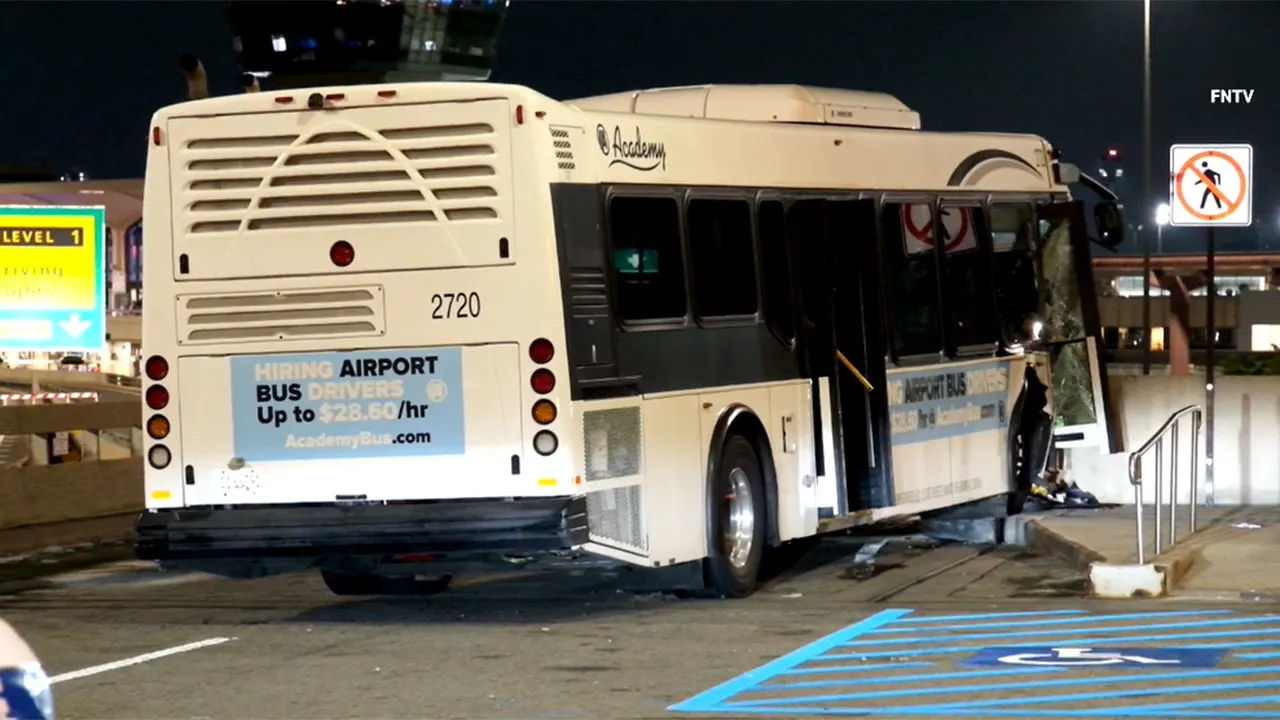
In the earliest hours of Monday morning, while most of the New York metropolitan area was still wrapped in sleep, a quiet but essential part of the aviation world was already moving. At Newark Liberty International Airport, employees were arriving for the early shift, some carrying coffee and barely opened eyes, others finishing a long night and looking forward to the ride home. For many airport workers, the shuttle bus is not just a convenience; it is a daily lifeline that carries them between parking lots, terminals, and remote work areas. Shortly after 3 a.m. on the Terminal B Departures Level 3 roadway, that routine commute was abruptly shattered. A shuttle bus carrying employees crashed into a concrete barrier, reportedly injuring thirteen people. The collision sent shockwaves through the normally quiet pre-dawn terminal, turning a familiar route into a scene of flashing emergency lights, broken glass, and urgent medical care. By the time the sun began to rise, the damage was visible to anyone passing through: a bus with its front end crumpled and pressed against the solid concrete wall, its windshield and door glass shattered, and yellow police tape marking the boundary of an investigation that had only just begun.
-
The physical evidence told a story of sudden, violent impact. Video obtained from the scene showed the badly damaged shuttle bus still wedged against the concrete barrier, its nose collapsed inward, the metallic shell of the vehicle folded like paper. Glass fragments littered the roadway, reflecting the glow of emergency lights. The bus had been designed to carry workers safely through the airport’s complex landscape, but in a matter of seconds it became the center of a rescue operation. According to local reports from News 12 New Jersey, three people suffered serious injuries while ten others received minor injuries, and remarkably, none were believed to be life-threatening. Even so, every one of those thirteen people experienced something terrifying—a sudden jolt, the sound of grinding metal, the shock of impact, and the confusion that follows. First responders arrived quickly, surrounding the site with police tape and tending to the wounded. The injured were transported to area hospitals for evaluation and treatment, according to WABC-TV. Their families received the kind of phone calls nobody wants to make in the early hours: a loved one has been in an accident, they are being checked out, we don’t know all the details yet, but please come. The hospitals would become quiet waiting rooms where coworkers gathered, hoping for news, reassuring each other, and remembering that the people on that bus were not anonymous statistics but neighbors, friends, and dedicated airport employees.
-
To truly understand the human weight of this crash, it helps to think about who rides an employee shuttle at Newark Liberty at three in the morning. These are the workers who keep the airport alive while the rest of us sleep: baggage handlers moving suitcases through the dark, security officers preparing for the first wave of travelers, catering staff loading meals onto aircraft, maintenance crews checking runways and jet bridges, cleaners sanitizing gates, and ramp agents guiding planes into their parking positions. Some of them had just finished a shift, exhausted and eager to reach their cars and drive home to their families. Others were just beginning their day, mentally rehearsing tasks and responsibilities. The shuttle bus is a shared space, often filled with quiet conversations, tired jokes, or the comfortable silence of people who know each other’s routines. For these workers, the airport is more than a place of departure and arrival; it is a community. That community was suddenly reminded of how fragile ordinary moments can be. A concrete barrier is usually just a safety feature, a solid boundary between vehicles and the terminal structure. But on this day, it became the site of a collision that turned people into patients, coworkers into witnesses, and friends into each other’s support system. The fact that no deaths occurred is close to a miracle, given the severity of the damage, but the emotional trauma will likely linger far longer than any physical wound.
-
The immediate aftermath was not only a medical emergency but also a logistical challenge for an airport that never truly closes. The crash shut down the Terminal B Departures Level 3 roadway, a main artery for vehicles dropping off passengers and employees. Crews moved quickly to clear debris from the area while the Port Authority Police Department managed the scene, directed traffic, and began documenting evidence. For travelers departing from Terminal B, the disruption meant a change of plans: the Port Authority Police advised that passengers should be dropped off on Level 2 because of police activity on the upper level. This small instruction, issued after the accident, created a ripple effect through the early-morning travel experience. Drivers suddenly had to navigate around barriers, follow new signs, and adjust to altered traffic patterns. Inside the terminal, passengers may have noticed an unusual police presence, delayed curbside drop-offs, and a sense that something serious had taken place just outside. Airports are places where time is measured in boarding windows and connection minutes, but this was a moment when the machinery of airport operations paused to absorb a shock. Behind the scenes, airline representatives were likely fielding calls, supervisors were trying to account for employees, and safety officers were beginning the painstaking work of figuring out what exactly had gone wrong. The reopening of the roadway would come, and normal operations would eventually resume, but the incident left an impression on everyone who encountered it.
-
The investigation now underway will focus on a central and troubling question: why did the shuttle bus crash into a concrete barrier? Authorities have not released the cause, and it would be premature to speculate. But the need for answers is more than procedural. Shuttle buses are a vital part of airport infrastructure, and when they fail, the consequences can be measured in broken bodies and shattered routines. Investigators will examine the condition of the bus, the driver’s background and training, whether mechanical failure played a role, whether the roadway was properly marked and lit, and whether fatigue or distraction may have been factors. The Port Authority of New York and New Jersey has deep experience with transportation safety, including bridges, tunnels, buses, and airports. But each incident is a reminder that safety is not achieved through policy manuals alone; it is earned every day through maintenance, vigilance, and honest analysis. Every airport employee who steps onto a shuttle bus assumes a certain level of protection. When that trust is broken, even for a moment, it demands accountability. The injured are still recovering, their coworkers are still processing what they saw, and the investigation is ongoing. In the days ahead, official reports will provide details, but they will never fully capture the personal toll of a single accident that changed so many mornings.
-
As Newark Liberty International Airport returns to its normal rhythm, with planes taking off and landing and travelers rushing through terminals, it is worth pausing to remember the hidden workforce that makes air travel possible. They are the ones who arrive before dawn and leave long after dark, who shuttle between concrete and steel, who grease the wheels of an industry that often forgets their names. This crash was not about a famous airline or a high-profile traveler; it was about the people who work behind the scenes, the ones whose daily commute is not through clouds but through employee lots and service roads. Their injuries are a reminder of how much we rely on them, and how easily their safety can be compromised. For the thirteen workers involved in this incident, the road to recovery may be long. Some will need surgery, physical therapy, or simply time to heal. Others will need to talk through the trauma, to feel safe again in a shuttle bus, to trust that the next ride will not end in violence. The community around them—coworkers, supervisors, union representatives, airport management—will need to show up with patience and compassion. The investigation will continue, reports will be written, and recommendations will be made. But the most important outcome is that these workers are alive, that their injuries, while serious, are not fatal, and that the airport family is wrapping around them in their time of need. In a world obsessed with flight delays and customer service scores, it is easy to forget that the airport runs on human beings. This week, they are the ones who need our attention, our empathy, and our hope for a swift and complete recovery.