


The roar of jet engines has fully returned to European skies. After the devastating emptiness of the pandemic years, when aircraft sat dormant on tarmacs and airports resembled ghost towns, the latest data paints a picture of complete, triumphant recovery. By the end of 2025, the number of commercial flights operating across the European Union had surged back to approximately 6.9 million, essentially matching the pre-pandemic benchmark of seven million recorded back in 2019. This isn’t just a statistical milestone; it’s a testament to the unquenchable human desire to explore, do business, and reconnect with loved ones. The European air travel network, a complex web of hubs and spokes stretching from the Atlantic coast to the Aegean Sea, is pumping with life again. This rebound wasn’t overnight—it was a gradual, steady climb that began in 2021, gaining momentum each year as travel restrictions eased and passenger confidence returned. The numbers from Eurostat, the EU’s statistical office, confirm that the industry has not only recovered its losses but has solidified its status as an indispensable economic engine. Whether it’s a quick weekend city break in Prague, a cross-continental business meeting, or a pilgrimage to a Mediterranean beach, the skies are teeming with activity once more. This resurgence represents billions of euros in economic activity, millions of jobs in aviation, tourism, and hospitality, and the restoration of a vital form of connectivity that many had feared was permanently altered. The fact that we have reached this 6.9 million figure is a clear sign that the crisis is truly in the rearview mirror, and the European aviation sector is looking ahead with renewed vigor, ready to tackle the next set of challenges, from sustainability to capacity.
Delving deeper into these remarkable statistics reveals an interesting split between two distinct types of air travel: scheduled and non-scheduled flights. Scheduled flights—the regular, daily commuter routes, the backbone of business travel, and the predictable links between major cities—accounted for a staggering 91.5% of all 2025 flights. These are the flights you can set your watch to, the A319s and A320s darting between London, Paris, Frankfurt, and Rome, operating on published timetables year-round. This dominance of scheduled service underscores the reliability and structure of modern European life, where businesses depend on the guaranteed daily connectivity. On the other hand, the remaining 8.5% of flights, roughly 586,000 individual operations, fall into the category of non-scheduled services. This category is far more colorful and dynamic, encompassing charter flights to sunny holiday resorts, seasonal leisure routes, private jets whisking executives to remote locations, and specialized cargo operations. These are the flights that epitomize flexibility and spontaneity. They surge during school holidays, materialize for major events like the Cannes Film Festival or the Monaco Grand Prix, and connect secondary airports with leisure hotspots. The definition itself, as stated by Eurostat, includes any commercial air service that isn’t strictly “operated according to a published timetable or with a regular frequency open to direct booking by the public.” This mix of the predictable and the flexible is what makes the European airspace so robust; the scheduled network provides the structural integrity, while the non-scheduled segment provides the adaptability to meet changing consumer demands and seasonal peaks without overwhelming the existing infrastructure.
The cyclical nature of travel is beautifully illustrated when we zoom into the summer months of 2025. June, July, and August are the peak season for European aviation, a period when family holidays, festival seasons, and the allure of Mediterranean sunshine drive air traffic to its zenith. The data for these three months alone provides a fascinating microcosm of the industry’s dynamics. In June, a total of 648,707 flights crisscrossed the EU, with a notable 11.2% of these being non-scheduled operations. This percentage jumps significantly in July, when the total rose to 690,855 flights, and the non-scheduled share peaked at 12.3%. August, the traditional month of summer exodus in Europe, saw the highest absolute number of flights—693,046—with non-scheduled services making up 11.4%. This seasonal surge in non-scheduled traffic is a direct reflection of the leisure market. Airlines and tour operators deploy extra aircraft, often wet-leased from other regions, to ferry holidaymakers from the cloudy skies of Northern Europe to the sunny beaches of Spain, Greece, Portugal, and Turkey. It’s a logistical ballet where airlines maximize their fleet utilization, keeping planes flying for 14 hours a day. The fact that non-scheduled flights account for a significantly higher share of traffic during the summer (averaging around 11-12%) compared to the annual average of 8.5% highlights how the industry pivots on a seasonal axis. This also brings immense pressure on air traffic control, ground handling, and airport security, often leading to the infamous summer chaos at major hubs, yet it also represents the lucrative peak season upon which the profitability of many airlines hinges.
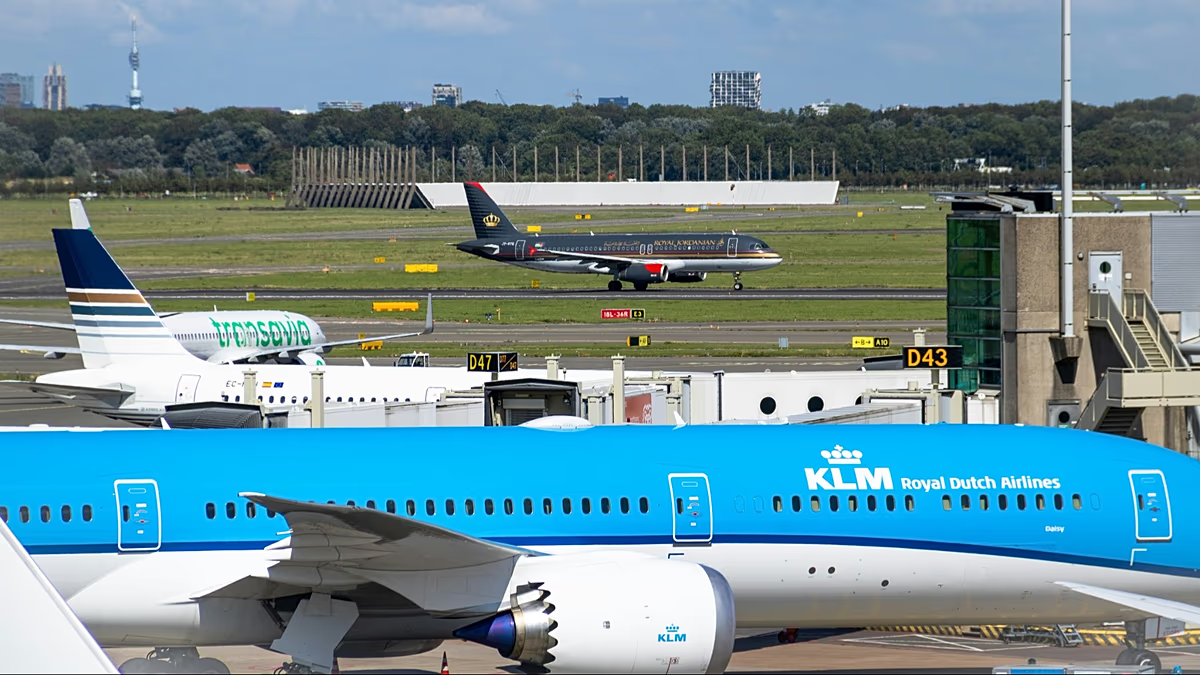
As the data unfolds, it becomes clear that European aviation is dominated by a handful of colossal hubs. Amsterdam Schiphol emerged as the undisputed champion in 2025, handling a staggering 488,000 departures and arrivals. This figure represents roughly 1,300 flights per day passing through the Dutch capital, a testament to KLM’s massive global network and Schiphol’s role as a key connection point for travel between Europe and the rest of the world. Hot on its heels is Paris Charles de Gaulle, with 476,000 flights. As the primary gateway for Air France and the country’s international aviation powerhouse, CDG serves as a critical link to Africa, Asia, and the Americas. Not far behind, Frankfurt/Main in Germany secured the third spot with 457,000 flights, driven by Lufthansa’s vast feeder network which makes it a vital hub for premium business travel and global cargo. The fourth and fifth positions are held by Spain’s dynamic duo: Adolfo Suárez Madrid-Barajas (423,000 flights) and Barcelona-El Prat (356,000 flights). Madrid has increasingly positioned itself as the primary gateway to Latin America, while Barcelona rides the wave of massive tourism demand and its status as a Mediterranean business center. These five airports alone account for over 2.2 million flights, a significant chunk of the total European traffic. Their strategic importance cannot be overstated—they act as massive economic engines for their respective regions, generating jobs, facilitating trade, and serving as the primary interface for the globalized world, connecting local communities to a web of international destinations.
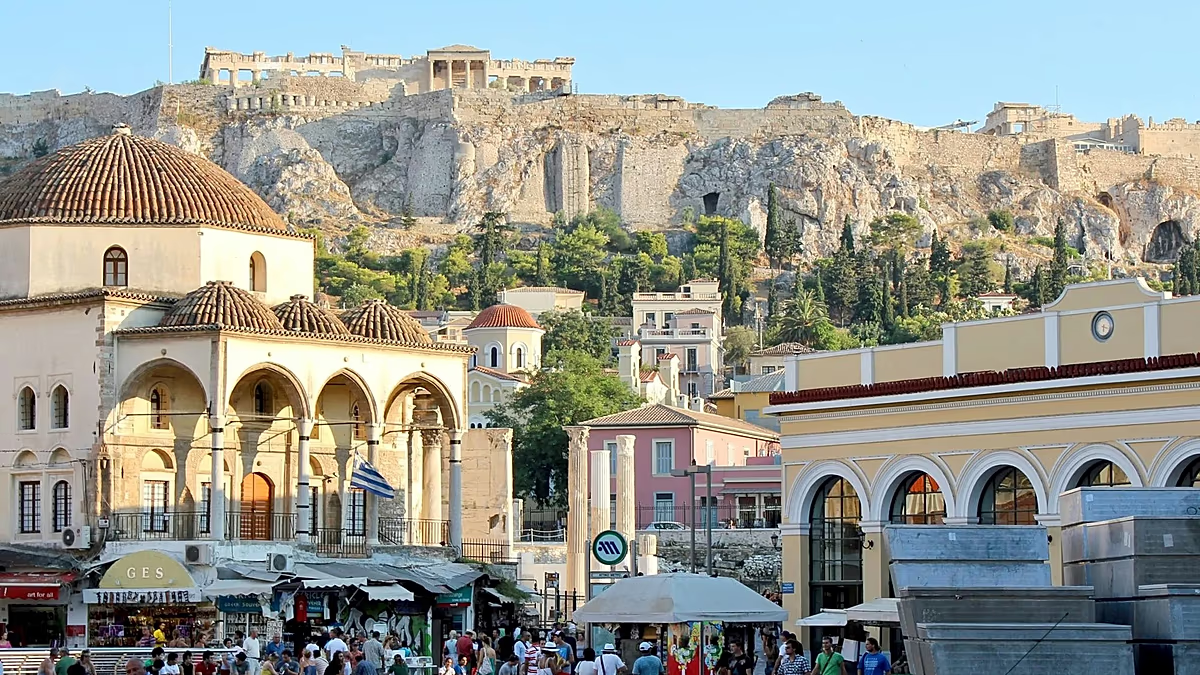
While the top five giants dominate the headlines, the remaining slots in the top ten demonstrate the diverse geography and distinct travel needs across Europe. Munich, the Bavarian capital, secured sixth place with 329,000 flights, serving as a crucial hub for Lufthansa’s southern operations and a gateway to the wealthy business region of southern Germany and the Alps. Rome Fiumicino follows closely with 320,000 flights, leveraging Italy’s rich cultural heritage and serving as the main base for ITA Airways, acting as a magnet for tourists eager to explore the Eternal City and the broader Italian peninsula. Further south, Athens/Eleftherios Venizelos recorded 271,000 flights. This airport is not just the gateway to Greece’s ancient monuments but is fundamentally a launchpad for the intricate network of flights that connect to the Greek islands—Crete, Rhodes, Santorini, and countless others. Its high number of non-scheduled flights (5.2% of its total) underscores its significance as a major charter destination. Copenhagen/Kastrup registered 254,000 flights, serving as the largest hub in Scandinavia and the home base for SAS, connecting the Baltic region and its tech-savvy population to the rest of Europe. Rounding out the top ten is Dublin, Ireland, with 252,000 flights. Dublin acts as the vital transatlantic bridge between Europe and North America, heavily utilized by US tech giants and pharmaceutical companies, and also a popular short-break destination for UK and European tourists. Each of these airports, while smaller than the top five, plays an indispensable role in their respective regions, managing passenger flows, facilitating business trade, and contributing significantly to local tourism economies.
A closer inspection of the non-scheduled flight shares within the top 10 reveals interesting regional quirks and economic drivers. Athens leads the charge with the highest share of non-scheduled traffic at 5.2%, perfectly aligning with its heavy reliance on charter flights to ferry tourists to the Aegean islands. Following closely are Madrid (4.8%) and Copenhagen (4.1%). Madrid’s high share is driven primarily by domestic and short-haul charter flights to the Spanish Canary Islands, which are a year-round sunny escape for continental Europeans. Copenhagen’s significant charter traffic reflects the strong Scandinavian tradition of taking package holidays to Southern Europe—flights booked as part of a complete tour package, often inclusive of hotels and excursions. This data beautifully illustrates the evolving nature of European travel. The industry is not a monolith; it is a delicate balance between the rigid bilateral scheduled networks serving business and primary government needs, and the agile, opportunistic non-scheduled services that capture the consumer’s desire for leisure. Looking ahead, the European aviation market is maturing. With the 2025 recovery now solid, the focus is shifting to how these hubs can expand their capacity amid environmental pressures, air traffic control strikes, and the push for sustainable aviation fuel. The non-scheduled segment, with its flexibility, is often adopted more readily for experimental routes or new sustainable fuel trials, making it a testing ground for the future. As we look toward the coming years, the resilience shown by these airports and the 6.9 million flights they accommodated suggests that European aviation isn’t just back to pre-pandemic levels—it has laid the groundwork for a smarter, more flexible, and potentially greener future. The race is now on not just to maintain this volume of traffic, but to handle it efficiently, sustainably, and safely for decades to come.