

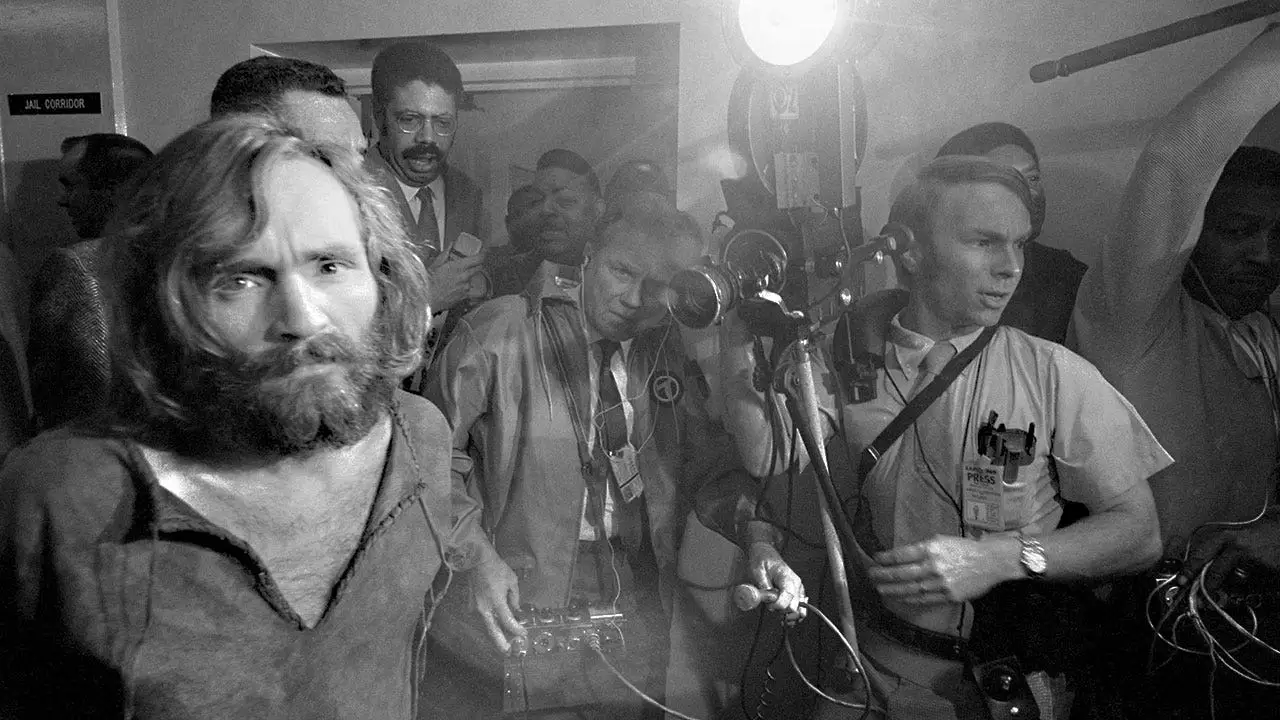
For most of her young life, Sophia Maddox believed she was just another aspiring artist trying to find her place in Los Angeles, a city full of dreamers scrambling from odd job to odd job while chasing a future in film. Then, in 2022, a phone call from her father, Daniel Arguelles, tore through that ordinary reality and replaced it with something far more complicated. Daniel had spent years searching for his biological father, hoping to fill a quiet hole that had haunted him since childhood. When he finally found a name through genetic testing, he stopped to brace himself before sharing it with his daughter. He told her the truth would be dark; he didn’t know if she was ready. Sophia’s mind raced through possibilities. She guessed Ted Bundy. Her father replied, “Bigger.” She tried to think of the biggest movie she knew, a film that dealt with the very subject they had stumbled onto—“Once Upon a Time… in Hollywood”—and suddenly the name surfaced. Charles Manson. In that moment, Sophia says she Googled him, looked at his face, and realized with a sinking heart that her dad’s resemblance to Manson was undeniable. She remembers thinking, “That’s my dad,” and then feeling the simple architecture of her identity collapse. It wasn’t just a shocking historical revelation; for the first time, she had to confront a hereditary shadow she never asked for.
That phone call pushed Sophia into an unforeseen role: a documentary filmmaker making sense of her own bloodline. The Hulu documentary, “My Grandfather Charles Manson,” captures her effort to understand how all of this came to be. But it is also an intimate, painful journey through family secrets. Daniel Arguelles, born in 1959, had grown up knowing his mother’s husband was not his biological father, but he didn’t push for answers until he reached adulthood. After his DNA sat in a genealogy database for years with no promising matches, he had nearly given up when a match finally appeared: a man named Michael Brunner. Building on media reports and research, Brunner turned out to be Manson’s son with Mary Brunner, one of Manson’s earliest followers. This not only confirmed the paternal link but made the tragedy personally unavoidable. For Sophia, though, the initial shock came with an urgent need to understand more—not to canonize Manson, but to figure out how to carry the weight, and whether a grandfather’s violence had told her anything about herself. Her father, meanwhile, was overwhelmed. He had encouraged her to make the film, but in the end, he couldn’t sit still as the past kept pulling him closer to the man he tried to never be. Sophia admits she has more distance because she’s a generation removed, while her father has to wrestle with ghosts is both physically closer and psychologically deeper.
To explain the complicated human reality behind the Manson legacy, Sophia starts by reminding viewers of the obvious: her and her father were “normal, working-class citizens” before all of this. They have no criminal records. They grew up with artistic talents, poetry, and dreams—a world away from the cult leader who orchestrated the infamous 1969 murders of pregnant actress Sharon Tate and six others. Yet the shadow of Manson still looms over their lives. People asked Sophia if she worried she had inherited evil, or if some dormant gene could surface in her as small acts of cruelty. She answered with a boredom that reflected a mature wisdom: her father and she are simply hardworking, sensitive folks trying to live quiet lives. Still, she felt a pull toward stories that no one has answered: can someone born into such an origin story make a choice to be good? That question drove her to examine Manson’s early years. Though Manson confessed with crimes, Sophia wanted to see what happened before the smiling cult leader—before the “Family,” before the hippie guru—became a madman. She read old reports, spoke to experts, and found a childhood that was tragic in ways she hadn’t expected. The father that raised him vanished, his mother, Kathleen Maddox, was a teenage girl who spent time in prison for robbery; her son was felt from relatives. At thirteen, Manson was already graduating to reform school. His experiences at the Indiana Boys School were devastating—he recalled being physically beaten and sexually assaulted as a juvenile. Instead of being a shield for protection, these institutions became training ground for mistrust and survival. Sophia speaks about seeing him housed with older teens convicted of violence, even murder, while he was younger and guilty only of running away, stealing bikes, or stealing cars. It’s a hard truth, she says, to realize that the callousness Manson later weaponized may have been built, at least in part, by a failed system. That doesn’t excuse anything, but it humanizes the void that was created long before the psychology turned murderous.
As she investigated more, Sophia’s perspective became complex, and that complexity was the heart of the documentary. She cares less about the cloak-and-dagger mythology than about the fissures in Manson’s environment: the poverty, the generational trauma, the constant movement, the violence of authority. Manson had spent about half his entire life in confinement, I mean, repeated incarceration from an early age. Prison shaped his survival instincts into a reliable, ruthless set of beliefs. He planned to make his last release from federal prison in 1967, and he quickly assembled a new pseudo-collectivist family of runaway young women and outcasts, men and women, who already had been broken by the warmness of the ’60s. The Manson Family was not a radical anomaly so much as a terrible occurrence. He learned, in prison and reform school, how to read vulnerability, and by the time he was free, he had found his powers to exploit it. But Sophia refuses to treat this as an excuse. In the documentary, she interviews people who knew, or lived by, the family; she shows compassion but draws a hard line. She says she knows exactly what Charles Manson did—orchestrating those brutal deaths, including Sharon Tate’s unborn child—and she is not trying to absolve him or justify what he did. What she is doing is trying to understand how dark propagates. Isn’t that the way to stop future histories from repeating? Pulling from a juvenile justice expert, she notes that Manson was not unusual in his experience; many boys went through similar trauma in similar systems. It’s far too easy to say he was a monster, she sees, because monsters are then placed outside the world, stating that no one has to ask the harder questions about their origins. Instead, she wants to ask why people like Manson come into existence, and what institutions create childhood conditions that produce such stunted, dangerous adults.
The film, like her family, is also part of watch for connection. During production, Sophia had a falling out with her father. As she began filming, the conversations about Manson became too much for Daniel, and although he had initially visited and encouraged her project, he eventually distanced himself. She says she respects his silence and doesn’t know if he has seen the film. In a later statement, Arguelles offered only a short, careful acknowledgment, saying he was proud of her and supported her, but that they had a difference of opinion on the narrative. His reserve makes sense: for Sophia, Manson was her grandfather’s poison, an abstract horror viewed through history, and her father’s, plus a biological truth, an impossible inheritance. He carried a name and a face that carried history, but maybe even more so, the melancholy of a man who understands that the threat of self-destruction can be born into you. Still, Sophia kept making the movie, reaching out to relatives of victims of Manson family. She said she was in contact with two relatives during filming, and every meeting was respectful. They didn’t blame her, they didn’t turn her away; they saw a grief of heir, not an enemy. She gently acknowledges that they are both looking for answers, and showing that at the site of extreme tragedy, truth—even from the opposite side of blood—can find common ground. The moments in the film are not about embarrassment; they are about seeing you are part inheritance, not guilty. She doesn’t claim to be either victim or survivor; she locates a third role: witness.
At the end of her journey, Sophia decided to claim her grandfather’s and father’s name—not as a weight, but as a transformation. She researched her family before adopting the surname, “Maddox,” and discovered it meant “goodness.” That discovery felt like a sacred moment, an embrace of a new life. I’m going to own it. I’m giving it new life, she said. That final act is the core of her surprising message while recognizing the legacy of horror running in the blood, she chooses to make her own name, her future, and her story. She doesn’t try to find herself in Manson face; she tries to turn her face away, toward home. Still, she has no false consolation. She says her intention is never to apologize for—or justify—any actions. She will never make that mistake. But she could refuse to be silenced by other people’s sin. She can make a film about possible histories, and therefore reclaim the agency that her grandfather once denied. Ultimately, this documentary is not so much a biography of Charles Manson as a portrait of healing in the presence of broken things; a story about remaining human when an unexpected, terrifying history enters your heart. It’s a story about ordinary people, her father and herself, wrestling with a fact they cannot change, and deciding to respond with consciousness rather than shame. As someone, Sophia seems to say that blood does not determine destiny. What does matter is what we do with it: the questions we ask, the language we choose, the way we refuse to be defined by reaching things, and the love we refuse to let turn into fear. In that, she is not just a granddaughter of a monster, but a living testament that even the most hurtful lines can turn into grounds for compassion, for poise, and for hope.