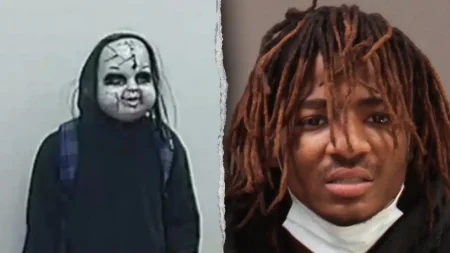



In the quiet, pre-dawn hours of a Philadelphia morning, when the city is still shaking off the remnants of the night and the first rays of sunlight are beginning to paint the skyscrapers in hues of gold and gray, the ordinary rhythm of life is sacred. It is a time for early risers, for joggers, for commuters grabbing a quick coffee, and for those heading to the transit stations. This fragile peace was shattered on August 12th in a way that has left the city on edge, turning a mundane commute into a scene from a low-budget horror film. A masked man, his face concealed behind a grotesque, Chucky-style Halloween mask—a visage of stitched skin and malevolent grin that has haunted the nightmares of generations—began a spree of terror through the heart of downtown. The suspect, now identified as 22-year-old Zymire Hughes, has become the target of an intense manhunt by the Philadelphia Police Department and the U.S. Marshals Service, following the issuance of an arrest warrant. The surveillance footage released to the public shows a chilling series of events, a stark reminder that horror can sometimes unfold in the most ordinary of places, and that the fear of a monster is not limited to fairy tales or cinematic release dates, but can walk the streets with a cell phone in hand, filming its own depravity. As District Attorney Larry Krasner pointedly remarked during a tense news conference, “If Zymire Hughes was trying to scare people, make them run: Who’s scared now? Who’s running now?” The question is rhetorical, yet it carries the weight of a city scrutinizing the footage, wondering what drives a young man to engage in such inexplicable cruelty.
The narrative of this terrifying episode begins not in the chaos of the streets, but in the mundane act of leaving one’s home. The surveillance footage painstakingly tracks Hughes’s movements, showing him departing his apartment complex, dressed in ordinary clothing, blending seamlessly into the early morning populace. He boards a bus, descending into the city’s central business district, a seemingly unremarkable commuter. It is here, at approximately 5:30 in the morning, that the transformation occurs. Slipping the Chucky mask over his head, he transitions from an ordinary citizen into an instrument of pure, unadulterated fear. His first encounter is with a person who, upon seeing the masked figure, becomes immediately overwhelmed with terror. The footage shows the victim reacting in a visceral way, crouching down with their hands raised in a pleading, supplicating manner, a silent yet desperate cry for mercy. Captain Jason Smith of the Philadelphia Police described the scene with sobering clarity: “The victim is absolutely terrified of Mr. Hughes. He crouches down with his hands up in a pleading motion. We don’t know exactly what was said… but it’s readily apparent that this individual is certainly in fear for their life.” The primal emotion captured in that frame is not an exaggerated performance; it is the raw, unfiltered response of a human being confronted with an inexplicable threat. Hughes, seemingly satisfied with this initial reaction, or perhaps seeking a greater thrill, then proceeds down Chestnut Street, a main artery of the city, harassing more individuals as he goes. Each interaction builds his confidence, each look of horror validating his bizarre spectacle.
The incident escalated to a terrifying crescendo when Hughes encountered a female jogger. This was not a random brush with a harmless prankster; it was a targeted, malicious assault on a person simply trying to exercise. As Hughes approached the woman, he held up his cell phone, a tool of modern documentation turned into a weapon of psychological warfare, and allegedly asked a chilling question that cut through the fabric of civilized society: “Are you ready to die?” The phrase is not merely a threat; it is a statement of intent, a declaration that he viewed her as nothing more than an object for his twisted amusement. The jogger, understandably petrified, fled for her life. In her desperate attempt to escape the leering mask and the haunting question, she suffered a serious injury to her leg, an injury that Captain Smith later told reporters would require extensive medical treatment. The physical harm is a tangible consequence, but the emotional and psychological trauma is likely to be far more profound and long-lasting. This was a direct, premeditated act. Hughes left his home with a purpose, rode a bus with the intention of committing mayhem, and then descended upon the city streets to inflict his will upon innocent people. The fact that he filmed his own actions suggests a twisted form of self-aggrandizement, a desire to relive the moments of power and control, or perhaps to share them with the world for some sort of distorted fame.
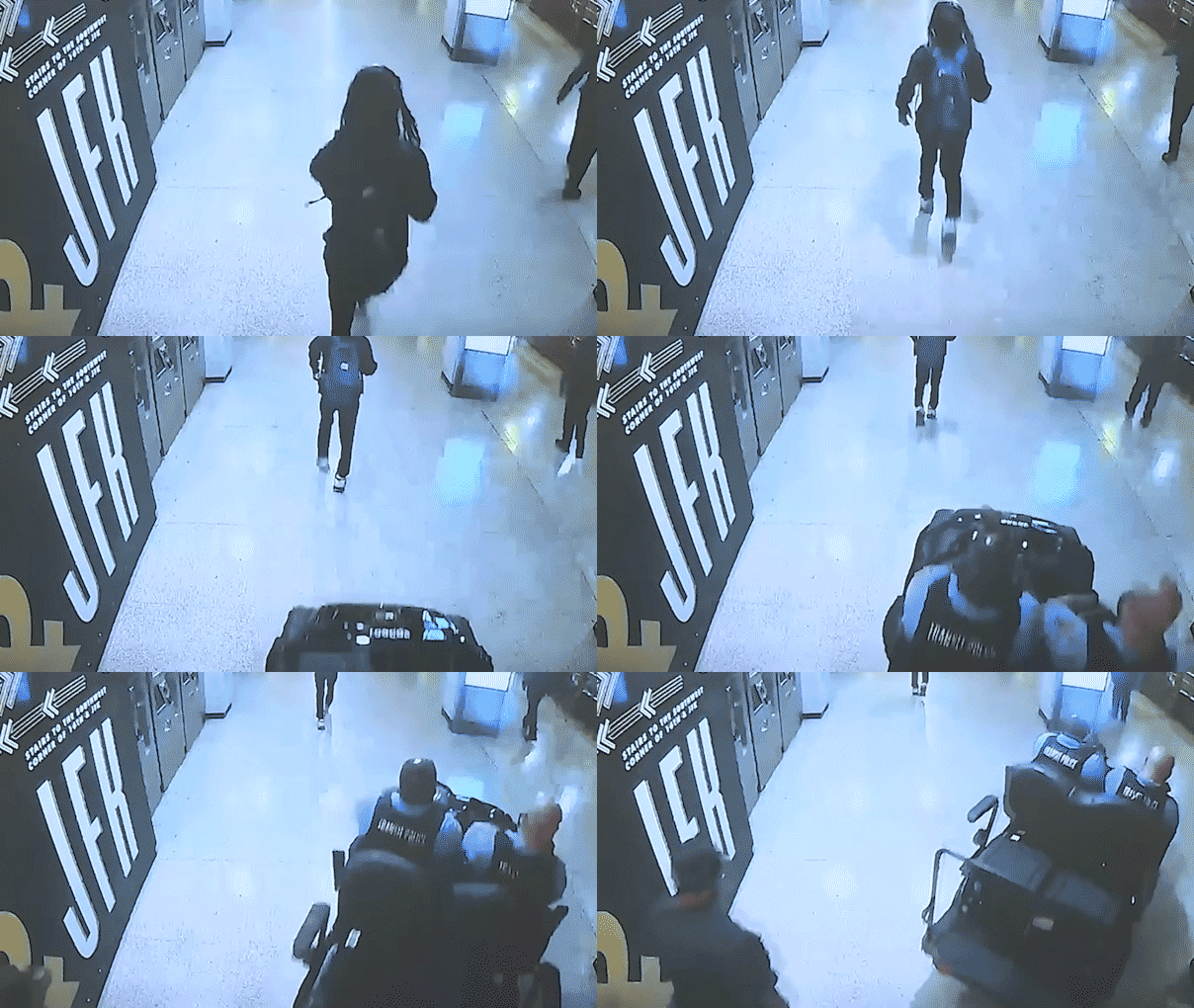
Hughes’s reign of terror, however, met a temporary obstacle when he descended into Suburban Station, a major transportation hub that serves as the nexus for commuters heading in and out of the city. Here, the quiet corridors and echoing staircases provided a new playground for his deranged game. He was spotted by two officers of the Southeastern Pennsylvania Transportation Authority (SEPTA), who were patrolling the station in a golf cart, alongside other officers on foot. The authorities, alert and committed, immediately commanded Hughes to remove the mask. The footage of this interaction shows a moment of hesitation, a crack in the facade of the film’s villain. Hughes complied with the order, but in a move of cunning and deceit, revealed that beneath the Chucky mask he wore a black, COVID-style mask, which he never removed. Captain Smith highlighted this detail, noting, “Underneath that Chucky-style Halloween mask, he’s got a black, COVID-style mask, which he never removes.” He was determined to remain anonymous, even as he faced the law. Before the officers could close the distance, Hughes, using the labyrinthine passages of the station to his advantage, evaded capture. He ran, weaving through commuters, engaging others in his sick game, attempting to scare more people even as law enforcement chased him. The officers followed, but he was too quick, too familiar with the terrain, and he managed to slip away, boarding a bus back to his apartment complex. Upon his return, he placed the mask in a backpack, seemingly transitioning back to his normal self, shedding the dangerous persona as easily as he had put it on. The station was left with a sense of unease, and the police with a clear target.
The question that haunts the investigation is a simple one: why? Why would a 22-year-old man engage in such a bizarre and terrifying spree, risking arrest and traumatizing strangers? Captain Smith offered a grim hypothesis, suggesting that Hughes acted for “his own sick personal amusement” or, perhaps more disturbingly, to create monetized social media content. In an age where clicks, views, and likes have become a currency of validation, the line between reality and performance often blurs. The desire to go viral, to become an internet sensation, can drive individuals to increasingly extreme and malevolent behavior. Hughes’s act of filming himself is the key to understanding this motive. He wasn’t simply a random offender; he was a performer, an artist of fear, documenting his own deviance for an unseen audience. This reflects a broader societal ailment, where the quest for attention can outweigh basic empathy and respect for others. The victims are not people to him; they are extras in a twisted reality show, chosen to react to his “starring” role. The terror they felt is not a human tragedy but a means to an end. The fact that he targeted vulnerable individuals—early morning joggers, lone commuters—suggests a predatory nature, preying on those who might be least likely to fight back. However, the lack of a clear monetary or psychological gain that justifies the risk suggests a deeper, more troubling dysfunction, a person disconnected from the consequences of their actions and the pain of others.
As the manhunt intensifies, Hughes remains at large, with police noting that he has ties to California and Nevada, indicating he may have fled the Philadelphia area. The authorities are leaving no stone unturned, multi-jurisdictional forces working in tandem to bring him into custody. The District Attorney’s taunt, “Who’s scared now?” serves as a stark assertion of the law’s position, a promise that the hunter will soon become the hunted. But beyond the legal pursuit, there is the lingering aftermath for the victims. The first victim, the one who crouched in pleading, will forever remember the image of that mask. The jogger, contending with a severe physical injury and the mental replay of “Are you ready to die?”, faces a long road to recovery, both physically and emotionally. The incident is a stark reminder of the fragility of our assumed safety, the thin veneer of civilization that can be shattered by a single individual’s cruelty. It also highlights the bizarre nature of modern horror, where a child’s Halloween costume can be repurposed as a tool of genuine intimidation. The city of Philadelphia, known for its grit and resilience, finds itself confronting a new kind of fear, one born not from geopolitical conflict or violent crime syndicates, but from the inexplicable, random actions of a young man chasing some perverse thrill. Ultimately, this story is not just about a felon on the run; it is about the power of fear to disrupt, the resilience of victims, and the unwavering commitment of law enforcement to restore order, ensuring that the only run that ends in triumph is not the one where people flee from a mask, but the one where justice catches up to the man who wore it.