



Bitcoin Holds Steady Above $64K as Global Bond Yields Surge and Crypto Market Braces for Fed Minutes
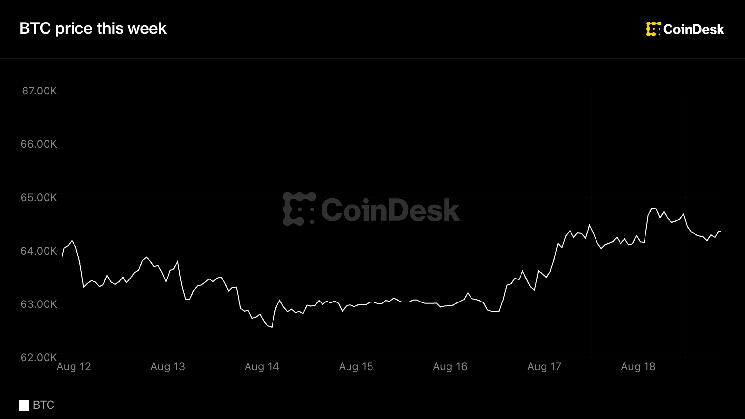
In a market starved for direction, Bitcoin managed to hold its ground on Wednesday, trading just above the $64,000 mark as traders and institutional investors alike remained glued to a confluence of global macroeconomic forces. The world’s largest digital asset slipped a marginal 0.5% since midnight UTC to reach approximately $64,347, extending a remarkably tight consolidation pattern between $61,500 and $66,900 that has now persisted since July 8. With volatility compressing to levels not seen in years, the cryptocurrency is sending signals that suggest a market holding its breath. This period of acute calm, however, feels less like a peaceful equilibrium and more like the stillness before a potential storm, with participants across risk assets looking toward the Federal Reserve’s latest policy hints and a global repricing of sovereign debt that threatens to upend traditional portfolio strategies.
The Bond Market Jitters That Have Crypto Braced for Impact
The primary accelerant behind the current market friction is undoubtedly the seismic move taking place in the global fixed-income markets, where bond prices have been in freefall, sending yields to multi-generational peaks. That surge has been savage for bondholders but is having a knock-on effect on growth assets like technology stocks, and by extension, the cryptocurrency market. The yield on the 30-year U.S. Treasury briefly spiked to 5.333%, touching its highest level in nearly two decades—a psychological threshold that has historically prompted a reassessment of risk across the board. It’s not just a domestic phenomenon; the pressure is distinctly global. Japan’s 10-year yield climbed to a staggering 30-year high, while Germany’s 30-year bund shattered records going back to 2011. Across the English Channel, France’s long-dated equivalents surged past levels not witnessed since the global financial crisis of 2008, underscoring a systemic repricing of risk that has yet to find a ceiling.
This pronounced slide in bond prices—which move inversely to yields—represents a paradigm shift for an investing world that has grown accustomed to decades of declining interest rates. For the crypto market, which has increasingly traded in tandem with tech and growth equities, this macro headwind is creating a formidable barrier. The surge in real yields makes holding non-yielding assets like Bitcoin and gold increasingly expensive from an opportunity cost perspective. As these yields have ripped higher, the pressure has shifted to risk assets to justify their valuations through growth prospects alone. With the cost of borrowing rising and the global economy possibly slowing under the weight of restrictive monetary policy, the ‘risk-asset’ correlation is proving to be a tight leash for Bitcoin, capping any sustained upside attempts despite pockets of bullish news in the broader blockchain ecosystem.
Traders are now looking toward the release of the Federal Reserve’s meeting minutes from the last FOMC decision. The committee voted to hold rates at their current range, but the details within the report are expected to provide valuable signals on future policy direction. Even though the Fed has adopted a data-dependent approach, the diverging opinions among its own voters—with three of the twelve voters dissenting in favor of a rate increase—highlight a deep tension within the central bank as it walks a tightrope between stifling inflation and avoiding a hard landing.
Decoding Derivatives: Weak Longs, Declining Open Interest
As spot price action attempts to find its footing, the derivatives market offers a deeper, more nuanced look into the underlying sentiment that is currently driving institutional behavior. At first glance, the data suggests a degree of hesitation, with traders reluctant to be overleveraged in either direction. However, a closer inspection of the long-to-short ratios reveals a market riddled with nuance. The taker ratio remains marginally bullish across timeframes up to four hours, with long positions controlling roughly 51% of the flow, according to the latest data from CoinGlass. Yet, this sentiment shifts just past the intraday horizon; once you inspect the daily timeframe, the tide turns ever so slightly bearish. At 50.21% in favor of shorts, it is clear that overnight positioning is governed by significant anxiety, creating a tug-of-war between those betting on a relief rally and those wary of an imminent downside break.
Perhaps the most telling indicator of current market detachment lies in the overall occupancy of the derivatives board: open interest. The total number of outstanding derivative contracts tied to Bitcoin has drifted lower, easing to $21.8 billion from a peak of around $23 billion witnessed on August 11. This contraction is a textbook sign that investors are choosing to close out existing positions rather than open new large-scale bets, a classic characteristic of a market waiting for a definitive catalyst before committing capital. The fact that this unwinding has not caused a sharp price crash suggests a scenario of profit-taking and de-risking rather than panic selling—a sentiment echoed by the low funding rates that have seemingly flatlined across major venues. With Bitcoin’s open interest-weighted rate hovering at a meager 0.0049% and Ethereum at 0.0022%, the market is clearly not overleveraged, keeping the risk of a wild positional squeeze fairly contained for the time being.
This environment of cautious steadiness is further supported by recent liquidation data, which paints a picture of controlled capital rather than aggressive risk-on leverage. In the last 24 hours, the most significant single liquidation involved a $23.35 million long position on Bitcoin’s USD pair on the Hyperliquid exchange, reflecting that forced closures have been relatively modest outside of high-leverage micro-flash events. Total liquidation data—pegged near $190 million across the broader market—shows a surprisingly even split, with shorts accounting for roughly $113 million of that total. Noticeably, Ethereum has dominated the liquidation heat maps in the past four hours at $5.35 million, with a distinct concentration on the short side. However, as analysts are quick to point out, this isn’t a classic short squeeze building up its head of steam; instead, it suggests these short covering flows are doing the heavy lifting, with very little evidence of fresh, leveraged long exposure being injected into the system in anticipation of an immediate breakout.
Futures Curve and Volatility: A Market Pricing for Calm?
Looking further out on the curve, the derivatives market is painting a cautiously optimistic—rather than euphoric—picture. The futures basis, a key measure of the gap between spot and futures prices, remains broadly positive in a signal that many interpret as constructive for the underlying asset. However, the current moderation is doing little to suggest traders are bracing for an imminent rally. The August 28 contracts are showing an annualized basis of around 12 percent, while the September 25 Deribit contracts are pricing in a more conservative 7.12 percent. This structure—typically referred to as a ‘contango’—suggests that market participants are pricing in modest upward potential without displaying the characteristic froth that forms during aggressive bull runs. It indicates a healthy demand for future exposure, but also a distinct lack of FOMO (fear of missing out) which historically has fueled parabolic runs.
In the options market, the silence is deafeningly loud. Implied volatility for the upcoming August 20 expiry sits at a remarkably suppressed 20.4%, effectively pricing in a move of merely plus or minus $656 over the next few sessions. When an asset exhibits such a low volatility outlook amidst a global macro storm, it signals that options market makers see extremely low odds of a sustained directional shift in the immediate term. Option activity has converged around the $64,000 to $65,000 strike range, creating a magnetic pull that keeps spot price anchored. This suggests that the Fed minutes will likely be the only catalyst capable of injecting volatility back into the system. A hawkish surprise could lead to a violent shift, but as it stands, the broader message from the volatility surface is that the market wants a reason to move, but absolutely refuses to pay a premium for the speculation.
Token Watch: ENA, LINK, and the Hunt for Momentum
While Bitcoin remains range-bound and yield curves do their damage, the search for alpha has pushed traders into the altcoin sector, though the action here is just as cautious. Among the day’s strongest performers, ENA has managed to buck the broader market’s sluggishness, surging nearly 3% to $0.0852. This rebound serves as a slight reprieve after a week of underperformance, suggesting that speculative demand is highly selective, rewarding short-covering more generously than fresh narratives. Chainlink, the decentralized oracle network, continues to benefit from the tailwinds of institutional adoption-related news, adding another 1.82% to trade at $9.70. The token has successfully held onto the gains sparked by Standard Chartered’s recent bullish forecast, allowing it to handily outperform most of its mid-cap DeFi peers. Its resilience cements its status as a ‘risk-on’ proxy within the wider digital asset complex, though the limited upside move underscores that these are stabilizing forces rather than trends set to explode.
However, the narrative is less forgiving for the “AI” cousins of the crypto world, though they are finding pockets of buyers. NEAR rose by a modest 1.76% to trade around the $1.615 mark, aligning with a broader, tentative bid in AI-adjacent tokens that have seen better days during the mid-August risk rout. It’s a small consolidation gain rather than a flashing green light for a reversal. On the other end of the spectrum, the speculative animal spirits that drove PUMP token to a 7.8% spike on Monday are clearly fading. The token has given back the bulk of those gains, shedding an additional 3.23% to settle at $0.003, a sharp reminder of the inherent volatility present in micro-cap digital assets. The market’s appetite for risk is currently shallow, and the need for constant momentum makes these post-pump continuations difficult.
As the broader altcoin market digests these moves, the “Altcoin Season” indicator from CoinMarketCap is holding firm at 44/100. While this marks an improvement from the depths of the recent sell-off—when it dipped to a somber 37/100 on August 7—it remains well below the 50-point threshold. This indicates that, despite pockets of resilience, the market still favors the digital asset king, Bitcoin, over the broader crypto complex. For now, the market remains a trader’s grind. The path of least resistance points toward more range-bound action until rate cuts are priced out of bonds or priced into risk assets, making strategic patience every bit as critical as capital for the days ahead.