

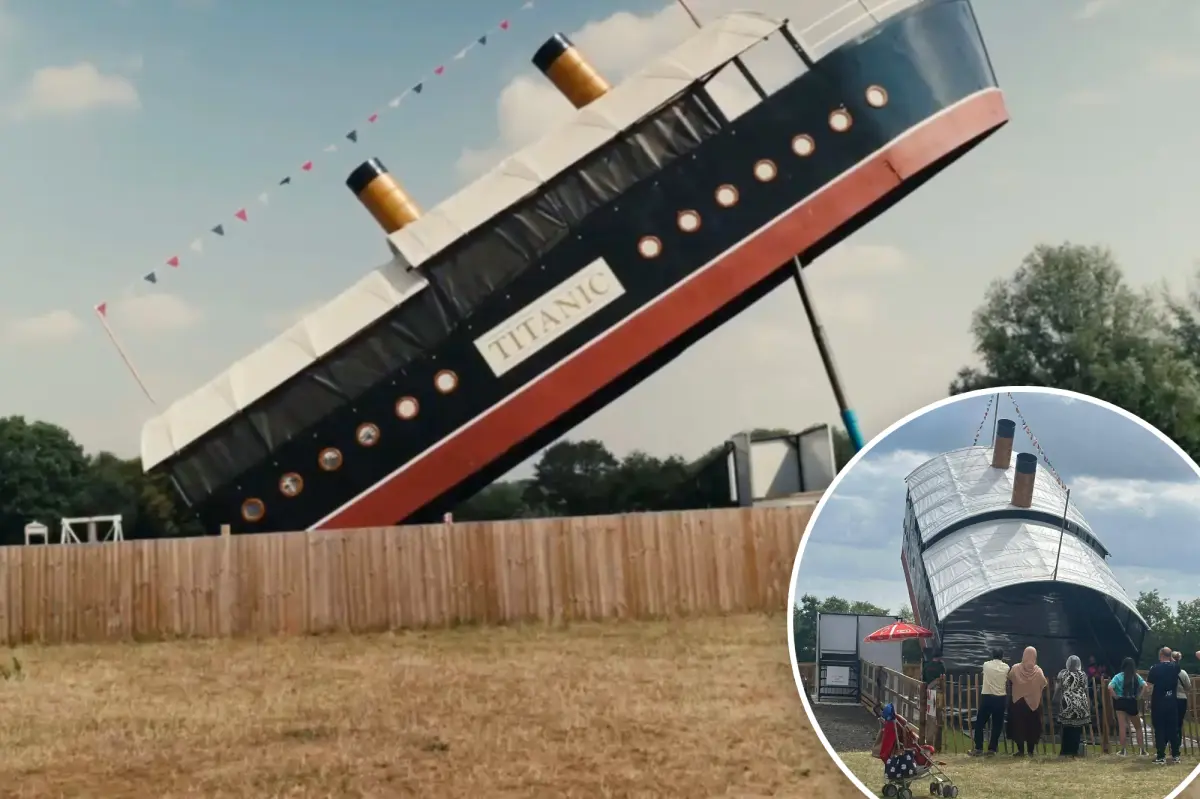
Nestled amidst the rolling, honey-hued fields of Hertfordshire, where the air is thick with the scent of ripening strawberries and the laughter of children chasing butterflies, the Graveley Fruit Farm presents itself as the quintessential picture of bucolic English summertime. Since 1981, families have flocked to this idyllic patch of countryside to engage in the wholesome traditions of berry picking, navigating sprawling maize mazes, and letting their little ones loose in the adventure playground. The car park is a symphony of slamming doors and excited squeals, the horizon punctuated by the bright swoops of slides and the clatter of wooden play structures. It is a place designed for innocent fun, for creating Kodak-moment memories, and for the simple, sticky joy of eating fruit fresh off the vine. Yet, lurking just beyond the herb garden and the tractor-pulled trailer rides, a deeply incongruous monument stands ready to greet young thrill-seekers—a dark, steel-gray behemoth that has recently plunged this peaceful rural idyll into a frothing vortex of online controversy and cultural soul-searching. This is the Titanic ride, a structure so tonally bizarre that it feels like an absurdist prank, a piece of surrealist art accidentally dropped into a pastoral landscape, challenging everything a visitor might expect from a local agricultural attraction.
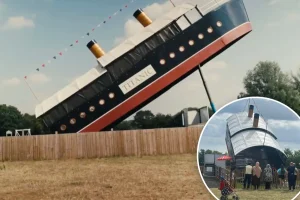
For the modest sum of just under three dollars, or roughly two pounds sterling, a child is invited to climb aboard a garishly painted, near-vertical replica of the RMS Titanic. The attention to detail is eerily precise, at least in nomenclature and theming. As a child queues up, they are handed a boarding pass, a tangible prop that mimics the tragic documentation issued to the actual passengers in 1912. Standing proudly on the side of the wooden structure, the ship’s name is emblazoned in bold, unmissable lettering—a ghostly invocation of a maritime legend that ended in catastrophe. But this is not a museum exhibit, nor a memorial. Instead of steering towards an iceberg in the North Atlantic, the faux ocean liner is perched upon the crest of a massive inflatable structure. Rather than sinking into icy depths, it simply waits for the next rider to clamber aboard, readying itself for a decidedly less tragic, yet metaphorically loaded, descent. The attraction, referred to unflinchingly on the farm’s signage as a “wreck,” offers children a brief ride on a replica of a ship whose name is synonymous with hubris, disaster, and the cold finality of the deep.
For just under three pounds, a child can experience a bizarre snippet of nautical history re-imagined as a theme park thrill. The experience begins with a theatrical flourish: each child is handed a faux boarding pass, a reproduction that mimics the official documentation issued to the doomed passengers of the RMS Titanic in 1912. The heavy irony is palpable—these benign pieces of paper, once a symbol of promise and a new life in America, are now the admission ticket to a playground slide. The pint-sized ride is designed to mimic the trajectory of the famous vessel’s tragic fate. The replica “ship” is elevated high into the air, a slow, mechanical climb that builds anticipation, before it dips forward, sending the shrieking riders hurtling down one of four twisting slides. The descent is brief and joyful, concluding in a soft, cushioned landing on a crash mat below, a starkly practical safety measure that stands in absurd opposition to the historical event it commemorates. A child tumbles off the mat, giggling, brushing the dust from their knees, unaware of the weight of the name emblazoned above them. For them, it is just a slide. For the adults watching, it is a bizarre, uncomfortable collision of childhood innocence and a maritime catastrophe that killed more than 1,500 souls.
This unsettling juxtaposition has finally ruptured the serenity of the farm’s idyllic setting. While the Titanic-themed attraction has been a fixture on the farm for several years, quietly operating without any significant friction, it has recently become the epicenter of a furious online debate. Parents, scrolling through social media and catching sight of the towering structure, found themselves deeply unsettled. To them, the ride is not a harmless nod to a famous ship but a tasteless glorification of one of the deadliest maritime disasters in history. They look at the painted hull, the familiar black and white livery, and the bold name emblazoned across its bow, and they do not see a fun slide for tots; they see a grim memorial trampled upon. The Titanic, which struck an iceberg on April 15, 1912, and plunged to the bottom of the North Atlantic, took with it over 1,500 souls—men, women, and children, many of whom met their end in the freezing, black water. To these concerned parents, the idea of turning that scene of frantic terror and mass drowning into a jaunty, bouncy castle-style slide felt less like harmless amusement and more like a grotesque desecration of memory, a slap in the face to the generations of families who trace their lineage back to that tragic night.
The backlash, when it finally erupted online, was swift, visceral, and utterly unrelenting. Where once there had been only the gentle buzz of farm activity, now there was the furious clicking of keyboards and the thunderous echo of moral outrage. Parents and history buffs alike took to social media, their words dripping with incredulity and disgust. One commenter lamented, “I’m sorry, but this is one of the most distasteful, disrespectful and strange attractions for children,” voicing a sentiment that seemed to resonate with a large chorus of online observers who struggled to find the humor or whimsy in a play structure that evokes the deaths of over 1,500 souls. They argued that the North Atlantic tragedy of April 15, 1912, which saw the “unsinkable” ship claim the lives of men, women, and children, is not a suitable theme for childlike amusement. The criticism grew more scathing, with others questioning the cultural and moral judgment of the farm’s managers. “Why is it named Titanic?” one baffled parent demanded, comparing it to a hypothetical children’s slide themed around the September 11th attacks on New York’s Twin Towers—an analogy designed to crystallize the perceived tone-deafness of the attraction. For these detractors, the ride isn’t just a harmless bit of fun; it is a sanitized, commodified repackaging of profound human suffering, a playground built upon the bones of over 1,500 people who lost their lives on that freezing April night in 1912.
This isn’t a new debate, but rather a simmering pot that has suddenly boiled over. The Titanic slide has been a fixture at the farm for several years, apparently operating without much fuss, a quirky if slightly macabre addition to the landscape that most visitors probably walked past with a shrug or a bemused glance. However, in the age of social media, where every peculiarity is magnified under the unforgiving lens of public opinion, it was only a matter of time before the ride’s inherent inappropriateness struck a nerve. A surge of anger erupted online, with parents and social commentators alike decrying the attraction as a monument to poor taste. The comments section of the farm’s pages became a digital battleground. “I’m sorry, but this is one of the most distasteful, disrespectful and strange attractions for children,” one appalled commentator wrote, perfectly capturing the sentiment of many. The grievance was not merely about a slide, but about the trivialization of immense human suffering—the 1,500 souls who perished in the icy waters of the North Atlantic on April 15, 1912. The comparison to a hypothetical “Twin Towers” themed slide was repeatedly invoked, serving as a stark, visceral shorthand for why this particular historical tragedy seemed uniquely off-limits. The parents argued that it wasn’t a matter of being overly sensitive; it was a simple matter of basic human empathy and historical decency. They couldn’t understand how a place dedicated to childish joy could commodify a disaster of such magnitude, turning the spectral echoes of a maritime graveyard into a source of cheap amusement. It felt, to them, like a slap in the face to the memory of the over 1,500 men, women, and children who perished in the freezing waters of the North Atlantic on April 15, 1912, and a deeply strange lesson to be imparting to the next generation.
The farm’s management initially seemed to bow to the inevitable tide of outrage. In a statement that dripped with defensive capitulation, representatives insisted they were “absolutely making no joke at all,” insisting that they understood the gravity of the subject matter. They publicly pledged to rename the attraction “ASAP,” attempting to soothe the angered parents and project a veneer of remorse. It seemed as though common sense and decency would prevail, and the grotesque mockery would be vanquished from the strawberry fields. However, this ceasefire lasted barely a blink of an eye. In a classic case of the “Streisand effect” and the perils of internet backlash, the initial outrage was swiftly met by an even louder, more vociferous wave of counter-protest. A groundswell of local residents and online champions of the ride rose to its defense, urging the farm not to capitulate to what they derisively labeled the “woke brigade.” They argued that the ride was harmless fun, a quirky nod to popular culture, and a test of the community’s backbone against hyper-sensitive, perpetually-offended outsiders. Under this intense pressure, farm manager Will publicly performed a U-turn, retracting the apology and announcing that the audacious name would stay. In a statement to the press, he defended the decision with a mixture of annoyance and practicality, pointing out that the farm sees around 500 visitors a day who use the slide, and that, to his knowledge, it had offended “only a small handful” of people. The decision, he implied, was a democratic one: the vast majority of his patrons either didn’t care or found the entire hullabaloo risible.
Manager Will’s defense deepened the divide, framing the controversy as a culture war skirmish between common-sense rural fun and urban, pearl-clutching sensitivities. He argued that the Titanic has transcended its historical reality to become something else entirely: a byword in the English language. It has morphed into a universal metaphor for any colossal failure, a punchline in countless jokes, and a staple of blockbuster cinema. He highlighted the temporal distance from the tragedy, noting that there are no living survivors and very few people with direct, firsthand memory of the catastrophe. “We get around five hundred people a day using it, and as far as I’m aware, it has offended only a handful of people,” he rationalized, framing the decision to revert the name as a triumph of the majority over a vocal minority. He framed the reversal not as a capitulation to public pressure in the other direction, but as a principled stand against those he perceived as self-appointed guardians of historical piety. The farm, he suggested, had initially bowed to pressure to rename it, but after hearing from the overwhelming number of regulars and locals who saw the whole affair as barmy humor, they decided to proudly keep the original name, refusing to let the “woke” storm dictate their family-friendly environment. The flip-flop left a sour taste in the mouths of the original complainants, who felt gaslit by a management that blew with the wind, but the farm stood firm, reinstating the sign with a sense of defiant permanence.
This entire saga, played out over headlines and comment sections, taps into a deeper, more uncomfortable question about how we, as a society, process tragedy and memory in the context of commerce and entertainment. Is it ever acceptable to use a historical disaster as the foundation for a children’s plaything? On one hand, the critique is valid; it feels ghoulish to treat the resting place of over a thousand people as a theme for frolic. The sheer inherent darkness of the situation—children gleefully sliding to the bottom of a “wreck” that represents a watery grave—is undeniably macabre. On the other hand, the farm manager’s point about cultural distance holds sway. The Titanic, over a century later, has transcended its status as a raw wound to become a cultural archetype—a story stripped of its gritty reality in favor of narrative drama, James Cameron’s romance, and the general mythologizing of history. For many, the name “Titanic” no longer evokes immediate, visceral grief but rather the image of Leonardo DiCaprio and Kate Winslet at the bow, or the famous line “I’m the king of the world!” It occupies a space in our collective memory akin to a disaster movie, a fabricated tragedy we know was real but have separated from its bleak reality. In rural areas, where the pace of life is slower and the sense of humor tends toward the dry and un-PC, the ride is likely viewed not as a memorial desecration, but merely as a clever, slightly ghoulish pun.
Ultimately, the stubborn survival of the Titanic slide at Graveley Fruit Farm serves as a fascinating case study in the collision between historical reverence and modern tourism. On one side, there is a legitimate argument that we have drifted too far from the gravity of historical events, allowing a pop-culture-adjacent familiarity to desensitize us to true horror. It is one thing to watch a documentary or visit a museum; it is quite another to pay a few pounds to go down a slide shaped like the dying vessel frolicking on the way to its doom. The comparison drawn by one commenter to a hypothetical “Twin Towers” slide is deliberately provocative, pushing the boundaries of what is considered acceptable historical satire versus outright disrespect. On the other side, there is the human instinct towards levity normalcy, and the passage of time. To the farm and its loyal patrons, the Titanic is no longer solely a mass grave but a pop-culture icon, its silhouette as recognizable as Mickey Mouse. They see the ride not as a re-enactment of drowning, but as a gentle, whimsical nod to a famous ship—an object of childhood curiosity. The line between honoring the dead and making light of their sacrifice is blurry, and where one person sees a gallows-humored outrage, another sees a clunky, harmless wooden toy in a field.
In the end, the Graveley Fruit Farm stands as a microcosm of the modern digital age, where a simple rural business is thrust into a gladiatorial arena of online judgment. There is no objective right or wrong here, only a cacophony of competing values: the sanctity of historical memory versus the unseriousness of a children’s slide; the desire to cling to the past versus the ability to move past trauma; the fear of offending versus the defiance of being told what to think. For the farm, the controversy has become a publicity boon—even the outrage served to put them on the map. And so, the Titanic sits there on the grassy knoll, a monument to human tragedy, but also to the absurdity of modern discourse. Children will continue to queue up, delighted by the theme, oblivious to the historical weight of the name. Their parents will either chuckle at the ironic audacity or grimace with historical discomfort. The debate will rage on in comment sections, but on the ground, the farm wins. The ship survives its sinking, rising time and again on hydraulic arms to send another shrieking child sliding down into the safety of the hay bales below, a strange, stubborn, and deeply human monument to the messiness of memory and the enduring power of a good, if morbid, pun. The ship is out of the water, but the tempest of public opinion shows no sign of calming.