


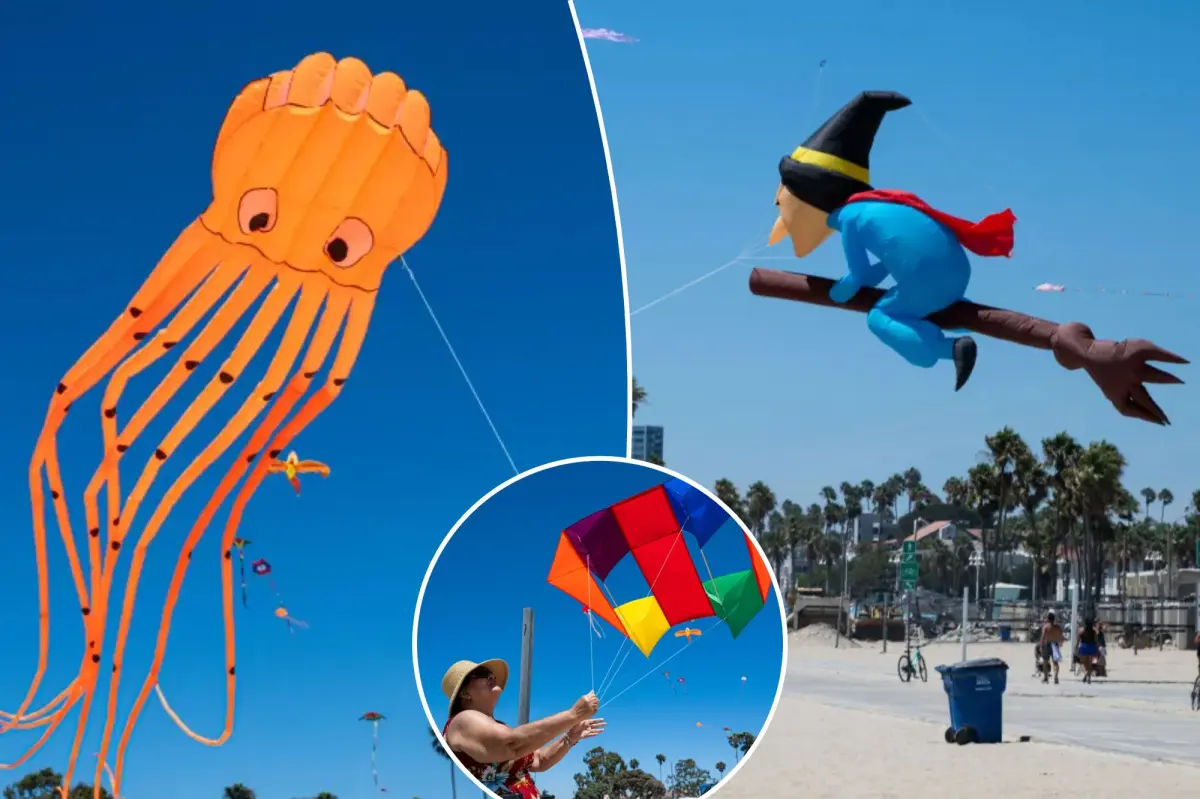
On Sunday, the sky above a California beach became a living canvas of color and motion as hundreds of kite lovers gathered for a festival that blends tradition, play, and togetherness under the open air. The thirteenth annual Long Beach Kite Festival transformed Rosie’s Dog Beach into a radiant carnival of bright shapes and joyful noise, welcoming families, couples, children, and even a few weekend visitors from far beyond Long Beach. From one o’clock in the afternoon until seven in the evening, the beach was filled with people who looked up, laughed, ran, and celebrated the sheer pleasure of watching things float in the wind. The festival, hosted by the Pacific Kite Club, honored Shakrain, the Bangladeshi Festival of Kites, a centuries-old tradition of winter celebration, while still feeling deeply local and inviting to anyone who stumbled upon it. There were giant squid-like octopuses with long, curling tentacles, silver rockets ready to launch from the breeze, a witch riding a broomstick with her dark skirts blowing, a menacing black-and-green spider as tall as a adult, and sharks soaring through the air like they had discovered a new ocean to call home. The beach itself was packed with vivid picnic blankets, coolers, and the occasional dog from Rosie’s Dog Beach, but for most people, the real magic was happening above them. Children ran with tangled strings in their hands; parents chased after little kites and mildly scolded each other about the madness; and from a distance, the whole gathering looked like a living, breathing exhibition of the human imagination. There was an ease to the day, a sense that even life’s simplest materials—paper, string, and a little wind—could lift spirits into a brighter place.
Among the many people who brought their own kites and experience to the festival was Greg Morrison, a longtime kite enthusiast who couldn’t stop smiling. “The wife and I try to go to as many Kite festivals as possible. This is our second year at the Long Beach festival,” Morrison said, while his colorful octopus kite performed soft, lazy aerobatics above the crowd. From his body language to the quiet air of a master, he moved along the beach the way a sailor might walk a deck, with ease and a deep sense of fun. He was not the only one whose passion for kites ran deeper than using a cheap plastic diamond from a souvenir store. Jimmy Westby arrived with a homemade kite before the festival even officially started, one that carried the unmistakable proclamation of Black Lives Matter, in strong, handmade lettering across the sky. For Westby, flying kites is not just a hobby but a reason to travel, meet like-minded people, and be part of something larger. “I try to travel to all the Kite festivals in California as far north as Morro Bay,” he said. “I take the wife and family to the 2-day fest and it’s a great experience every time.” His spirit mirrored the day’s deeper idea: a kite festival is not only a showcase of strange and wonderful designs, but a way of creating community through a shared, beautiful act of hope.
To understand that awe and attachment, something about the origins of the celebration helps. Shakrain, the Bangladeshi Festival of Kites, is a long-standing festival where families climb to rooftops, fly colorful kites, and often fill the sky with a wild song of night. The tradition is tied to the winter month of Magh in the Bengali calendar, and it is marked at the end of the season by the landing of winter, when the sky is so clear and blue that it becomes the perfect target for a kite. This year, the festival honoring that tradition kept as much of it as possible: maybe not the crowded rooftops of Dhaka, but the enthusiastic shouts and the spirit of friendly rivalry that you can hear anywhere two children try to cut each other’s string, or any experienced flier brings out a surprising masterpiece. Organizers clearly understood that the festival shouldn’t rely only on stories; they actively handed out 500 free kites to children and families, and 300 free backpacks to kids on a first-come, first-served basis. For many young attendees, the simple feeling of holding a brand-new kite—the wooden spar, the folded translucent fabric, the little tail still in a plastic wrapper—would become the favorite memory of the weekend. There was nothing complicated about it: the festival simply placed a bit of color into a child’s hand and trusted them to bring it into the sky. And they did. By early afternoon, dozens of small kites were already climbing, dipping, and dancing against the more careful displays by the club’s veterans.
If the kites were the heart of the festival, the ground beneath them was just as alive. Long Beach’s stretch of sand was not only a place to launch a colorful object; it was an outdoor, spontaneous community filled with laughter. In addition to open flying, the afternoon featured a full schedule that included games, art contests, live Bangladeshi music, and cultural dance performances. At one stops, there were hands down a joyful dance performance that made even a few visitors try to follow the movements; near another, the air was filled with the smoky, irresistibly delicious smell of local food vendors, mixing with the salt breeze blowing from the harbor. There were booths operated by local vendors, where people stopped to feel woven fabrics, try delicious snacks, or just dry themselves in the shade before returning to the strong shore wind. At the awards ceremony, kitesof all kinds were recognized by their owners and by the Club, and the winners were announced to speeches that weren’t just about design and skill, but about wild ideas and patient care. The scene had everything you might want in an inclusive summer celebration: types of laughter, small children in pushing for a last bite, teenagers attempting to fly ridiculous larger-than-life toys, and older couples holding hands as they watched their own fabric creations float above the blue. It felt, above all else, human—a reminder of how good a group of strangers can feel when everyone is looking at the same sky at the same time, giving themselves permission to be amazed.
Behind all of the color was the quiet purpose of a genuinely unlikely community. The Pacific Kite Club of California, the group that hosted the festival, started out with a simple but extremely meaningful idea: to bring people from different lives together around an activity that is one of the oldest in the world, and to teach them to take care of the place where they gather. Founded by a group of local ocean lovers and community organizers, the group grew into a grassroots nonprofit that in one is thriving club, and in another, an environmental organization. Beyond hosting kite festivals, the Pacific Kite Club also leads active beach cleanups, community donation drives, and outreach programs designed to strengthen the ask-everyone-a-bit-know each other—not just about kites, but about shared obligation to one another and the natural world. It is this sense of being a steward that gave the event a quieter meaning under the dazzling colors. Each handed kite represented that we are still okay to dream, and each piece of trash collected from the shore showed that the festival organizers also wanted that dream to remain possible on future generations. The festival was widely a show, but it was also a way of saying: We are watching each other, we are sharing this beach, this air, and this windy afternoon, and we take this responsibility seriously.
By the time the Long Beach Kite Festival was finally wrapped up under the late sun, the beach smelled of sun cream and salt and the air was still heavy with the energy of the afternoon; there were still a few kites drifting off in the distance, as if they weren’t ready to admit the day was over. It had been only a few hours since the festival started at 1 p.m., but it had enough memories to fill a whole summer. Overheads, I had seen unlikely creatures walk and fly and fall, and the beach had become another actor in the great, daily drama of a community gathering. January is a month of so many private moments, and with the world so much still divided by invisible walls, a mythical day like this stood out as a quiet act of magic. A free kite in the hand of a child, a stranger helping you untangle your line, a dance routine you didn’t fully understand but moved your heart anyway; all of those are the actual tools through which communities are woven. As families in rolled their fliers and walked back toward their vehicles, they carried more than souvenirs and tiredness; they carried a shared sense of the day that would linger in photographs, in excited voices, and in small red marks on their fingers. Long Beach has hosted this festival for over a decade now, and with it always takes place on a different schedule, but the heart of the festival will be the same: an invitation to come out, look up, and not just see a kite, but see each other and the broad, open sky where all of us are welcome.