

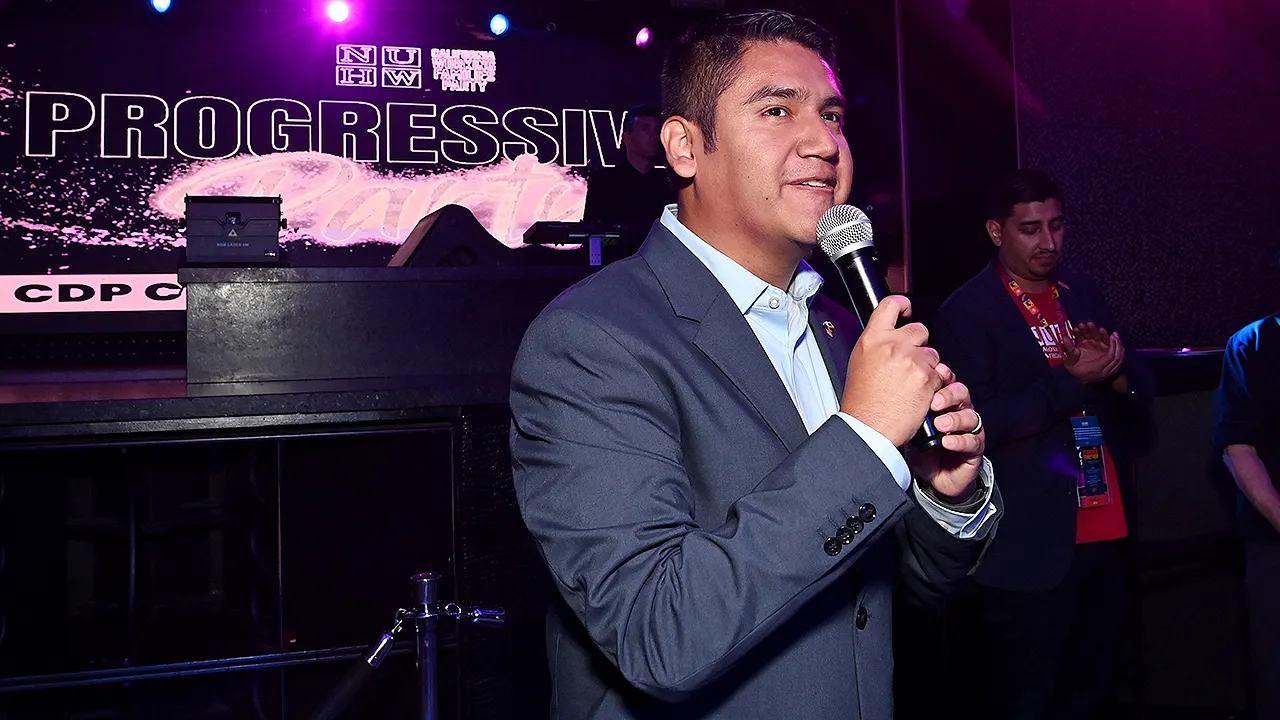
In California’s 22nd Congressional District, the political battle for control of the House is playing out in a place where the personal and political are never far apart. The district, rated a toss-up by the nonpartisan Cook Political Report with a razor-thin D+1 partisan lean, stretches through the Central Valley, a vast agricultural region of dairy farms, orchards, and small towns where many families have deep roots and even deeper concerns about their futures. Democratic challenger Randy Villegas, a political science professor at College of the Sequoias and a Visalia school board trustee, is taking on Republican Rep. David Valadao in a race that Democrats have made a top pickup target. Villegas has the backing of Vermont Sen. Bernie Sanders, and he has built his campaign around his identity as an educator. But according to his own writings and reports on his work with students, Villegas has also used the classroom and academia as a platform for diversity, equity and inclusion (DEI) initiatives and activist groups. His record is now a flashpoint in a campaign that could help determine which party controls the House, and it raises a question that goes far beyond this one district: What should a teacher be? For Villegas, the answer seems clear. For his critics, it is a warning. And for the voters of the Valley, it is a choice that will shape their representation in Washington.
Villegas’s educational philosophy is laid out in a 2022 academic paper he co-authored, titled “A Commitment to Teaching, Learning, and Student Advocacy: Community College Careers,” published by the American Political Science Association as a chapter in Strategies for Navigating Graduate School and Beyond. “At the heart of community college teaching is diversity, equity, and inclusion, and culturally responsive teaching,” he wrote. “Community colleges commit to teaching excellence and to a social justice-driven duty to accessibility. Most community colleges have similar institutional characteristics as a result. For example, community colleges are open access institutions. This means that all students are accepted.” While the paper pre-dates President Donald Trump’s push to eliminate DEI mandates across the federal government and education system, it offers a clear window into Villegas’s worldview. He and his co-authors framed diversity and inclusion as a responsibility extending beyond campus, writing that “a commitment to diversity and inclusion expands from the classroom to the communities in which students live” and arguing that students’ “social and economic realities” should also shape course design. His dissertation, “Voices from the Valley of Vulnerability,” written for the University of California, Santa Cruz, goes even further. Villegas identifies himself as a “former community organizer and scholar activist” and argues that activism can be part of scholarly work. He dismisses concerns about objectivity, saying his activism gave him access to information and that his identity and life experiences made his research stronger. He cites scholar Zepeda-Millán, who argued that researchers’ “biases can actually be assets.” Throughout the dissertation, Villegas describes organizing May Day demonstrations, protesting outside an immigrant detention center, and working with community groups to advocate for far-left causes. He calls educational institutions “anti-political” and praises community organizations for “actively politicizing and socializing youth” and empowering them to become “agents of change.”
Those ideas have never stayed in the ivory tower. In 2018, Villegas helped lead the Central Valley Freedom Summer (CVFS), a program that connected students with community organizations for voter outreach, civic engagement and grassroots organizing. Participants worked on issues including LGBTQ rights, immigration, environmental justice and racial inequality while conducting voter-registration and turnout efforts. One partner was Jakara Movement, a group that in 2020 launched a campaign seeking the removal of a statue of Mahatma Gandhi, citing what it described as Gandhi’s “history of anti-Blackness and racism,” as Breitbart reported. Some CVFS graduates went on to launch activist groups of their own, including LOUD for Tomorrow, a self-described “queer and trans BIPOC youth-led” organization that has hosted youth drag events across the Central Valley. For Villegas, these efforts are not extracurricular; they are the logical expression of his belief that education should be tied to social change. He has described himself as a “scholar activist” and argues that his own life experiences—growing up in the Valley, organizing alongside immigrants, fighting for racial justice—make him a better teacher and researcher. Supporters see a candidate who is authentically connected to the communities he wants to represent. Critics see a man who blurs the line between instruction and indoctrination, using public education to build a pipeline for left-wing activism. The debate over his work with CVFS, Jakara Movement, and LOUD for Tomorrow is not merely academic; it is a window into how he might approach the responsibilities of a member of Congress.
National Republicans have seized on that record with relish. “Randy Villegas was cooked up in a lab to be the radical left’s perfect woke freak. The only thing he cares about is political power and his far-left agenda,” Republican National Committee spokesperson Nick Poche told Fox News Digital. The attack is part of a broader GOP strategy to tie Democratic candidates to DEI and social justice movements, especially in battleground districts. Villegas did not respond to Fox News Digital’s questions about his statements that educators also wear the hat of a “social activist.” Instead, a spokesperson turned the spotlight on Valadao. “David Valadao ripped away healthcare and food assistance from Valley families to hand his billionaire buddies a tax break,” the spokesperson said. “These desperate attacks won’t hide his toxic record, or the domestic abusers bankrolling his campaign.” The comments appear to refer to Valadao voting in favor of President Donald Trump’s “One Big Beautiful Bill,” a sweeping tax and spending package that included roughly $1 trillion in Medicaid cuts. Democrats have argued the cuts could cause tens of thousands of people in Valadao’s heavily Medi-Cal-dependent district to lose coverage. Fox News Digital reached out to Valadao’s chief of staff and communications director for comment, as well as Villegas’s campaign for clarification on the allegation that “domestic abusers” are financing Valadao’s campaign. The allegation was not detailed, but the back-and-forth shows how quickly the race has shifted from educational philosophy to raw political combat.
Valadao’s vote on the spending package gives Villegas a powerful counter-narrative. In a district where many residents depend on Medi-Cal, California’s Medicaid program, healthcare is not an abstraction; it is a matter of survival. Democrats say the spending bill’s Medicaid cuts could strip coverage from tens of thousands of people in the 22nd District, a heavily agricultural, largely Latino area with high rates of poverty and chronic illness. For Villegas’s campaign, the message is simple: Valadao may have a moderate reputation, but when it mattered, he chose tax cuts for the wealthy over health coverage for the Valley. The “domestic abusers” accusation is a sharp and personal escalation, though the campaign offered no details. Valadao’s team did not respond to Fox News Digital’s request for comment. The dispute over Villegas’s DEI and activism record, however, remains front and center. For national Republicans, Villegas is a walking caricature of left-wing academia—someone who would turn a congressional office into an extension of the campus culture war. For Villegas and his allies, the attacks are a distortion of a career spent serving students and fighting for communities that have too often been ignored by Sacramento and Washington. The truth likely lies somewhere in between, but in a toss-up district, perceptions matter more than nuance.
At its heart, this race is about what kind of representative the Central Valley wants and, on a larger scale, what kind of country America is becoming. Villegas’s story is rooted in the Valley: he is a professor at a community college, a trustee on the local school board, and a former organizer who has worked alongside some of the region’s most marginalized people. He has never pretended to be a neutral observer. To his supporters, that honesty is a strength; they see a man who believes education should empower young people to question power and demand change. To his critics, it is a warning; they see a politician who thinks schools are “anti-political” and teachers should be “social activists.” The voters who will decide this race are not pundits. They are parents, farmworkers, small-business owners, and retirees. They care about their children’s schools, their own health, and the cost of living. They will have to weigh Villegas’s writings and activism against Valadao’s record and the Republicans’ dire warnings. In a toss-up district with the House majority on the line, every conversation matters—in the fields, at the grocery store, outside the school gates. The outcome will send a signal not just about California, but about the country’s mood on DEI, education, and the proper role of a teacher. And behind all the attack lines are real people, trying to figure out what kind of future they want for themselves and their families. That is the human heart of this election, and it will be decided one vote at a time.