



Paragraph 1: The Rupture of Private Life in the Public Square
In the sweltering, politically charged summer of a divided nation, the normally quiet, pine-scented state of Maine has become the unlikely epicenter of a personal scandal so intimate and so raw that it threatens to crack the very foundations of a fragile Democratic coalition. The race for the U.S. Senate seat long held by the formidable Republican incumbent, Susan Collins, has taken a bizarre and deeply human turn, catapulting a relatively obscure labor organizer and state senator named Troy Jackson into the blinding, unforgiving glare of the national spotlight. The catalyst for this upheaval was not a policy disagreement or a failed budget negotiation, but rather a revelation that feels plucked from a gothic New England novel: Jackson, the freshly anointed Democratic nominee, reportedly fathered two children with his second cousin, a woman named Lana Pelletier, who has been his devoted partner and high school sweetheart. This bombshell, meticulously published by the conservative outlet The Maine Wire, detailed genealogical research purporting to show a direct blood tie between Pelletier’s father and Jackson’s mother. In an era where every aspect of a politician’s life is dissected with surgical cruelty, the news hit like a thunderclap, sending shockwaves through the corridors of Democratic power in Washington and forcing a deeply awkward calculus: how does a party that champions progressive family values and personal privacy respond to a candidate whose personal history includes a consanguineous relationship, a 1988 assault arrest, and a predecessor who dropped out amidst a rape allegation? The answer, it appears, is a mixture of stony silence, fierce loyalty, and a desperate hope that the voters of Maine will look past the tangled branches of the Jackson family tree and focus instead on the stark political choice before them. The scandal has undone the neat narrative of a party on the offensive, replacing it with a messy, human story that refuses to be neatly categorized, leaving Democratic leaders walking a tightrope between acknowledging uncomfortable truths and dismissing them as “gossip.”
Paragraph 2: The Silence of Donna Brazile and the Politics of Discretion
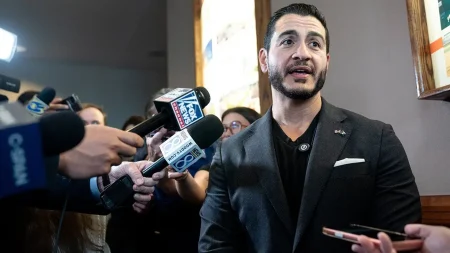
At the heart of the Democratic defense is Donna Brazile, the veteran political operative and former interim chair of the Democratic National Committee, a woman who has weathered more political firestorms than most and emerged with her pragmatic instincts intact. When pressed by Fox News Digital on the explosive claims regarding Jackson’s relationship with his cousin, Brazile did not charge to his defense with righteous fury, nor did she retreat into moral condemnation. Instead, she offered a masterclass in political de-escalation, cladding her words in a velvet glove of ambiguity. “There’s a lot of people who are doing a lot of gossip as news,” she mused, her tone weary and cautious, “and I don’t want to break news that might not be true — especially on something so personal — that’s not what I do.” This is the humanizing core of the entire saga: the acknowledgement that beneath the political calculations, beneath the strategy memos and polling data, lie the flesh-and-blood realities of two people who chose to build a life together decades ago, raising children and forging a partnership that has withstood the test of time. Brazile’s refusal to engage with the salacious details—calling them “innuendos” and “lies”—is not merely a cynical political dodge; it is a recognition of the inherent dignity owed to a private history that has suddenly been dragged into the arena. She gently pivoted away from the personal wreckage to the cold calculus of electoral politics, noting that the Maine race would be “one of the most competitive races” and that the party would be “watching in the fall.” For Brazile, the story is not about cousins or police reports; it is about the survival of a Senate seat in a narrowly divided chamber. Yet, even her steeled pragmatism could not fully mask the underlying discomfort—the understanding that in American politics, the private lives of public servants are often the most potent weapons of their adversaries, and that the sanctity of a family home can be shattered by the click of a reporter’s keyboard.
Paragraph 3: The Chaotic Path to Candidacy and the Ghost of Graham Platner
To truly humanize the pressure Troy Jackson is under, one must rewind the chaotic tempest of the last few months that led to his unlikely nomination. The Democratic primary originally belonged to Graham Platner, a far-left firebrand who won the June 9th primary but whose campaign was plagued by a series of escalating controversies that culminated in a devastating rape allegation, forcing him to formally withdraw on July 10th—just barely in time for the party to scramble and select a replacement. Jackson, a state senator and union railroader known for his gruff demeanor and blue-collar advocacy, was thrust into this vacuum, stepping into a race already stained by taint and desperation. Imagine the emotional whiplash: one moment, Jackson is a relatively low-profile state legislator fighting for worker benefits in Augusta; the next, he is the standard-bearer tasked with toppling one of the most entrenched incumbents in modern political history, all while carrying the legacy of his predecessor’s shame. The handoff was never clean, and the party’s machinery, hungry for a lifeline, viewed Jackson as the safest pair of hands available. But the universe, it seems, had other plans. The revelation about his cousin relationship—reported within weeks of his nomination—shattered the comfortable narrative that Jackson was a boring, safe choice. It transformed him into a figure of morbid curiosity, a man whose private choices in his youth were now dissected on the same front pages that once chronicled Susan Collins’s own moderate compromises. The human weight of this is staggering: Jackson is not merely fighting for a political office; he is fighting for his family’s legacy, for the understanding of his children who must now grapple with the public revelation of their parents’ genetic connection, and for the simple, profound desire to be judged on his legislative record and his lifelong commitment to his community rather than on the branching map of his ancestry.
Paragraph 4: The 1988 Police Report and the Defense of a Life Partner
As if the genealogical bombshell were not enough, the ensuing media frenzy resurrected a yellowed, decades-old police report from 1988, alleging that a young Troy Jackson had assaulted a man in an altercation over Pelletier, and that Pelletier herself had reportedly told police that Jackson “pushed her around.” This archival relic, unearthed from the dusty files of a forgotten past, painted a picture of a volatile, possessive young man—a far cry from the weathered statesman he has become. In a statement that was both contrite and defiant, Jackson owned the fight, saying, “I took responsibility for [the fight] then, and I take responsibility for it now.” But it is the response from Lana Pelletier that serves as the most profound human anchor in this swirling maelstrom. Faced with a report that threatened to define the father of her children as a violent abuser, Pelletier issued a quiet but resolute defense: “I do not remember making the statements attributed to me and they are not accurate. This is the first time I have seen this report from 40 years ago. Troy and I have built a life and family together and I know the person he has been through the decades since, both as a caring partner and father.” Her words resonate with the deep, unshakeable loyalty of a woman who has shared nearly four decades of life with another person—the daily grind of raising kids, the shared triumphs and tragedies, the quiet moments of ordinary existence. She refuses to let a forty-year-old script authored by a different, younger version of herself dictate the legacy of their family. This is the quintessential human conflict: the public demand to reduce a life to a single black-and-white document, versus the private truth of a long, complicated, evolving relationship. Pelletier’s statement is a testament to the idea that people change, that a scuffle in 1988 does not define the man who tucks his children in at night in 2023, and that the most profound testimony to a character is not found in a police ledger, but in the eyes of those who love them through the decades.
Paragraph 5: The Political Counteroffensive and the Stubborn Deadlock
In the cutthroat arena of campaign politics, adversity is often met with counterattack, and Jackson’s camp has tried to frame the entire scandal as a dirty trick orchestrated by the Collins machine. “Susan Collins will do anything to distract from the fact that she votes with Trump 96% of the time and has sold out working people in Maine,” the campaign declared, accusing the incumbent of orchestrating “shameful and desperate” personal attacks on Troy’s family. Yet, notably, Jackson has never directly denied the core biological claim of his relationship to Pelletier; rather, he has deflected, focusing on the timing and the source of the leak rather than engaging with the factual specifics. This strategic silence is a human gamble—a calculation that the voters of Maine, known for their independent streak and their preference for politicians with dirt under their fingernails, might view Jackson’s refusal to air his family laundry as a form of stoic dignity rather than evasive guilt. Compounding the political irony is the state of the race itself. A recent Fox News Poll revealed that despite the firestorm of controversy, the race between Jackson and Collins remains a statistical dead heat, suggesting that the voters may be immune to the shock value of the headlines, or perhaps that they have seen so much political turmoil that they require something even more extraordinary to shift their loyalties. This deadlock humanizes the electorate, casting them not as passive consumers of scandal, but as discerning judges who might weigh decades of legislative labor against a youthful indiscretion and a genetic footnote. For Jackson, the path forward is a brutal marathon of town halls and handshakes, each encounter shadowed by the unspoken question of his cousin, his children, and his past. He must humanize himself to an audience that has been primed to see a caricature—a lumberjack who married his kin—and convince them that his bedrock principles on labor rights and health care matter more than the branches of his family tree.
Paragraph 6: The Enduring Human Cost and the Question of Redemption
Ultimately, the saga of Troy Jackson transcends the boundaries of a political scandal and becomes a profound meditation on privacy, redemption, and the terrifying fragility of a public life. We are left with a tableau of broken pieces: a party leader like Donna Brazile praying for the storm to pass, a woman like Lana Pelletier defending a lifetime of love against a forty-year-old accusation, two children learning that the secret of their parentage is now a national talking point, and a veteran incumbent eyeing the chaos from the safety of her established perch. The collision of these private realities with the public machinery of an election forces us to confront uncomfortable questions about our own society. Are we obsessed with purely punitive history, digging through archives to find the one sin that cancels out a lifetime of service? Or do we recognize the innate complexity of human beings, the capacity for profound change, and the sanctity of bonds that we may not fully understand? In a world saturated with social media outrage and instant condemnations, the Jackson case serves as a stark reminder that every candidate is first and foremost a person—someone who loved, erred, built a home, and faced their own trials long before they ever filed for candidacy. As the leaves in Maine begin to turn, the voters preparing to cast their ballots must reconcile their political preferences with a deeply human ethical dilemma. They can choose to see Troy Jackson as a man forever marked by a 1988 fight and a genealogical chart, or they can choose to see him as a father, a partner, a union man who has spent a lifetime fighting for the working class. The story is far from over, and the resolution will not come from a press release or a poll, but from the quiet, deeply personal deliberations of thousands of individual voters who, like Jackson himself, are learning that the past never stays buried, and that the most humanizing act of all is the willingness to grant someone the grace to have outgrown their own history.