


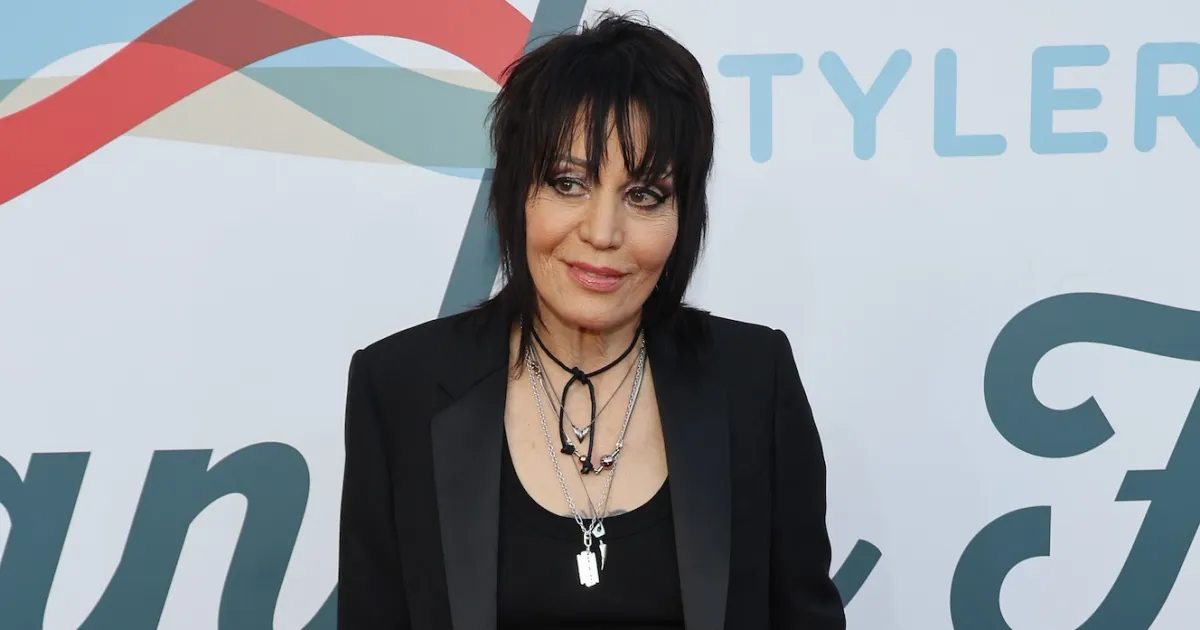
The world of rock and roll has always been defined by its relentless energy, a chaotic yet beautiful symphony of screaming guitars, thumping basslines, and the raw, unfiltered passion of artists who live their lives on the road. Few figures embody this enduring, rebellious spirit quite like Joan Jett. For decades, the pioneering frontwoman has stood as a beacon of grit and authenticity, commanding stages across the globe with an uncompromising presence that has inspired generations of musicians. However, even the most formidable icons are not immune to the fragile realities of the human body. In an unexpected turn of events that sent shockwaves of concern through the music community, the 67-year-old rock legend was recently forced to put on the brakes. On Wednesday, August 5, Jett’s team took to her official Instagram Story to share a sobering update that instantly grounded her high-octane summer schedule: the singer had suffered a serious back injury, requiring immediate orthopedic surgery to repair a fractured vertebra. The announcement, written with a mixture of clinical pragmatism and deep personal regret, revealed that Jett would be stepping away from the spotlight to focus entirely on her healing and rehabilitation. As a direct result of this sudden medical crisis, she has been forced to cancel her highly anticipated headlining performances scheduled for September 5 in Costa Mesa, California, and September 24 in Louisville, Kentucky. For a performer who has spent virtually her entire life under the stage lights, the decision to pull the plug on these shows was undoubtedly agonizing, but it underscores a vital truth that every veteran performer eventually faces: the body’s demands for rest and repair must ultimately take precedence over the demands of the road.
To truly understand the gravity of Jett’s current situation, one must look closely at the medical realities of a spinal fracture and the grueling journey of recovery that lies ahead for her. According to experts at the Cleveland Clinic, a fractured vertebra—commonly referred to as a fractured spine—is a serious condition characterized by a break, crack, or collapse in one of the thirty-three intricate bones that make up the human spinal column. These injuries are typically categorized by their intense physical toll, often resulting from high-impact trauma such as a severe fall, a car accident, or, in older adults, a gradual weakening of bone density caused by conditions like osteoporosis. While Jett and her representative team have chosen to keep the specific circumstances surrounding her injury private, the physical consequences remain incredibly demanding regardless of how the fracture occurred. When a patient undergoes orthopedic surgery to stabilize a spinal fracture, the road back to normal mobility is notoriously long and requires immense patience. For those who manage to avoid the operating table, a spinal fracture still requires at least three months of strict rest to heal properly; however, for patients like Jett who require surgical intervention, the timeline becomes significantly more complex. The immediate post-operative period demands roughly six weeks just for the surgical incisions and manipulated deep tissues to recover, which is then followed by several agonizing months of waiting for the bone itself to fully fuse and heal. For an active, physical performer whose stage presence relies on bending, twisting, and holding a heavy electric guitar for hours at a time, this recovery process cannot be rushed, making her upcoming months of intensive physical therapy absolutely crucial to her long-term well-being.
The sudden halt to Jett’s schedule is made even more jarring when contrasted with the sheer momentum she had built up over the preceding months. Since May, the “I Love Rock ‘n’ Roll” singer had been living out of suitcases, embarking on a grueling but triumphant international tour that saw her and her band, the Blackhearts, tearing through venues across Europe. This European leg of her tour was nothing short of a victory lap, reminding audiences across the Atlantic of the timeless appeal of her catalog and the raw power of her live performances. Just days before the announcement of her injury, on August 3, Jett had shared a vibrant, celebratory compilation video on her Instagram, capturing the sweat-drenched, high-energy magic of her summer shows. Accompanied by a caption that read, “Thanks for the summer love Europe, can’t wait to come back,” the post radiated the joy of a seasoned artist who still finds her greatest fulfillment on stage. At that moment, there was no outward indication of the physical trial that was about to unfold. The sudden transition from the roaring applause of European stadiums to the sterile, quiet environment of a hospital recovery room serves as a stark, deeply humanizing reminder of how quickly an artist’s world can be turned upside down. It highlights the invisible physical tightrope that veteran performers walk every single day, balancing the intense, athletic demands of their art with the quiet vulnerabilities of their physical bodies.
This latest health crisis adds a poignant layer of context to comments Jett made earlier this year regarding the increasing difficulty of maintaining a touring lifestyle as she gets older. In an incredibly candid and introspective interview with The Telegraph in June, the rock icon opened up about the shifting relationship between her aging body and her lifelong career. “I’ve been touring every year of my life since I’ve been in a band,” Jett reflected, acknowledging the relentless cycle of travel that has defined her existence since her teenage days with the Runaways in the late 1970s. She went on to make a sharp, humorous, yet deeply honest distinction between the act of performing and the logistics of getting to the venue: “So the touring I don’t mind. It’s the traveling that’s an ass-kicker, I’ll tell you. As I get older, it’s not easy to recuperate as when I was in my 20s.” This admission resonates deeply with anyone who has watched their body change over time, but for a touring musician, the stakes are incomparably higher. The constant disruption of sleep schedules, the physical strain of long flights, the relentless pressure of changing time zones, and the lack of physical stability all accumulate over time, leaving even the most seasoned rock-and-roll warriors vulnerable to fatigue and injury. Jett’s willingness to speak openly about these challenges humanizes her, stripping away the untouchable veneer of a rock star to reveal a woman navigating the natural, sometimes frustrating limitations of aging with grace, humor, and realistic self-awareness.
Yet, despite the undeniable physical hardships and the exhausting reality of life on the road, Jett’s motivation to keep pushing forward remains entirely undiminished, rooted in a profound, almost spiritual connection with her audience. During her interview with The Telegraph, she spoke passionately about the transcendent power of live music, describing it as a vital necessity in an increasingly divided and chaotic world. “Especially these days, when we need it more than ever,” Jett explained, her words carrying the weight of someone who has witnessed the cultural shifts of the last five decades. “We can all finally be one for a moment, as clichéd as that sounds. But it’s true. When you can lose yourself in that moment… it’s not about thinking about what’s going to happen. You just do it. You just be it.” This philosophy elevates her concerts from simple entertainment to a form of communal therapy, a sacred space where thousands of strangers can gather under one roof, cast aside their daily anxieties, and unite in a shared, fleeting moment of pure, present-moment joy. For Jett, the stage is not merely a place of work; it is a sanctuary of connection, a vehicle through which she can heal, inspire, and unite. Knowing how deeply she cherishes this exchange makes the cancellation of her upcoming shows even more heartbreaking, as it deprives both her and her loyal fans of that precious, unifying magic that only a live rock show can generate.
As Joan Jett embarks on this challenging new chapter of healing and physical rehabilitation, the overwhelming sentiment from her global community of fans, friends, and fellow musicians is one of profound support, admiration, and patience. Her team’s statement made it clear that while she deeply hates to disappoint those who had bought tickets to see her perform in California and Kentucky, her immediate focus must be entirely directed inward toward physical therapy and recovery. This forced intermission, though painful, is a necessary investment in her future, ensuring that she can return to doing what she loves most without compromising her health. Joan Jett has spent her entire career defying expectations, breaking down barriers in a male-dominated industry, and proving time and time again that she possesses a resilience that is virtually unmatched. This spinal injury is undoubtedly a formidable opponent, but the same fiery determination that propelled her to the Rock and Roll Hall of Fame will surely guide her through the grueling process of physical therapy. True to her indomitable spirit, the statement closed with a reassuring promise that should give comfort to everyone holding their breath for her recovery: she is fully focused on her healing so that she can continue “delivering tremendous concerts for many years to come.” For now, the guitar may be temporarily put away and the stage lights dimmed, but the heart of this legendary rocker beats as strong as ever, and her fans will be waiting with open arms whenever she is ready to step back into the spotlight and reclaim her throne.