


Over the course of a single, whirlwind weekend, Donald Trump’s Truth Social feed transformed into a vibrant, surreal gallery of the digital age, characterized by a rapid-fire succession of artificial intelligence-generated images. For twenty-four hours, the former president shared dozens of highly stylized, digitally fabricated portraits that plunged his followers into a bizarre cross-section of American folklore, science fiction, pop culture, and geopolitical fantasy. Rather than relying on traditional campaign photographs or standard press releases, this concentrated burst of activity highlighted a profound shift in how modern political figures communicate with their base, utilizing the boundary-pushing capabilities of generative AI to craft a mythic, larger-than-life persona. These images, which rapidly spread across the internet, did not merely capture Trump as he is, but rather as an idealized, malleable symbol capable of morphing to fit whatever narrative his supporters desired. By blending high-stakes political branding with the lawless, humorous spirit of internet meme culture, the weekend posting spree showed how deeply artificial intelligence has integrated into the fabric of his digital strategy, turning his social media platform into a theater of the imagination where history, reality, and computer-generated dreams seamlessly collide.
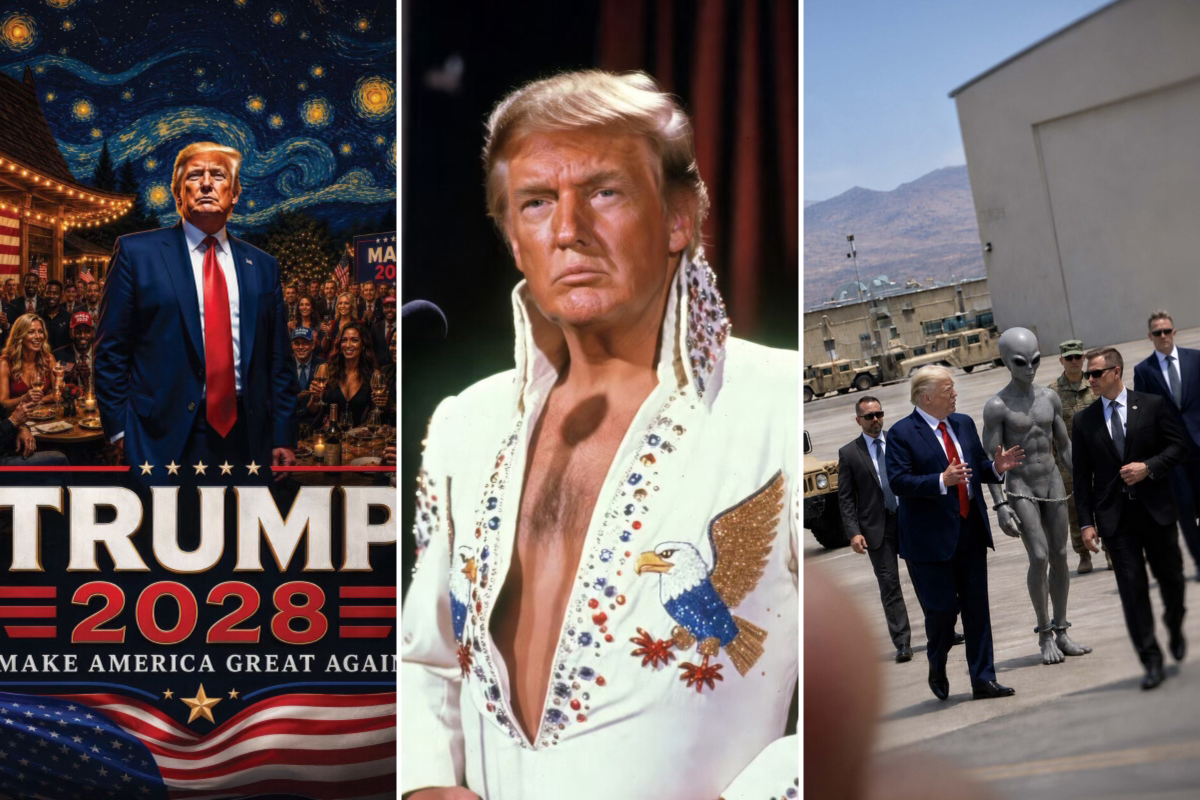
Among the most visually striking and widely discussed images of the weekend were those that leaned heavily into pop culture absurdity and science fiction tropes, presenting Trump as a versatile hero of the cultural imagination. In one particularly outlandish depiction, Trump was shown walking side-by-side with a handcuffed, large-headed extraterrestrial creature at what appeared to be a highly classified military installation, flanked by stern-faced security personnel and heavy tactical vehicles. Another image took a nostalgic, musical turn, dressing him in a glitzy, rhinestone-encrusted white jumpsuit that paid unmistakable homage to Elvis Presley’s legendary Las Vegas performance era. The feed also took a reflective, albeit highly manufactured, turn with a poignant graphic depicting a present-day Trump seated directly across a table from a youthful, clean-cut version of himself dressed in a military academy cadet uniform. Underneath this temporal meeting was the caption, “Same Guy. Even more energy now!”, a direct attempt to project timeless vitality and dismiss concerns about aging. To cap off this surreal collection of personal branding, a campaign-style poster declared “Trump 2028,” playfully brushing aside the standard two-term limit imposed by the United States Constitution. Together, these lighthearted yet deliberate images humanized his brand, transforming a polarizing political figure into an entertaining protagonist of a digital comic book.
Beyond the realms of science fiction and rock-and-roll, American history served as a central, solemn anchor for many of the weekend’s AI creations, as the posts repeatedly sought to align Trump with the nation’s most revered historical figures. One prominent image placed him at a rustic wooden table alongside George Washington and Abraham Lincoln, the three of them huddled together like old colleagues, ready to sign a monumental, nation-defining document. In another dramatic tableau, Trump was cast as a heroic Revolutionary War general standing resolutely amidst a chaotic, smoke-filled battlefield, surrounded by colonial-era soldiers and waving American flags. The collection also featured a striking, split-face graphic that seamlessly merged half of Trump’s face with that of an unnamed Founding Father, accompanied by the bold text “250 Years”—a clear and deliberate nod to the upcoming semiquincentennial anniversary of the Declaration of Independence in 2026. By placing himself in these historical tableaus, Trump’s feed bypassed traditional historical accuracy to evoke a powerful, emotional sense of continuity, framing his contemporary political movement as the natural, inevitable heir to the grand legacy of the American experiment.
The visual journey did not stop with historical figures; it also ventured into the realm of colossal civic architecture, revealing a deep fascination with monumentalism and physical legacy. A particularly eye-catching post featured a massive, brilliant white arch modeled closely after Paris’s iconic Arc de Triomphe, adorned with gleaming gold trim and set against a dramatic sky. Trump personally annotated this post, referring to the structure as the “Triumphal Arch” and clarifying that the image represented the monument in its draft phase, prior to the addition of “the magnificent Statues and Artwork” that would eventually complete it. This was accompanied by another gilded rendering of a colossal, golden Abraham Lincoln statue surrounded by Civil War-era soldiers and draped in American flags, echoing the grandiose style of national war memorials. These digital blueprints are not entirely detached from reality; they directly mirror Trump’s long-standing, real-world political promises, such as his proposed “National Garden of American Heroes,” a massive monument park celebrating historic citizens. Through these AI-generated structures, he was able to offer his followers a vivid, tangible preview of a grand, neoclassical aesthetic that he believes represents the peak of American cultural and architectural achievement.
In addition to history and art, the digital storm touched upon provocative geopolitical themes, translating complex international relations into bold, humorous visual statements. One highly shared image displayed the cheerful greeting “Hello, Greenland!” emblazoned over a dramatically altered landscape where a giant, smiling Donald Trump loomed protectively over the snow-covered Arctic territory. Another post took a sharper, more nationalistic turn, displaying a colorful map of South America where Venezuela was prominently labeled as the “51st State” and styled with the stars and stripes of the American flag. These controversial images played directly on expansionist themes and unconventional territorial debates that have periodically surfaced throughout Trump’s political career—such as his genuine, highly publicized interest in purchasing Greenland during his first presidency. By rendering these audacious foreign policy ideas into cartoonish, colorful digital memes, his social media feed managed to disarm critics with humor while simultaneously reinforcing a bold, nationalist message of American dominance and territorial ambition to his enthusiastic base.
Ultimately, this weekend-long bombardment of computer-generated art is indicative of a broader, highly intentional shift in the way Donald Trump views the role of technology in modern society and political warfare. He has frequently expressed strong, vocal support for the rapid expansion of domestic artificial intelligence, repeatedly arguing that American dominance in the tech sector is absolutely vital to maintaining a competitive edge against global rivals like China, asserting that the technology will “make the United States stronger.” By actively using his own platform as a canvas for AI-generated art, memes, and supporter-created content, he is demonstrating a hands-on, highly personal adoption of the very technology he champions. For his followers, these images provide a unique, constantly updating mythology that blends reality with fantasy, allowing them to see their leader not just as a politician, but as a time-traveling patriot, a pop-culture icon, and a builder of empires. In this brave new world of political communication, the traditional press release has been entirely supplanted by the algorithm, leaving behind an incredibly humanized, highly entertaining, and endlessly shareable digital legacy.