


For the vast majority of people, the simple, routine act of turning on a kitchen faucet or flushing a toilet is accompanied by an unconscious expectation of absolute safety and reliability. It is a quiet, foundational promise of modern society—one that we rarely pause to contemplate until the intricate, hidden machinery that supports it is suddenly cast into jeopardy. That comfortable illusion of security was violently disrupted recently when federal authorities sounded a frantic alarm regarding a widespread, coordinated campaign of cyberattacks targeting the water and wastewater systems that sustain communities across the United States. On July 30, 2026, a joint advisory issued by the Federal Bureau of Investigation (FBI) and the Environmental Protection Agency (EPA) revealed that hostile digital actors had actively infiltrated and compromised critical water utilities in at least seven states beginning just days earlier, on July 27. The revelation sent shockwaves through local municipal offices, state capitols, and federal security agencies alike, transforming abstract warnings about the vulnerability of public infrastructure into a tangible, high-stakes emergency. As investigators rushed to trace the origins of these digital intrusions, the quiet panic reverberating through the utility sector made it undeniably clear that the front lines of global conflict are no longer confined to distant battlefields, but are now creeping directly into the piping, pumps, and treatment plants of everyday American neighborhoods.
To understand how a remote keyboard in another part of the world can threaten the drinking water of an American town, one must look at the highly specialized, often outdated technology that keeps our modern utilities functioning. At the heart of this crisis are devices known as Programmable Logic Controllers, or PLCs—the rugged, industrial microcomputers that act as the physical muscles and nervous system of water treatment facilities. These devices are responsible for automatically regulating delicate chemical levels, monitoring water pressure, opening and closing vital valves, and ensuring that wastewater is safely processed without spilling back into local ecosystems. In their rush to modernize and allow technicians the convenience of monitoring facilities remotely, many utilities connected these sensitive controllers directly to the public internet, often without realizing they were leaving the digital front door unlocked. Federal investigators discovered that malicious hackers systematically scanned the web for these exposed controllers, bypassed their defenses, and altered critical internet protocol (IP) addresses and administrative passwords. This simple but devastating maneuver effectively locked local human operators out of their own systems, blinding them to what was happening inside their plants and causing severe operational disruptions, including localized flooding and dangerous drops in water pressure. The crisis forced a desperate scramble by federal cybersecurity experts, who implored local plant managers to immediately disconnect their control systems from the public internet and return, wherever possible, to manual, analog operations before a catastrophic failure could occur.
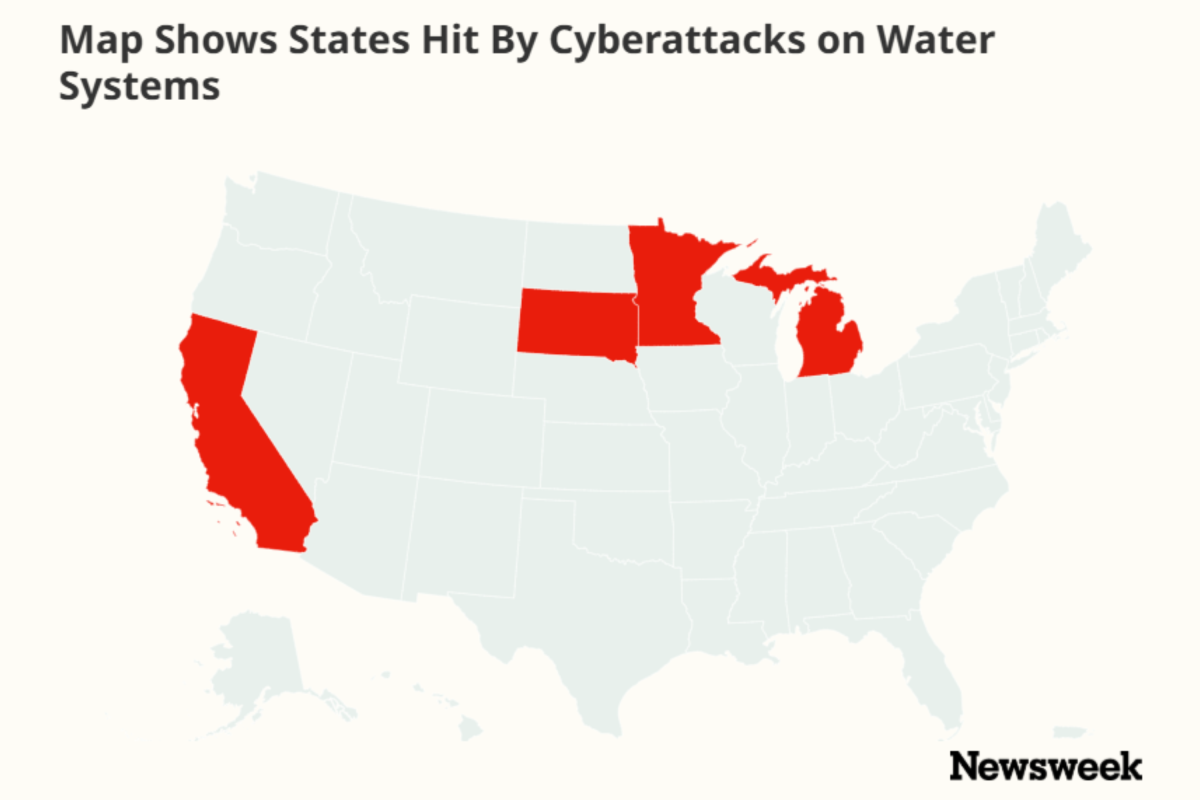
The geographical scale of the assault quickly became apparent as individual states began coming forward with their own alarming accounts of digital sabotage, with the most severe and highly publicized cluster of incidents concentrated in the Midwest. In Minnesota, state officials made the stunning disclosure that more than thirty separate water systems across their territory had been targeted by cyberattacks, a revelation that instantly thrust the state into the center of a national media storm. The sheer volume of these attacks caught the attention of political leaders, including President Donald Trump, who seized upon the crisis during a public address on critical infrastructure security to lambast Minnesota’s leadership, labeling state officials as “grossly incompetent” for failing to shield their citizens’ water supply from external threats. Despite the intense public scrutiny and political finger-pointing, local investigators and plant operators worked around the clock in near-anonymity, quietly identifying compromised systems, resetting corrupted codes, and shielding local reservoirs from contamination. Meanwhile, in neighboring Michigan, state authorities were forced to confront their own digital incursions after a handful of communities reported anomalous system behaviors that perfectly matched the tactics outlined in the FBI and EPA alerts. At one wastewater facility managed by the Michigan Department of Environment, Great Lakes, and Energy, hackers had successfully penetrated the digital defenses and altered the operating configurations of crucial machinery; however, due to the rapid response of local engineers who isolated the affected systems, the threat was neutralized before a single drop of contaminated water could compromise the clean drinking supplies of local households.
As the digital contagion spread, communities further west found themselves locked in their own quiet battles to preserve the sanctity of their public utilities, illustrating that no town is too small or too remote to escape the reach of global cybercriminals. In the scenic Black Hills region of South Dakota, the municipal government of Rapid City announced with startling transparency that one of its essential wastewater lift stations had been targeted in a cyberattack designed to disrupt the city’s sewage management capabilities. While the prospect of an adversary tampering with waste management infrastructure carried deeply unsettling public health implications, city officials acted with remarkable speed to isolate the compromised lift station from the broader network, assuring anxious residents that at no point was the safety of their drinking water or public safety compromised. Further west, in California, a parallel drama unfolded involving California Water Service (Cal Water), one of the largest and most prominent private water utilities in the western United States. In that instance, the threat was accompanied by public posturing, as a notorious hacking collective boasted on the dark web that they had completely breached the utility’s sophisticated internal networks. While the claim sparked immediate fears of a widespread crisis affecting millions of West Coast residents, a exhaustive forensic investigation eventually revealed a far more reassuring reality: the hackers had merely used stolen login credentials to access the online account of a single, individual customer, failing entirely to penetrate the secure operational technology systems that treat and distribute California’s water.
This sudden, coordinated barrage of attacks has inevitably reignited a fierce, geopolitically charged debate regarding who is pulling the strings behind these digital screens, with federal investigators focusing heavily on the shadow of foreign state-sponsored cyber warfare. Specifically, U.S. intelligence agencies are meticulously probing whether these recent incursions are the work of sophisticated Iranian hacking collectives, though officials caution that a definitive, formal attribution remains elusive as technical forensic evidence is still being collected. The suspicion is far from groundless; the tactics, targets, and timing of these attacks bear a chilling resemblance to a watershed incident on November 25, 2023, when Iranian-backed hackers successfully hijacked the digital control systems of the Municipal Water Authority of Aliquippa in western Pennsylvania, forcing operators to run the plant manually and sparking a nationwide panic about the vulnerability of our water supply. However, investigators are also keeping a close eye on the possibility that another hostile state actor—or perhaps a highly capable criminal syndicate—is deliberately mimicking Iranian digital signatures in a “false-flag” operation designed to mislead American intelligence and inflame international tensions. This mystery has quickly been absorbed into the polarized landscape of American politics, where even national security threats are viewed through a partisan lens; while intelligence briefings hint at Middle Eastern state involvement, Donald Trump publicly dismissed the Iranian connection regarding the Minnesota incidents, arguing instead that the lack of concrete evidence points to a failure of local leadership rather than a sophisticated foreign plot, further complicating the public’s understanding of the threat.
As the dust begins to settle on this latest wave of cyber incidents, the enduring lesson for the American public and the gatekeepers of our critical infrastructure is that the line between the physical world and the digital world has permanently dissolved. The FBI’s warning that water systems in at least seven states were compromised suggests that there are still silent, undisclosed victims of this campaign who are quietly rebuilding their digital defenses away from the public eye. For decades, local water districts have operated under the assumption that their primary challenges were physical in nature—dealing with aging pipes, water main breaks, and natural disasters—but they must now accept that they are active participants in a perpetual, invisible global conflict. The tragedy of this new reality is that while a massive, state-sponsored adversary like Iran or China possesses nearly unlimited resources and elite hacker armies, the defense of American water systems often falls on the shoulders of small, underfunded municipal utilities managed by a handful of local employees who lack advanced cybersecurity training. Safeguarding these systems going forward will require a monumental, human-centered shift in how we design and fund our public utilities, moving away from vulnerable, internet-connected conveniences and investing heavily in robust cybersecurity defenses, community-level resilience, and the training of local utility workers. Ultimately, the battle to protect the simple, vital act of turning on a kitchen tap is no longer just an administrative chore for local governments; it has become one of the most critical, defining national security challenges of the modern era, demanding our collective attention, funding, and unwavering vigilance.