



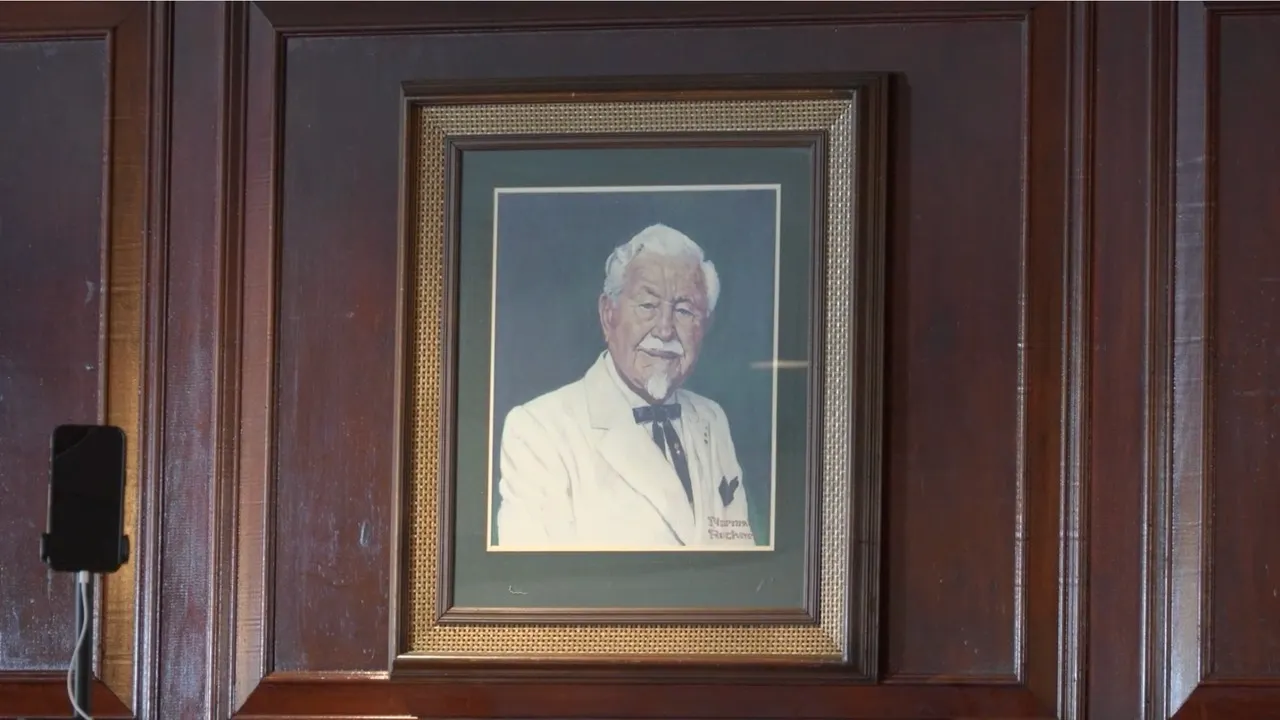
On a crisp evening in Shelbyville, Kentucky, the modest town became the epicenter of culinary nostalgia as collectors, lifelong fans, and curious onlookers gathered both in person and online for a truly historic auction. More than seventy deeply personal artifacts once belonging to the legendary Colonel Harland Sanders—the iconic, white-suited patriarch of Kentucky Fried Chicken—were put up for bid, releasing decades of tucked-away memories into the hands of a passionate public. For years, these items had quietly rested in the dark basements, dusty closets, and attic corners of the Sanders family, preserved as private keepsakes of a household name. Bill Menish, the lead auctioneer and owner of The Menish Group, guided the high-energy evening, noting that the family ultimately decided the time had come to share these cherished fragments of history with the millions of people around the globe who still harbor a deep, genuine affection for the Colonel. The atmosphere in the auction hall was charged with a mixture of reverence and excitement, as each strike of the gavel transformed everyday household items into sacred relics of modern Americana.
Among the night’s most anticipated treasures was a humble 1964 personal pocket planner, which quickly became the center of a fierce, rapid-fire bidding war before finally selling for a staggering $30,000. This seemingly ordinary notebook captured the imaginations of bidders because of a cryptic, handwritten inscription scrawled across its back cover, which many suspect reveals details of the elusive eleven herbs and spices that built the global fast-food empire. In addition to this coveted journal, a prestigious 1955 Kentucky Colonel certificate fetched a remarkable $23,000, while the Colonel’s signature black clip-on bow tie—the very symbol of his Southern gentleman persona—commanded an impressive $8,000 from an eager buyer. One dedicated collector, who had actually worked directly under the Colonel decades ago, watched the proceedings with nostalgic awe, pointing out that the planner was easily the most fascinating artifact of the evening because it offered an intimate, unfiltered window into the daily thoughts and meticulous planning of a self-made corporate giant. For those in attendance, these items were far more than mere memorabilia; they were tangible links to an era of grit, hustle, and the absolute determination of a man who refused to let his dreams die with age.
Standing quietly amidst the bustling crowd of enthusiastic bidders was Elizabeth Pitchford, the Colonel’s granddaughter, who attended the auction to witness the final chapter of these family treasures firsthand. For Pitchford, the evening was a profoundly emotional journey, watching the quiet, everyday objects she had grown up around find new homes with complete strangers who revered her grandfather. It is a unique and often overwhelming experience to share one’s family patriarch with the entire world, balancing the private memories of a warm, loving grandfather against the towering, larger-than-life corporate caricature recognized on every continent. Watching these items sell was bittersweet, yet Pitchford expressed a deep comfort in seeing the genuine joy and respect on the faces of the buyers, knowing that her grandfather’s physical legacy was being entrusted to people who would cherish and preserve it for generations to come. Her presence served as a poignant reminder that behind the global corporate branding and the millions of buckets of chicken sold daily, there was once a real, flesh-and-blood family dinner table, rich with laughter, love, and a very human story of survival and triumph.
Beyond the sheer novelty of the collector’s items, the auction also illuminated the brilliant, practical engineering mind of Harland Sanders, whose relentless work ethic completely revolutionized the food service industry. In the mid-twentieth century, preparing quality fried chicken was a slow, deliberate art practice that took upwards of thirty minutes—a timeline completely incompatible with the rapidly emerging, fast-paced lifestyle of post-war America. Showing his true genius as an innovator, Sanders took a heavy commercial pressure cooker, which was never originally designed or intended for frying chicken, and successfully modified it to safely and rapidly cook his chicken in just ten minutes flat. This single, brilliant stroke of kitchen hacking allowed him to scale his business models, paving the way for the high-volume, rapid-service franchise model that would soon take the culinary world by storm. The tools and documents sold at the auction did not just represent a mascot’s wardrobe, but rather the hard-fought intellectual property and mechanical triumphs of a true American pioneer who single-handedly reshaped how the world eats.
While the physical memorabilia auction has successfully concluded, the final and perhaps grandest pieces of the Colonel’s earthly estate are still awaiting their next protectors. Currently up for grabs through a high-stakes, sealed-bid process are Blackwood Hall, the stately former home of the Sanders family, and the nearby Claudia Sanders Dinner House, a beloved local restaurant named in honor of the Colonel’s devoted wife and business partner. This landmark dining establishment was opened by the couple after they sold Kentucky Fried Chicken, serving as a haven of authentic Southern hospitality and remaining a vital, living monument to the family’s rich regional history. Since 1974, these historic properties have been meticulously maintained and cared for by the Settle family, who have acted as dedicated custodians of the Sanders legacy in Shelbyville for nearly half a century. With the final bids due by midnight on Friday, a palpable sense of anticipation hangs over the local community, as residents and history buffs alike wait to see who will step forward to shepherd these iconic properties into a brand-new era of Southern storytelling.
Ultimately, the Shelbyville auction proved that the enduring magic of Colonel Harland Sanders lies not in the corporate logo, but in the timeless romance of his human journey. He was a man who faced countless failures, job losses, and setbacks, only finding his true, wild success in the autumn of his life through sheer perseverance, a pressure cooker, and a recipe he believed in with all his heart. In a modernized, highly digital world that often feels sterile and mass-produced, the fierce bidding wars over a simple clip-on bow tie or an old, handwritten planner reveal our collective, deep-seated hunger for authenticity and real human stories. The legacy of the Colonel continues to thrive because he remains the ultimate personification of the American Dream—a reminding force that it is never too late to reinvent oneself, work hard, and leave a mark on the world. As these seventy-plus treasured belongings scatter across the country to their new owners, the warmth, grit, and hospitable spirit of the man in the white suit will undoubtedly continue to inspire and capture the imagination of generations to come.