


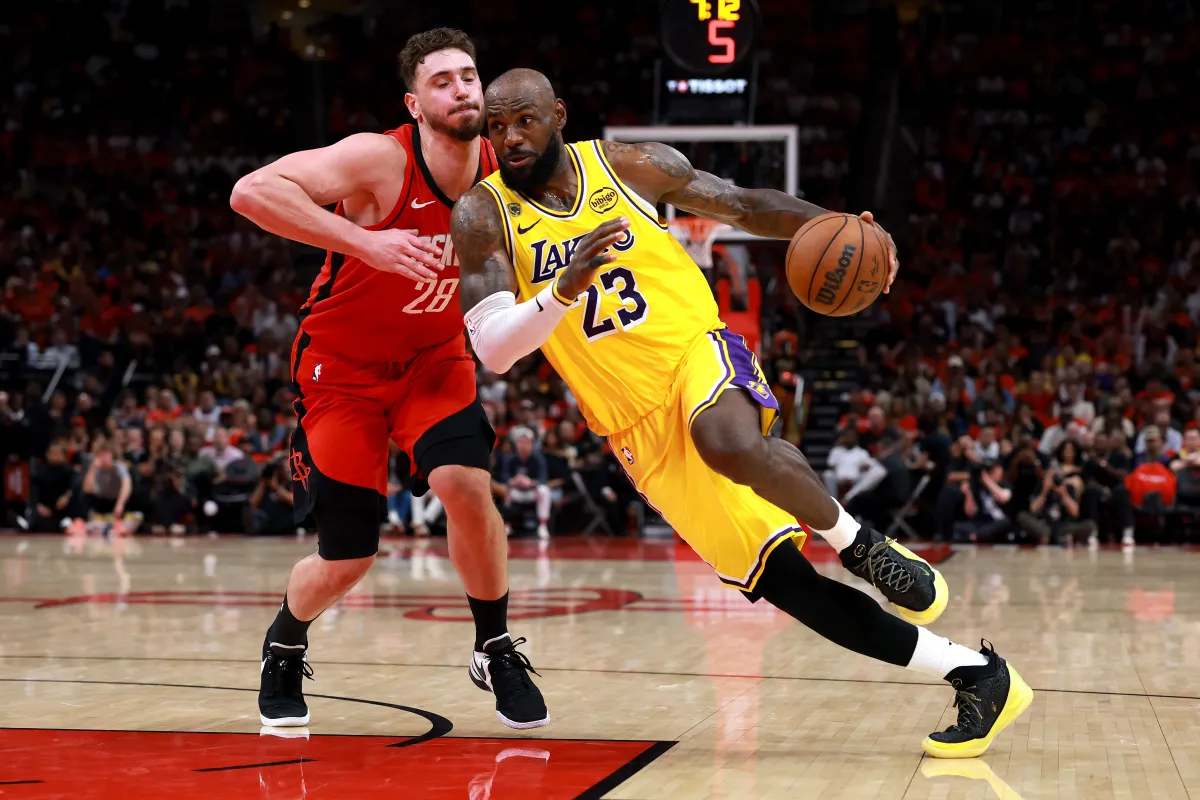
This past spring, the landscape of professional basketball witnessed another extraordinary and deeply human chapter in the seemingly ageless odyssey of LeBron James. At forty-one years old, a time when almost every other historical peer had long since traded their high-top sneakers for tailored broadcasting suits or quiet retirements on the golf course, James was still spearheading the postseason ambitions of the Los Angeles Lakers. The opening round of the NBA playoffs pitted his veteran squad against the youthful, hyper-energetic Houston Rockets, resulting in a grueling series that the Lakers ultimately won. Yet, the most culturally resonant artifact from that hard-fought victory was not a statistical milestone or a game-winning shot, but rather a viral, humanizing encounter with Houston’s rising star, Alperen Sengun. An animated on-court exchange between the weary legendary veteran and the audacious young big man birthed a fresh, instantly classic LeBron James meme that dominated social media feeds for weeks. It was a beautiful moment of levity that highlighted the deep generational bridge James has constructed over his decades in the league—a visual testament to the fact that even as his athletic peak naturally recedes, his cultural gravity remains entirely unmatched. Ironically, this hard-won triumph against Houston was quickly followed by a sobering sweep at the hands of the young, relentless Oklahoma City Thunder in the subsequent round. This sudden, unceremonious exit not only shattered the Lakers’ hopes for another championship run but also brought a definitive, quiet end to James’ landmark eight-year tenure in the city of Los Angeles, leaving a profound sense of finality in its wake.
In the immediate aftermath of that postseason exit, the whispering winds of retirement grew deafening, leaving fans, analysts, and close friends wondering if the game’s most prolific icon had finally reached his limit. The true psychological state of the aging superstar was recently illuminated by his longtime friend, agent, and trusted confidant, Rich Paul, during an intimate appearance on the sports talk show Game Over. Speaking with co-host Max Kellerman, Paul opened up about the profound emotional weight hanging over James as the season concluded, revealing how incredibly close the legendary forward came to walking away from the game forever. Paul began a thought, noting that the first-round series against the Rockets was the pivot upon which everything turned, a sentence Kellerman intuitively finished by asking if that specific battle convinced James to keep playing. Paul affirmed this with quiet sincerity, admitting that he truly believed the joy, friction, and validation of navigating that physical battle with Houston rescued James from retirement. Had the Lakers been swept in that opening round, or even lost in a decisive five games, Paul confessed that the outcome would have likely been entirely different, and the legendary forward would have quietly written his farewell. This candid admission humanizes the monumental struggle of the elite athlete, demonstrating that even a figure of LeBron’s mythical stature is subject to moments of profound self-doubt, requiring the pure spark of a hard-earned playoff victory to remind him why the sacrifice is still worth it. Thanks to that competitive spark against the Rockets, his inner circle was granted the precious gift of “one more ride,” preserving a career that was balancing on the precipice of its final curtain.
The climax of this suspenseful offseason arrived on Friday, July 24, when James bypassed traditional media machinery to speak directly to his fans, announcing what he emphatically characterized as “my last decision.” Through a deeply reflective, long-form message posted to his personal X account, he laid bare the inner turmoil he experienced when the grueling season finally concluded, admitting he was initially convinced his playing days were over. He confessed that when he faced the media at his final postgame press conference, his uncertainty was genuine, as he desperately needed a period of profound isolation to look himself in the mirror and decide if the burning love for the game still existed. This vulnerable introspection ultimately yielded a renewed sense of purpose, prompting him to sign a shocking two-year, $8 million contract—which includes a highly coveted player option—to join the Philadelphia 76ers, as reported by ESPN’s prominent insider Shams Charania. The financial structure of this contract is perhaps the most humanizing element of the entire saga, representing an unprecedented sacrifice for a billionaire athlete who could have easily demanded a maximum salary. By accepting such a modest sum, James stripped away any cynical assumptions about greed or status, proving to a skeptical public that his remaining time on the hardwood is fueled purely by the romantic, intrinsic pursuit of competition and the simple desire to contribute to a winning environment.
While LeBron’s decision was deeply rooted in his personal re-evaluation of his passion for the sport, it was also highly calculated, catalyzed by a massive front-office earthquake that transformed the competitive landscape of the Eastern Conference. On July 1, just weeks before LeBron’s announcement, the Boston Celtics sent shockwaves through the league by trading superstar forward Jaylen Brown to the Philadelphia 76ers. For an analytical basketball mind like James, this blockbuster trade was not merely a headline, but an invitation to build something historic in the City of Brotherly Love. The arrival of Brown in Philadelphia immediately provided the aging superstar with the perfect sporting ecosystem, offering a dynamic, elite offensive and defensive partner capable of carrying the heavy physical burdens of the regular season. Throughout his career, LeBron has mastered the art of spatial geometry and team chemistry, and he quickly recognized that aligning himself with a talent of Brown’s caliber could alleviate the intense pressure on his forty-one-year-old body. On his social media broadcast, James openly acknowledged this tactical calculus, stating that after meticulous consideration, he truly believes his unique skillset can help elevate the newly reconstructed 76ers into an undeniable championship powerhouse. This strategic pivot illustrates that LeBron’s longevity is not just a triumph of physical training, but a testament to his cerebral understanding of the game’s shifting tides, allowing him to position himself exactly where history can be made.
By choosing to write the final chapter of his basketball odyssey in Philadelphia, James is embracing a sporting culture that is as fiercely demanding as it is deeply sentimental. The 76ers franchise and its famously passionate fanbase have spent over four decades enduring a painful championship drought, yearning to replicate the legendary magic of 1983 when Moses Malone and Julius Erving dominated the league. To step into this passionate, blue-collar environment as an aging outsider is an immense challenge, yet it is precisely the kind of high-stakes narrative that has always brought out the best in LeBron. Philadelphia is a city that demands authenticity and grit above all else, and by willingly stepping into this sports-obsessed crucible, James is subjecting himself to a level of scrutiny that would break lesser players at the end of their careers. If he can navigate the intense emotional currents of the Philly faithful and deliver the city its long-awaited parade down Broad Street, he will instantly secure an immortal status alongside the greatest icons in Pennsylvania sports history. This move represents a brilliant departure from the celebrity-driven atmosphere of Los Angeles, trading the Hollywood limelight for a gritty, historic basketball town that lives and breathes every single possession with agonizing intensity.
Ultimately, this bold migration to Philadelphia is the ultimate, poetic gamble in LeBron James’ lifelong quest to cement his status as the undisputed Greatest of All Time. If he successfully guides the 76ers to an NBA title, he will achieve a legendary milestone that would elevate his legacy far beyond the reach of conventional statistical debates. Winning a championship in Philadelphia would make him the first player in the history of the sport to capture NBA titles with four entirely different franchises—having already constructed championship legacies with the Miami Heat, the Cleveland Cavaliers, and the Los Angeles Lakers. This unprecedented feat would serve as the ultimate testament to his unparalleled adaptability, demonstrating an ability to transform entirely different team cultures, front offices, and cities into championship-caliber operations. As he prepares to lace up his sneakers for a record-tying twenty-fourth NBA season, the story is no longer about chasing individual scoring records or fighting the inevitable progression of Father Time. Instead, it has become a deeply human story of a legendary craftsman seeking to paint one final, magnificent masterpiece, proving that through wisdom, passion, and an unbreakable love for the game, greatness can always find a way to reinvent itself.