




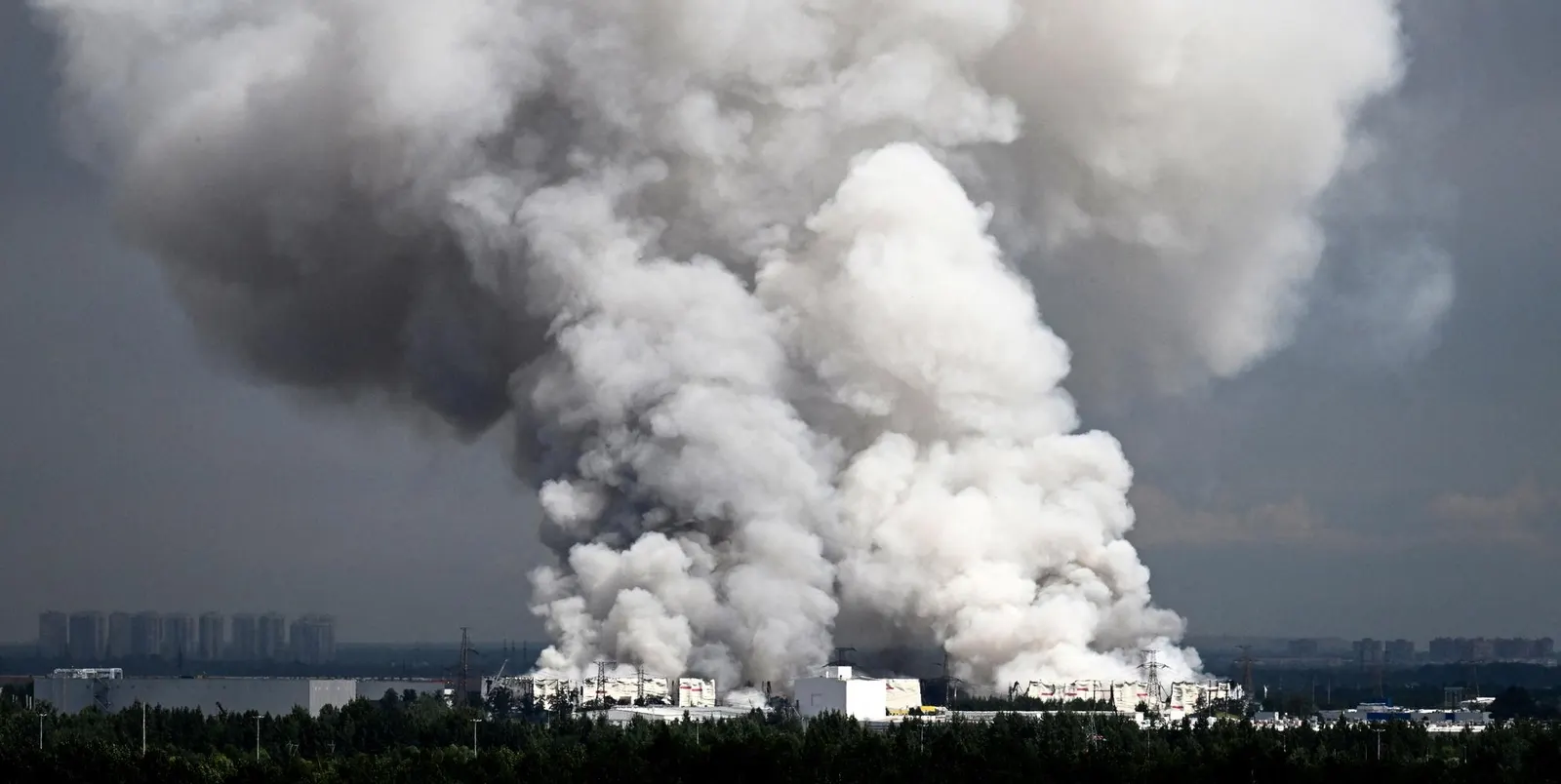
The cold morning sky over St. Petersburg was suddenly torn apart on Friday by the high-pitched whine of incoming engines, followed by a series of deafening explosions that marked the latest chapter in a devastating corporate and human tragedy. Multiple Ukrainian kamikaze drones slammed directly into two massive distribution centers belonging to Russia’s premier e-commerce giant, Wildberries. This coordinated assault brings the total number of devastating attacks on the company’s infrastructure to seven within a single week, sending billowing clouds of toxic black smoke high into the atmosphere and leaving a trail of ash and ruin. For the company’s founder and leader, Tatyana Kim—Russia’s richest self-made woman—the physical destruction carries an agonizing human toll. While she confirmed on her Telegram account that no lives were lost in this latest St. Petersburg strike, the preceding days of relentless aerial bombardments on other major warehouses in central Russia, Moscow’s outskirts, and southern regions near Crimea have killed at least eight ordinary civilians and left dozens of warehouse workers severely injured. Confronted with the smoldering ruins of over half her company’s largest distribution hubs, an emotional Kim expressed her deep sorrow, admitting she had “no words to describe the feelings” of seeing innocent employees targeted simply for doing their daily jobs. In a desperate bid to support the working-class families caught in the crossfire of a geopolitical conflict they did not start, Wildberries announced it would pay 2 million rubles ($25,500) to the family of each deceased worker, alongside significant payouts for those recovering from serious injuries.
Behind the tactical precision of these drone strikes lies a cold, calculated strategy designed to dismantle the logistical backbone of Russian domestic comfort. Ukrainian President Volodymyr Zelensky publicly defended the targeting of Wildberries, asserting that these colossal storage facilities, though ostensibly civilian retail spaces, function as active military distribution nodes. Zelensky pointed out that the platform is regularly used to sell and distribute tactical military gear direct to the frontlines, including specialized drones, advanced navigation systems, bulletproof flak jackets, and nationalist propaganda merchandise celebrating Vladimir Putin’s military campaign. This campaign of destruction also carries a bitter element of retaliation: Ukrainian officials view the strikes as direct payback for Russia’s systematic bombardment of Ukraine’s own civilian postal service, Nova Poshta, which has seen its distribution terminals in Odessa and Mykolaiv leveled by Russian missiles. For the Ukrainian military, the objective extends beyond degrading physical supply lines to achieving a profound psychological disruption. Ukrainian drone commander Robert Brovdi noted that the strikes are explicitly designed to puncture the bubble of normalcy enjoyed by the Russian public, shattering within seconds the illusion of a comfortable, peacetime consumer existence while a brutal war is waged across the border.
To fully understand the gravity of these losses, one must look at the exceptional human journey of Tatyana Kim, whose life’s work is now literally burning to the ground. Long before she became an international billionaire commanding a workforce of 48,000 people and generating over $9 billion in annual revenue, Kim was a 28-year-old schoolteacher on maternity leave, looking for a way to support her young family. In 2004, working out of her modest apartment, she began buying bulk clothing from German mail-order catalogs and hand-delivering packages to local customers. Through sheer grit, creative foresight, and an innate understanding of the evolving internet age, she transformed her small-scale side hustle into a massive national marketplace, introducing fitting rooms at pickup points so customers could try on clothes before paying. By 2014, she had adopted the open-marketplace model that turned Wildberries into the “Russian Amazon,” empowering over 88,000 independent merchants and lifting her own net worth to an estimated $8.1 billion. Her story of domestic-room-to-global-empire success made her a symbol of modern female empowerment in Russia, a self-made titan operating in a corporate landscape traditionally dominated by male oil and gas oligarchs.
Yet, active wartime drone strikes are only the latest storm in what has been a tumultuous and dangerous period for Kim. Only last year, her empire became a literal battleground in a chaotic and violent domestic dispute. In 2024, her estranged ex-husband, Vladislav Bakalchuk, accompanied by a faction of heavily armed men, attempted a hostile takeover by storming the Wildberries corporate headquarters in central Moscow. The resulting firefight in the building’s lobby left two security guards dead and multiple people wounded, highlighting the ruthless and often lawless nature of corporate power struggles in Russia. Desperate to protect her life’s work, Kim executed a controversial merger with the advertising giant Russ Outdoor, a move that required giving up a third of her prized 99% stake in her company. The high-stakes transaction was personally approved by Vladimir Putin, who envisioned the merged entity as a formidable Eastern geopolitical block capable of rivaling Western and Asian giants like Amazon, Alibaba, and Softbank. These ambitious plans, which included a highly publicized expansion into the African continent, have now been abruptly halted as the reality of war forces Kim to abandon international growth simply to keep her domestic operations from collapsing.
The sudden vulnerability of these massive distribution hubs has also exposed a critical architectural and logistical crisis affecting the global e-commerce industry. According to safety experts, the sheer design of modern mega-warehouses makes them virtually impossible to defend or extinguish once a fire takes hold. Built to maximize storage efficiency and facilitate rapid automated sorting, these facilities often cover the physical footprint of dozens of football fields with soaring 45-foot ceilings and incredibly narrow aisles that block standard firefighting equipment. Packed tight with highly flammable modern consumer goods—such as aerosol sprays, cheap synthetic garments, and volatile lithium-ion battery packs—they burn with an intense, chemical fury that quickly overwhelms automated sprinkler systems. Making matters worse for Wildberries, Tatyana Kim revealed that while her facilities were fully insured, standard commercial policies do not cover acts of war, terrorism, or foreign drone strikes, leaving the company to absorb a staggering $1.3 billion in damages out of pocket. Sensing the financial abyss, rival Russian e-commerce platforms like Ozon and Yandex quickly moved to rewrite their contracts with third-party sellers, legally exempting themselves from liability should their own hubs be targeted by Ukrainian aviation.
Despite the smoke, the immense financial ruin, and the terrifying prospect of future air raids, Tatyana Kim remains the focal point of her company’s survival, attempting to project a sense of calm resolve to her millions of anxious customers. Behind the scenes, she is orchestrating a monumental logistical redirection, scrambling to dynamically reroute shipping channels and inventory to alternative regional warehouses so that the platform can continue to process and deliver its staggering 7 million customer orders per day. On her public channels, she has maintained a stoic front, writing to her followers that “we will all overcome this” together through hard work and unity. However, the path forward is fraught with peril; as she works around the clock to rebuild her lines of communication and transport, Ukraine’s relentless drone commands show absolutely no signs of stopping. This high-stakes conflict has evolved far beyond a clash of military forces on a distant frontline, morphing into a direct, fiery siege on civilian supply chains and the lives of the ordinary warehouse workers caught in between.