



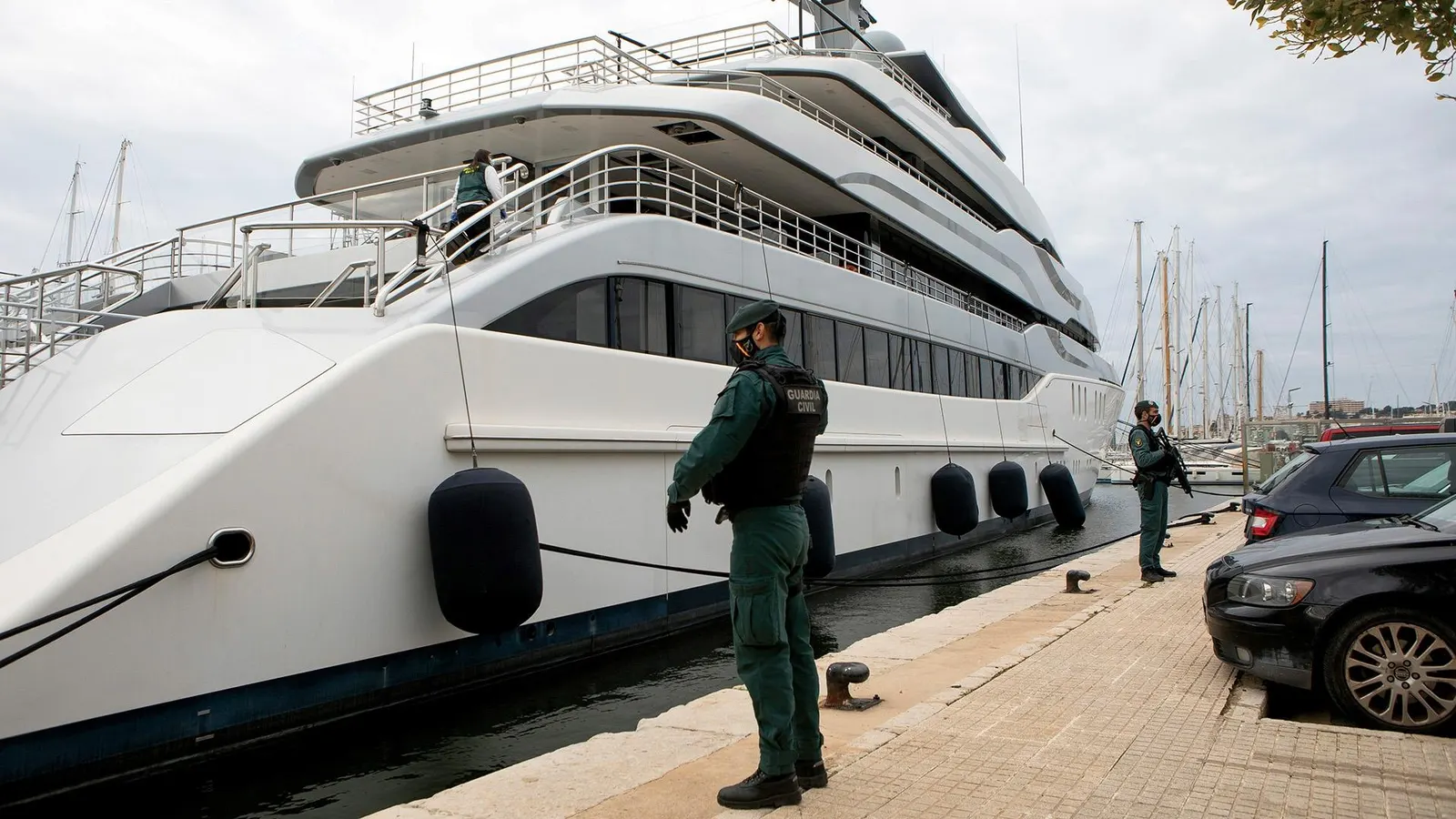
On a crisp spring morning on April 4, 2022, less than six weeks after the rumble of Russian tanks broke the peace of Eastern Europe, a dramatic scene unfolded in the historic port city of Palma de Mallorca, Spain. Officers from the Spanish Guardia Civil, flanked by heavily armed agents from the FBI and U.S. Homeland Security, marched down the docks to board the Tango, a breathtaking 255-foot superyacht worth an estimated $90 million. Allegedly owned by the sanctioned Russian billionaire Viktor Vekselberg, the vessel was seized under a sweeping United States warrant accusing its owner of bank fraud, money laundering, and flagrant sanctions violations. It was designed as a glittering, high-profile opening salvo in a coordinated Western campaign to squeeze the pocketbooks of the Russian oligarchs who had quietly supported Vladimir Putin’s regime for financial gain. At the time, then-U.S. Attorney General Merrick Garland stood before television cameras and proudly boasted of the task force’s first historic asset seizure, promising it would be far from the last. Weeks later, he doubled down with a bold, morally resonant pledge: the Justice Department would utilize every tool at its disposal to seize these assets, sell them off, and transfer the multimillion-dollar proceeds directly to the people of Ukraine to help rebuild their shattered lives and infrastructure. Yet, more than four years after those grand declarations, Garland’s confident rhetoric has dissolved into a massive, highly embarrassing fiscal headache. Today, the Tango sits almost precisely where it was captured, bobbing uselessly in its high-end berth in Palma as its paint peels, its complex machinery degrades, and Washington remains no closer to selling it than it was on day one. Instead of sending financial relief to the frontlines of Kyiv, American taxpayers have been forced to quietly fork over an estimated $14 million just to keep this single ghost ship from sinking.
To understand how a public relations triumph transformed into a bureaucratic and financial quagmire, one must look at the brutal, unyielding physical reality of superyacht maintenance. Unlike a mansion or a sports car, which can be locked up and left to sit in a garage, a superyacht is an incredibly delicate, highly active artificial ecosystem that begins to decay the moment its engines fall silent and its systems are turned off. Without a continuous supply of electricity, fuel, and human supervision, these floating glass palaces succumb to the hostile marine environment almost immediately. In Palma, yacht brokers look out their office windows day after day to see the Tango baking in the relentless Mediterranean sun, kept barely afloat by a skeleton crew of about ten people who must run the engines and generators constantly to prevent mold, rust, and catastrophic mechanical failure. Local legal experts point out that non-operational superyachts are a financial black hole, requiring massive sums of money to maintain even if they never move an inch. A striking example of this physical rot is the 353-foot Luminosity, which has been stranded in Montenegro since its linked owner, Andrei Guryev Jr., was sanctioned by the European Union. Its original crew was abruptly dismissed without pay, leaving the vessel abandoned to the elements. Today, the once-glorious vessel, once described as a floating glass masterpiece, is actively rotting in the water; its teak decks are warping and splitting under the hot sun, thick crusts of barnacles are colonizing its underside, and local workers hired by the government have reportedly resorted to looting its television sets, dining tables, and high-end equipment to make up for unpaid wages. In a matter of years, the yacht’s pre-war value of $275 million has been slashed in half simply because its engines were allowed to die.
This physical deterioration has created an astronomical financial tab that ordinary Western taxpayers have been forced to pay, a reality that governments have gone to extraordinary lengths to hide from the public. Seeking to uncover the true cost of this failed strategy, investigative journalists filed freedom of information requests in eleven countries, only to run into a formidable wall of governmental secrecy. United States agencies failed to respond for months, while several European nations, including Germany and Italy, flatly refused to cooperate, citing confidentiality clauses or claiming that release of the financial data would compromise state secrets. Despite this institutional stonewalling, independent investigations and superyacht intelligence data have revealed that the four-year odyssey of freezing these vessels has cost Western nations a staggering $390 million in maintenance, fuel, mooring fees, and insurance. The second-largest portion of this bill has been footed by American taxpayers, who have paid at least $50 million, while Italy has suffered the worst financial blow, shellling out nearly $100 million for the four frozen yachts parked in its scenic harbors. Among them is the colossal 465-foot Scheherazade, suspected of being owned by Vladimir Putin himself, which has accumulated a $15 million preservation bill while sitting idle in the port of Marina di Carrara. For the local residents of these historic port cities, the presence of these mega-yachts has morphed from a novelty into a profound source of irritation. In the northeastern Italian city of Trieste, the local population has had their historic views of the Adriatic Sea ruined for years by the 468-foot Sailing Yacht A, a bizarrely designed, $578 million vessel that the city’s mayor publicly condemned as a disgraceful waste of public funds. Meanwhile, on the opposite side of the Italian peninsula, the 214-foot Lady M has been quietly draining state coffers of $700 every single day for utility hookups, alongside $15,000 a month in mooring fees and $57,000 annually in basic mechanical checkups.
The core reason these vessels remain stranded in expensive limbo lies in the vast legal gulf between “freezing” an asset and actually “seizing” or “confiscating” it. When Western governments initially targeted the oligarchs in 2022, politicians eagerly “froze” assets to demonstrate swift condemnation, a temporary measure that bans the owner from moving or selling the property but does not change who legally owns it. Actually confiscating a yacht requires the state to legally prove in a court of law that the owner committed a specific crime, such as money laundering or bank fraud, and then obtain a formal forfeiture warrant—an incredibly complex and slow legal process. Out of a staggering $58 billion in blocked Russian oligarch assets worldwide, which includes private jets, luxury real estate, corporate holdings, and bank accounts, only about five percent has been successfully and formally seized by various states. When it comes to the fleet of luxury superyachts, the numbers are even more pathetic: of the twenty vessels detained, only four have been formally seized. The United States, which possesses a relatively robust civil forfeiture framework born out of its historic war on drugs, has still struggled to navigate the legal defense teams of these ultra-wealthy individuals. The situation in the European Union is even more chaotic, as most member states completely lacked the appropriate legal frameworks to handle the seizure and management of multi-million-dollar maritime assets when the sanctions were first rolled out. To make matters worse, oligarchs intentionally shield their yachts behind an incredibly complex, labyrinthine network of shell companies, offshore trusts, and tax havens like the English Channel island of Guernsey, making it nearly impossible for prosecutors to definitively prove ownership in court. In Germany, the renowned shipyard Lürssen, which built the $600 million megayacht Dilbar, successfully sued the German government to recoup millions of dollars in maintenance fees, proving in court that the complex trust associated with the vessel was no longer legally subject to sanctions and shifting the massive financial burden directly back onto the state.
On the rare occasions where governments actually managed to push these seized yachts through to a public auction, the sales were thoroughly bungled, serving as a lucrative playground for opportunistic billionaires rather than providing aid to Ukraine. Consider the highly publicized saga of the 348-foot Amadea, a breathtaking six-deck vessel complete with a helicopter pad, a ten-meter infinity pool, and a hand-painted grand piano. After being seized in Fiji on behalf of the FBI, the yacht was sailed to San Diego, where it became the subject of a fierce two-year legal battle between the U.S. government and a “straw owner” who claimed to be the true proprietor, during which American taxpayers spent $36 million on basic upkeep. When the U.S. finally won the case and sold the vessel at auction, it went at a massive 37 percent discount to its original value, with the state pocketing $150 million—none of which was earmarked for Ukraine, but was instead kept for “agency and program expenses.” The lucky winning bidder was Abbas Sajwani, a 26-year-old Dubai real estate heir and son of a prominent billionaire developer closely linked to Donald Trump. Sajwani was recently spotted lounging on a cream-colored couch in the yacht’s wood-paneled atrium, proudly showing off his deeply discounted luxury toy to visitors. Similar farces played out with the Axioma, which was sold at a discount to Turkish industrialists for $37.5 million, and the Alfa Nero, which sat in Antigua spewing untreated wastewater into the local harbor after its onboard sewage treatment system failed. The Antiguan government eventually rushed to sell the Alfa Nero as an environmental hazard, and after ex-Google CEO Eric Schmidt backed out of a $68 million bid due to legal threats from the oligarch’s daughter, the yacht was sold to the very same Turkish industrialist for a bargain-basement price of $40 million. Within less than a year of his purchases, the Turkish buyer put both the Axioma and the Alfa Nero back on the market at astronomical markups, aiming to flip the seized vessels for massive personal profits while the island nation of Antigua used its meager proceeds to pay off its own municipal debts.
As the dust settles on this chaotic four-year experiment, the geopolitical theater of superyacht seizures has devolved into a multi-million-dollar fiasco that has utterly failed to put a dent in Vladimir Putin’s war machine, while threatening to hit Western taxpayers with even more bills in the future. Rather than fighting to reclaim their rapidly deteriorating and heavily depreciated vessels, several prominent former yacht owners are now launching aggressive offensive lawsuits against Western governments, demandng tens of millions of dollars in financial damages for loss of use, depreciation, and lost charter income. A shell company representing the owners of the $200 million Royal Romance has already filed a massive lawsuit against Croatia, and prominent international lawyers warn that as European courts slowly strike down poorly drafted sanctions designations, the risk of governments paying out massive taxpayer-funded compensation settlements will skyrocket. The ultra-wealthy individuals targeted by these campaigns are uniquely resource-rich, highly litigious, and fully prepared to drag municipal and national governments through decades of costly litigation. What began in the spring of 2022 as a bold, visually satisfying display of Western unity and resolve has quietly transformed into a cautionary tale of bureaucratic arrogance and political posturing. Governments rushed to seize the most visible, glamorous symbols of oligarchic wealth without any regard for the massive logistical costs of maintaining them, the complex legal realities of international maritime ownership, or the ultimate destination of the proceeds. Consequently, the grand promise to fund the reconstruction of Ukraine has yielded absolutely nothing, leaving average citizens of the West to foot the bill for the expensive preservation of a deteriorating fleet of playthings for the ultra-rich.